
Before You Ask for a Quote: Define the Mushroom Ingredient You Need
“Please quote your price for mushroom extract” sounds like a clear request. It is not. Two suppliers can answer with the same mushroom name and offer different species, fungal parts, processes, carriers, test methods and markets. A buyer guide to writing an RFQ every supplier reads the same way.

“Please quote your price for mushroom extract” sounds like a clear request. It is not.
Buyer guide. Technical review updated 1 September 2026.
Two suppliers can reply with the same common mushroom name and offer materials that differ in species, fungal part, substrate status, extraction process, carrier content, analytical method, sensory performance, and intended market. The lower price may reflect a different product rather than a better offer.
A useful request for quotation starts by defining what the ingredient must do and what evidence the buyer needs. The aim is not to write the longest specification possible. It is to give each supplier the same commercial and technical target.
1. Which material identity are you actually asking for?
A common name is only the beginning. State the scientific name you expect and ask the supplier to confirm it. Then define the fungal material:
- fruiting body;
- pure mycelium separated from its growth medium;
- myceliated grain or another myceliated substrate; or
- a defined combination.
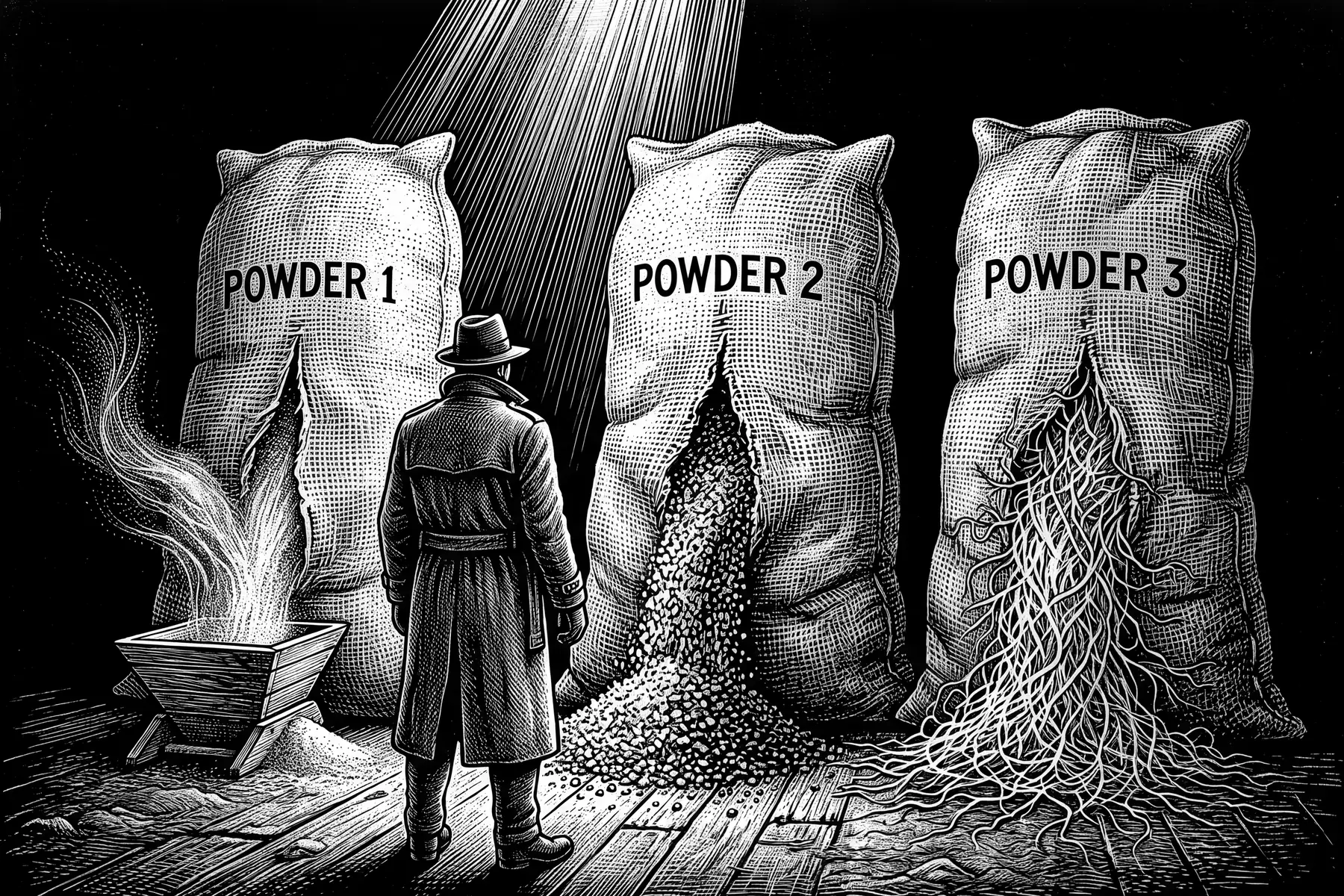
Fruiting body, pure mycelium or myceliated substrate: the same common name can hide three different materials.
These descriptions should not be treated as interchangeable (see fruiting body, mycelium and mycelium grown on grain). If the material includes a substrate, ask how that fact appears in the product name, specification, and certificate of analysis.
Identity also needs an evidence plan. Ask which method the supplier uses to verify the incoming material or finished ingredient, and whether the method is appropriate for the material being tested. A statement such as “identity: conforms” is much more useful when the method and acceptance basis are clear.
2. Powder or mushroom extract: what must be defined before the ratio?
“Mushroom powder” may mean milled raw material. “Mushroom extract” indicates that a separation step has taken place, but the word alone does not describe the process or the resulting composition.
For an extract, clarify:
- the starting material;
- the extraction medium, such as water or water and ethanol (what water and alcohol extraction actually pull out);
- whether the product is a single or sequential extract;
- whether a carrier or processing aid remains in the finished powder (drying and carriers in mushroom extracts);
- the requested extract ratio, if one is relevant; and
- which measurable attributes matter more than the ratio.
Identical sacks, one mushroom above them all. The ratio on the label does not tell you which sack you are buying.
An extract ratio should not carry the whole buying decision. Two products with the same stated ratio can still differ because the starting material, process definition, yield basis, carrier content, and analytical profile are not the same.
3. How should a specification be written? Result plus method
A target number without a method can create false agreement. “Beta-glucan: 20%” is incomplete if the parties are using different analytical methods or reporting conventions (the number on the label vs. real extract quality). Reishi triterpenes are another important example. A UV-visible colorimetric assay may report a broad response as “total triterpenoids” using ursolic acid or oleanolic acid as the calibration reference. An HPLC or UPLC method may instead quantify a defined panel of ganoderic and ganoderenic acids using specified reference standards, or a validated multi-component method based on one standard. These are different analyte definitions and calibration bases. Their results should not be compared as though they were the same specification. [4,5,6,7]
For each important specification, define four things:
- the attribute being measured;
- the test method;
- the acceptance limit or range; and
- the reporting basis, including units and dry-weight basis where relevant.
This applies to composition, moisture, particle size, microbiology, heavy metals, pesticide residues, residual solvents, and other attributes relevant to the intended product and market. Not every project needs the same panel. The requirement should follow the actual material, application, dosage form, destination market, and risk assessment.
In the United States, dietary supplement manufacturers operate under a framework that requires component specifications and verification. FDA guidance also describes supplier qualification and, in the relevant circumstances, expects a supplier certificate of analysis to state the test or examination method, limits, and actual results. [1] This is a useful reminder that a result cannot be evaluated separately from the method and the buyer’s qualification process.
4. Where will the ingredient be used?
A material can meet its chemical specification and still be a poor fit for the finished product. Give the supplier enough formulation context to evaluate application fit.
For a beverage, that may include the serving amount, pH, processing temperature, mixing equipment, desired clarity, acceptable sediment, flavor system, sweetener system, and target shelf life. For a capsule or tablet, bulk density, flow, particle size, compressibility, and excipient compatibility may matter more.
Use precise performance language. “Water-soluble” is often too broad. Do you need a clear solution, a stable dispersion, or simply a powder that incorporates without floating or forming lumps? State how the finished product will be processed and what failure would look like.
If sensory limits matter, describe them. A reference sample, color range, or agreed tasting method is more actionable than “good taste.”
5. Which market and product category is the ingredient for?
The same ingredient may be assessed differently depending on where and how it will be sold. Tell the supplier the destination country or region and whether the finished product is a dietary supplement, conventional food, beverage, or another category.
This affects the documents and tests that may be relevant. For example, U.S. food and dietary supplement manufacturing are not governed by one identical CGMP framework. [2] In the European Union, contaminant requirements are tied to the applicable food categories and current legislation. [3] A generic request to “meet EU limits” is less useful than identifying the product, market, and limits your compliance team has determined are applicable.
The supplier can provide documents and manufacturing information, but the party placing the finished product on the market still needs its own regulatory assessment.
6. Which documents do you expect with the offer and with each lot?
Separate qualification documents from routine lot documents. Your initial request may include:
- product specification;
- recent representative certificate of analysis;
- manufacturing flow summary;
- ingredient composition, including carriers or excipients;
- allergen, GMO, irradiation, and other declarations relevant to the project;
- applicable quality or food-safety certificates;
- country of origin and traceability information; and
- stability or application data, when available and relevant.
Then define which documents must accompany every shipment. Do not ask for a long list simply because it appears on a standard form. Each requested document should answer a real qualification, compliance, or release question.
7. Which commercial details change the quote?
A technically complete request can still produce an unusable price if the commercial basis is missing. Include:
- estimated annual volume and expected order size;
- sample quantity;
- required packaging format;
- delivery location and preferred trade terms;
- target timing for samples and commercial orders;
- whether the request is for a standard product or custom development; and
- any required change-control or notification expectations.
Separate the forecast from a firm commitment. A realistic range helps the supplier choose the right production and packaging basis without turning an early estimate into a promise.
8. How do you compare the replies?
When offers arrive, build a comparison table with one row for each requirement. Mark each response as:
- meets;
- does not meet;
- alternative proposed; or
- information missing.

One row per requirement. Offers are compared against the requirement, not against the product name.
Keep technical fit and commercial terms visible at the same time, but do not collapse them into one score too early. A cheaper offer with a different material, method, or application performance is not a direct price comparison. An expensive offer is not automatically more suitable either.
Questions and deviations are useful. A supplier who identifies a conflict between your specification and your application may be providing more value than one who simply writes “complies” beside every line.
What does a minimum mushroom ingredient RFQ contain?
If you need a short starting point, send these fields:
| Field | Information to provide |
|---|---|
| Ingredient identity | Common and scientific name |
| Fungal material | Fruiting body, pure mycelium, myceliated substrate, or combination |
| Product type | Powder or extract; key process expectations |
| Composition | Carrier or excipient restrictions; target attributes |
| Specifications | Limits, methods, units, and reporting basis |
| Application | Dosage form, use level, process, and key performance needs |
| Market | Destination and finished-product category |
| Documents | Qualification package and lot-specific records |
| Commercial basis | Sample size, order volume, packaging, delivery, and timing |
| Alternatives | Whether the supplier may propose a technically justified alternative |
This is enough to begin a useful conversation. The remaining details can be resolved during sample qualification.
What is the next useful step?
Before requesting price, ask one internal question: Which differences would make this ingredient unsuitable for our finished product? Put those points into the RFQ first. This is also why price is not the first step in our B2B inquiries.
If you send us your intended application, destination market, material preference, target specifications, testing expectations, and estimated volume, our team can review the request, identify missing decisions, and determine whether a standard or custom option should be evaluated. A clear requirement makes the first quotation more useful and keeps the sample discussion focused. You can start with our procurement brief or request samples.
FAQ
What should a mushroom extract RFQ include?
Scientific name, fungal material (fruiting body, mycelium, myceliated substrate), powder or extract with the extraction medium, specifications written as result plus method, application, destination market, documents expected with the offer and each lot, and the commercial basis.
Is the extract ratio enough to compare two offers?
No. Two products with the same stated ratio can differ in starting material, process, yield basis, carrier content and analytical profile. Ask which measurable attributes matter more than the ratio.
Why is “beta-glucan: 20%” not a complete specification?
Because the number depends on the analytical method and reporting basis. A specification needs the attribute, the test method, the acceptance limit and the reporting basis, including units and dry-weight basis.
Does the supplier’s documentation replace my own regulatory assessment?
No. The supplier can provide specifications, certificates and manufacturing information, but the party placing the finished product on the market still needs its own assessment for the destination market.
This guide is general information for ingredient buyers. It is not legal or regulatory advice; requirements depend on the product, market and your own risk assessment.
Sources
- U.S. Food and Drug Administration. Small Entity Compliance Guide: Current Good Manufacturing Practice in Manufacturing, Packaging, Labeling, or Holding Operations for Dietary Supplements. View source
- U.S. Food and Drug Administration. Current Good Manufacturing Practices (CGMPs) for Food and Dietary Supplements. View source
- European Union. Commission Regulation (EU) 2023/915 on maximum levels for certain contaminants in food, consolidated text checked 31 August 2026. View source
- Wang X-M et al. “Analysis of triterpenoids in Ganoderma lucidum using liquid chromatography coupled with electrospray ionization mass spectrometry.” Supporting the HPLC quantification of a defined panel of ganoderic acids. View source
- Wu L-F et al. “A single standard to determine multi-components method for comparative quality assessment of three Ganoderma species.” Supporting validated UPLC multi-component quantification of defined Ganoderma triterpenoids. View source
- Liu Y et al. “Comparison of different methods for the determination of the total triterpenoids in Ganoderma lucidum.” Supporting the distinction between a colorimetric total-triterpenoid result and HPLC measurement of individual triterpenoids. View source
- Zhou X et al. “Quality Evaluation of Ganoderma lucidum from Different Geographical Origins by Chemical Fingerprinting and Quantitative Analysis.” Frontiers in Pharmacology, 2020. Supporting UV-visible reporting as oleanolic-acid equivalents alongside separate chromatographic analysis. View source
Have specific requirements?
Build a procurement brief: catalog match, missing inputs and a ready inquiry draft. Nothing is sent.