
Cordyceps
Cordyceps militaris
Aqueous fruiting-body extract with optional standardisation on cordycepin, adenosine and β-glucans
Extract from Cordyceps militaris fruiting bodies grown under controlled conditions on a rice-based substrate with mushroom components (not on grain as a filler). Hot water extraction is the basis, with an additional alcohol fraction for nucleosides. No maltodextrin and no carrier beyond technical necessity.
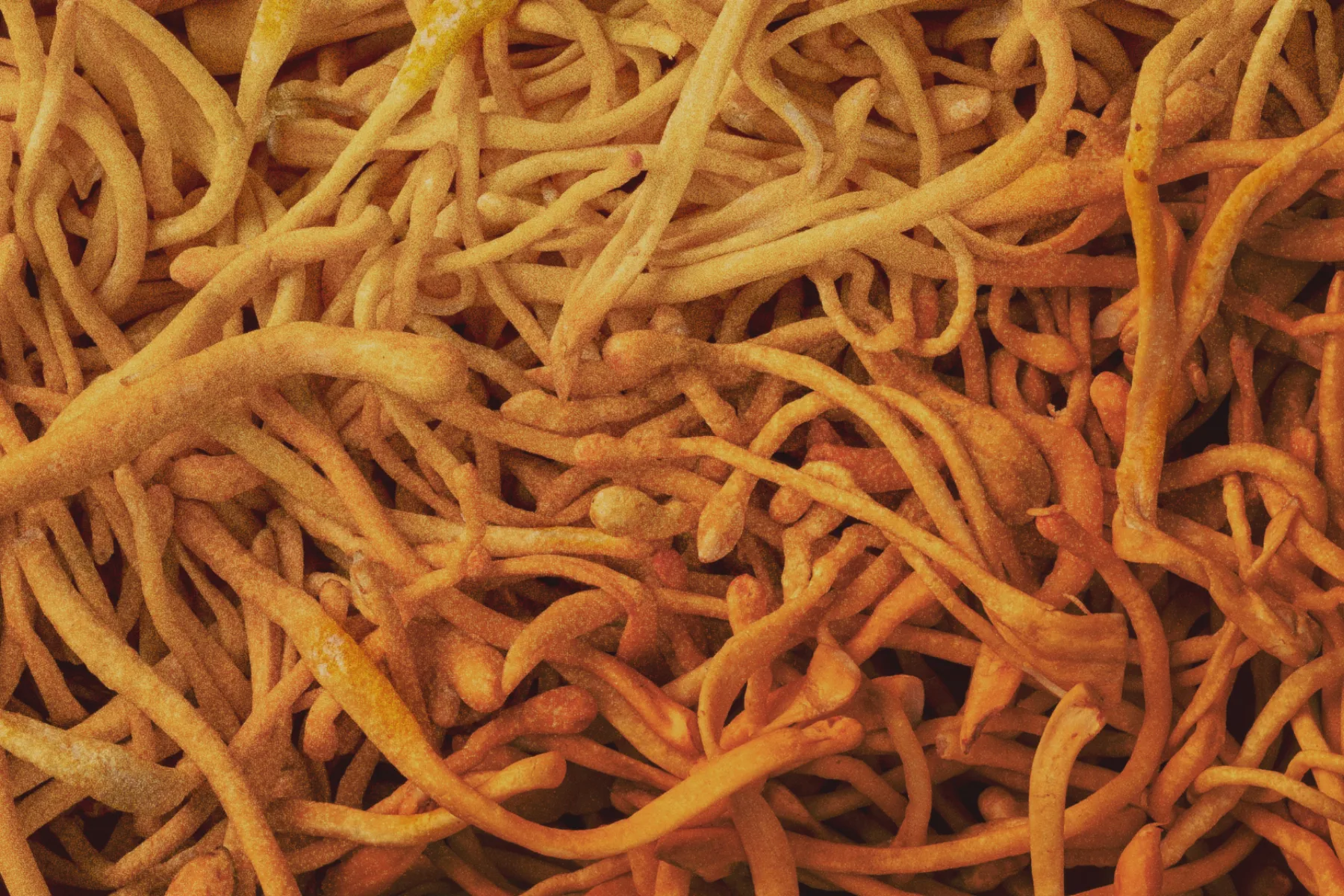
Cordyceps militaris and Cordyceps sinensis — not the same species
Two different species circulate on the functional-mushroom market, both called "Cordyceps", both used for centuries in TCM tradition:
Cordyceps sinensis (correctly: Ophiocordyceps sinensis), Chinese "冬虫夏草" (dōng chóng xià cǎo, "winter worm, summer grass"). A wild species parasitising moth caterpillars on the Tibetan plateau at altitudes of 3000–5000 m a.s.l. One of the most expensive biological raw materials in the world (~30,000–50,000 EUR/kg). Extracts from wild sinensis are rare and very expensive on the market. Anything cheaper is most often militaris or mycelium fermentation.
Cordyceps militaris, Chinese "北虫草" (běi chóng cǎo, "northern worm-grass"). A close relative of sinensis, feasible for controlled cultivation on a rice-based substrate with mushroom components (not for mycelium cultivation on grain). Its bioactive profile is similar to sinensis, with one key advantage: controlled-cultivation militaris has HIGHER concentrations of cordycepin than wild sinensis by nature. Hence the European market standard.
At Aloha Fungi we work with Cordyceps militaris, because it delivers batch reproducibility, an auditable source and higher declarable concentrations of functional markers. We also offer partners the option of sourcing wild sinensis on special order (significantly higher price, limited availability).
What's in the extract
Several dozen bioactive compounds have been identified in the fruiting-body extract of Cordyceps militaris. Cordycepin (3'-deoxyadenosine) is a nucleoside unique to the genus Cordyceps and a functional marker for this species, present in our standard extract at 0.3–1.0%. Adenosine and related nucleosides (uridine, guanosine, inosine) — profile measured by HPLC. β-1,3/1,6-glucans above 30% activate Dectin-1 and TLR4 receptors [Brown & Gordon 2003]. Polysaccharides CPS-1 and CPS-2 (isolated fractions) described by Yu et al. [2007]. Mannitol (cordycepic acid, D-mannitol) — characteristic of the genus, used as an authenticity marker. Ergosterol and fungal sterols. Essential amino acids, low-molecular-weight peptides.
Most Cordyceps extracts on the EU market come from Cordyceps militaris cultivation on a rice-based substrate with mushroom components — this is the industry standard for this species, not a compromise. Unlike with Reishi or Lion's Mane, where "mycelium on grain" dilutes the bioactive profile, for militaris rice-substrate cultivation is the optimal approach, giving higher concentrations of cordycepin than wild sinensis. At Aloha Fungi we work with militaris fruiting bodies, measure cordycepin on every batch and distinguish fruiting-body extract (above 30% β-glucans) from mycelium extract (diluted, without a cordycepin declaration). At Aloha Fungi we use exclusively fruiting-body extract in the EU. In non-EU countries we also offer mycelium extracts for this species.
Typical batch specification
Typical batch: β-glucans above 30% by Megazyme K-YBGL method (EUROFINS laboratory). Cordycepin 0.3–1.0% by HPLC. Adenosine 0.1–0.3% by HPLC. Mannitol (D-mannitol/cordycepic acid) 2–6% by HPLC as a species authenticity marker. Total polysaccharides 25–35%. Extraction ratio 10:1. Moisture ≤ 5%. Microbiology compliant with the European Pharmacopoeia (Ph.Eur.). Every batch comes with a full COA including test methodology and species confirmation (DNA barcoding ITS1/ITS2 on request).
Premium variant
★ Co-brandingFor brands that want to create their own functional-mushroom product and base it on our raw-material standard. You use extracts selected by Aloha Fungi, and once the criteria are met you can add our quality seal to your packaging.
MOQ: 5 kg
Our logo on your product →Raw material
Mature Cordyceps militaris fruiting bodies from controlled cultivation in non-industrial regions of China (Yunnan, Heilongjiang). Cultivation on a rice-based substrate enriched with mushroom components in sterile climate chambers, at 18–22°C and 80–90% humidity, with a photoperiod stimulating fruiting-body formation. Cultivation time from inoculation to harvest: 45–60 days. Farms are audited quarterly, including substrate microbiology testing and DNA barcoding species confirmation. Harvest at full maturity (orange-yellow fruiting-body colour, length 4–7 cm, before spore release).
Extraction process
Drying of the fruiting bodies at 40–45°C to preserve cordycepin (a thermolabile compound that degrades above 60°C). Milling. Main process: hot water extraction at 90°C for β-glucans, polysaccharides and the water-soluble portion of nucleosides. Additional fraction: low-temperature ethanol extraction for the full nucleoside profile (cordycepin, adenosine). Combining the fractions in a precise ratio, concentration at reduced temperature, drying to powder form without maltodextrin under parameters that protect cordycepin.
Cordyceps militaris — fruiting body from our controlled cultivation
Mechanisms described in the literature
Current research on Cordyceps militaris (mainly in vitro, animal models, and a few small clinical RCTs in humans) describes three principal mechanisms of action.
- 01
Cordycepin and mitochondrial energy metabolism
The best-described mechanism. Cordycepin (3'-deoxyadenosine) is a structural analogue of adenosine. In animal models and in vitro it affects energy metabolism: it increases mitochondrial oxygen utilisation, modulates ATP synthesis and influences oxidative phosphorylation [Tuli et al. 2013, 3 Biotech; Das et al. 2010]. Hirsch et al. [2017], in a 3-week RCT (n=28 healthy adults, 4 g Cordyceps extract daily), observed an increase in VO2max of about 11% and a higher ventilatory threshold. The sample is small and the study needs replication in larger groups. Another RCT (Chen et al. 2010, n=20) did not show a significant effect on VO2max after 6 weeks of 3 g/day, underlining the heterogeneity of results.
- 02
β-glucans and activation of innate immunity
β-1,3/1,6-glucans of Cordyceps militaris activate Dectin-1 and TLR4 receptors on dendritic cells [Brown & Gordon 2003]. The polysaccharides CPS-1 and CPS-2 (fractions isolated by Yu et al. 2007) modify macrophage cytokine production in in vitro tests. The mechanism is common to all functional mushrooms with β-glucans, but in militaris it partly overlaps with the cordycepin effect (through influence on the metabolism of immune cells). Large clinical RCTs in humans are not yet available.
- 03
Modulation of HIF-1α and erythropoietin production in preclinical models
Some studies (mainly Chinese, in vitro and in animal models) describe the influence of Cordyceps militaris and Cordyceps sinensis extracts on erythropoietin production in the kidneys. The mechanism probably runs through modulation of HIF-1α (hypoxia-inducible factor) under hypoxic conditions. All observations require caution in interpretation, however: large clinical RCTs in humans that would confirm a clinical effect on EPO levels are not yet available, and most of the cited works are small studies that require replication. This must not be interpreted as a basis for communication along the lines of "a natural alternative to EPO" or similar — that would be medical communication, legally prohibited.
★ Cordyceps in the Aloha Fungi brand
This is how Cordyceps looks as a finished product
Aloha Fungi is not only a B2B raw material — it's also our consumer brand. Here's how we use the same Cordyceps extract in our own products LONGEVITY and PRIME on alohafungi.pl. You can distribute these products or draw inspiration from their form and communication for your own brand.
 LONGEVITY
Cordyceps proszek 50 g
Proszek 50 g
Ekstrakt z całych owocników Cordyceps w proszku. Forma do odmierzania i mieszania z napojem.
119,00 złShop → LONGEVITY
Cordyceps krople 30 ml
Krople 30 ml
Płynny ekstrakt do odmierzania pipetą. Można dodać go do porannego napoju lub latte.
169,00 złShop → LONGEVITY
Cordyceps kapsułki 90 szt.
Kapsułki 90 szt.
Ekstrakt z Cordyceps z linii LONGEVITY w wygodnej formie kapsułkowej.
129,00 złShop → PRIME
PRIMECordyceps proszek 50 g
Proszek 50 g
Wielofrakcyjny ekstrakt 10:1 w proszku. Zawartość kordycepiny i adenozyny jest podana w specyfikacji.
189,00 złShop → PRIME
PRIMECordyceps kapsułki 90 szt.
Kapsułki 90 szt.
Wielofrakcyjny ekstrakt PRIME w kapsułkach. Opakowanie zawiera 90 sztuk.
189,00 złShop →
Consumer communication — what's allowed, what to avoid
Health claims on finished products are regulated by EU rules (1924/2006 and 432/2012). Cordyceps has no authorised EFSA claim, so any phrasing about the product's effect on the body requires particular care in consumer communication. TCM tradition (Cordyceps sinensis and militaris have been used for centuries as Kidney Yang tonics) and the mechanisms described in peer-reviewed literature allow communication about Cordyceps' traditional use, provided certain language boundaries are observed. Below are the boundaries that are legally permitted.
What works
Communication directions safe for partners
Traditional use in Traditional Chinese Medicine (Cordyceps was traditionally used in the context of supporting vitality, physical condition and endurance, as a Kidney Yang tonic for people with chronic fatigue and general weakness) — using the form "traditionally used in the context of X", not "supports X". Description of bioactive compounds (β-glucans above 30%, cordycepin, adenosine, mannitol). Description of the process (extract from Cordyceps militaris fruiting body, water-alcohol extraction, low-temperature drying to preserve cordycepin). Reporting research findings ("study X from year Y describes…", not "Cordyceps does Y"). Reference to the profile of functional markers (cordycepin as a nucleoside unique to the genus).
What to avoid
Strictly prohibited communication
Attributing to the product the treatment, prevention or alleviation of specific disease entities (covered by the ICD-10 classification system, including erectile dysfunction, chronic fatigue syndrome, anaemia, kidney failure, cardiovascular conditions, autoimmune diseases, oncological conditions). Forbidden words: "treats", "cures", "prevents", "therapy", "natural doping", "alternative to EPO", "erythropoietin booster", "natural Viagra", "medical aphrodisiac", "clinical efficacy", "normalises", "dosage" (in consumer communication "recommended daily portion" is used). Regardless of any study quote, research must not be cited in a way that suggests an effect of the product on a specific condition.
Critical for Cordyceps
Two specific regulatory risks:
1) Association with sports doping. Cordyceps is not on the WADA list, but narratives such as "natural doping" or "legal alternative to EPO" are legally prohibited — this classifies the product as a sports-performance substance = ICD-10 + prescription requirement.
2) Sexual association. "Natural Viagra", "potency enhancement", "libido" are functional claims toward erectile dysfunction (ICD-10 F52). UOKiK actively pursues such phrasings in the supplement industry.
Extract applications
Cordyceps militaris extract works technologically in most formats. Capsules — standard fill 300–500 mg of extract, excellent in stacks with other functional mushrooms. Powder — in pre-workout sachets, coffee blends, hot beverages. Cordyceps has a slightly bitter, earthy taste with a nutty note and pairs well with coffee and cacao. Liquid extract (tincture) — drops under the tongue for 30–60 seconds or into a drink. Chocolates and bars — flavour tolerance 1–3% by weight. Coffee and cacao — natural synergy (popular "mushroom coffee" formats). Cold RTD beverages — medium solubility in cold water, usually requires an emulsifier or a "dissolve in hot water, then chill" approach. Pre-workout / sport — a popular format with additional B vitamins, caffeine, taurine. NOTE: a B2B partner producing for athletes should be aware of prohibited marketing phrasings (section H).
Stability, storage and packaging
Stability: 24–36 months in original packaging, at room temperature (up to 25°C), away from direct light. Inert packaging (nitrogen) on request. Cordycepin is thermolabile, so the extract should not be exposed to temperatures above 40°C for extended periods — important for storage in warmer climates. Cordyceps is mildly hygroscopic, we recommend tight closure after sampling and storage below 60% relative humidity, especially in production of loose powders.
Precautions
Cordyceps is well tolerated by most people, but has a few specific warnings. With anticoagulants and antiplatelet drugs (warfarin, NOACs, acetylsalicylic acid in cardiology doses) consultation with the treating physician is recommended; Cordyceps has a documented mild anticoagulant action. With antidiabetic drugs glycaemic monitoring is recommended; a mild hypoglycaemic effect has been described in animal models. With immunosuppressants in people after organ transplants (cyclosporine, tacrolimus, mycophenolate) consultation is recommended; β-glucans activate innate immunity. In autoimmune diseases in an active flare phase (RA, lupus, Hashimoto in flare) caution is required. With hormonal medications (hormone replacement therapy, oral contraception, testosterone therapy) consultation is recommended; some studies suggest an effect of Cordyceps on the profile of sex hormones and cortisol. Before planned surgeries, discontinue Cordyceps for at least 14 days before the procedure. Not recommended during pregnancy, breastfeeding or for people under 18 years of age. Professional athletes competing under licence should consult their sports physician, even though Cordyceps is not on the current WADA list — the sports industry is sensitive to raw materials with a "natural doping" reputation. As standard, we include the key warnings on the consumer label of the final product — we provide brands with specific wording compliant with EU food law.
Regulatory status
Cordyceps militaris is traditionally present on the EU market as an ingredient in food supplements and does not appear on the Novel Food list (regulation 2015/2283). Its pre-1997 status is based on historical use in TCM and European trade, but it is not formally confirmed by EFSA — different member states interpret this differently (Germany is more restrictive than Poland). NOTE: Cordyceps sinensis (=Ophiocordyceps sinensis) has a separate and more complicated regulatory status because of its wild origin and species protection in some countries (India, China). Product notification to GIS (Polish Chief Sanitary Inspectorate) is required under the food safety act. We support partners with technical documentation, certificates of origin, DNA species barcoding and raw-material specification for notification — but we don't replace professional legal counsel.
★ Fastest path
Ready-made Aloha Fungi products for your business
Choose ready-made products from the LONGEVITY or PRIME line, or individual SKUs, and sell them under the Aloha Fungi brand in your channel.
This solution is for shops, clinics, practices and online partners who want to add functional mushrooms to their offer quickly, without building a product from scratch.
MOQ
1 500 PLN
Lead time
24h
First delivery
24h
Selected literature
10 sources
Selected literature
10 sources- Tuli HS, Sharma AK, Sandhu SS, Kashyap D (2013). Cordycepin: a bioactive metabolite with therapeutic potential. Life Sci 93(23):863-869. PMID: 24121196.
- Das SK, Masuda M, Sakurai A, Sakakibara M (2010). Medicinal uses of the mushroom Cordyceps militaris: current state and prospects. Fitoterapia 81(8):961-968. PMID: 20650308.
- Hirsch KR et al. (2017). Cordyceps militaris improves tolerance to high-intensity exercise after acute and chronic supplementation. J Diet Suppl 14(1):42-53. PMID: 27408987.
- Chen S et al. (2010). Effect of Cs-4 (Cordyceps sinensis) on exercise performance in healthy older subjects: RCT. J Altern Complement Med 16(5):585-590. PMID: 20804368.
- Yu R, Yang W, Song L, Yan C, Zhang Z, Zhao Y (2007). Structural characterization and antioxidant activity of a polysaccharide from the fruiting bodies of cultured Cordyceps militaris. Carbohydr Polym 70(4):430-436.
- Brown GD, Gordon S (2003). Fungal β-glucans and mammalian immunity, Dectin-1 receptors. Nature. PMID: 12646903.
- Liu Y, Wang J, Wang W, Zhang H, Zhang X, Han C (2015). The Chemical Constituents and Pharmacological Actions of Cordyceps sinensis. Evid Based Complement Alternat Med 2015:575063. PMID: 26500671.
- Xu J et al. (2016). Bioactive proteins from mushrooms. Biotechnol Adv 34(7):1209-1219.
- Jędrejko K, Kała K, Sułkowska-Ziaja K, Krakowska A, Zięba P et al., Muszyńska B (2022). Cordyceps militaris — Fruiting Bodies, Mycelium, and Supplements: Valuable Component of Daily Diet. Antioxidants 11(10):1861 — Polish review. Department of Pharmaceutical Botany of Medicinal Plants and Mushrooms, Jagiellonian University Medical College.
- Jędrejko K et al., Muszyńska B (2024). Analysis of bioactive compounds in Cordyceps militaris fruiting bodies and dietary supplements: in vitro bioaccessibility in artificial digestive juices. Int J Food Sci Technol 59(6):4011-4019 — a pioneering Polish study of the bioaccessibility of cordycepin and adenosine in simulated digestive juices. JU Medical College.