
Coriolus
Trametes versicolor (syn. Coriolus versicolor)
Water extract from fruiting bodies with optional standardisation on β-glucans, PSP and PSK
Extract from Trametes versicolor fruiting bodies grown in controlled cultivation on a substrate of beech sawdust and bran, audited regularly. Hot water extraction as the primary process (PSK and PSP are polysaccharide-peptide complexes best extracted at 90-95°C).
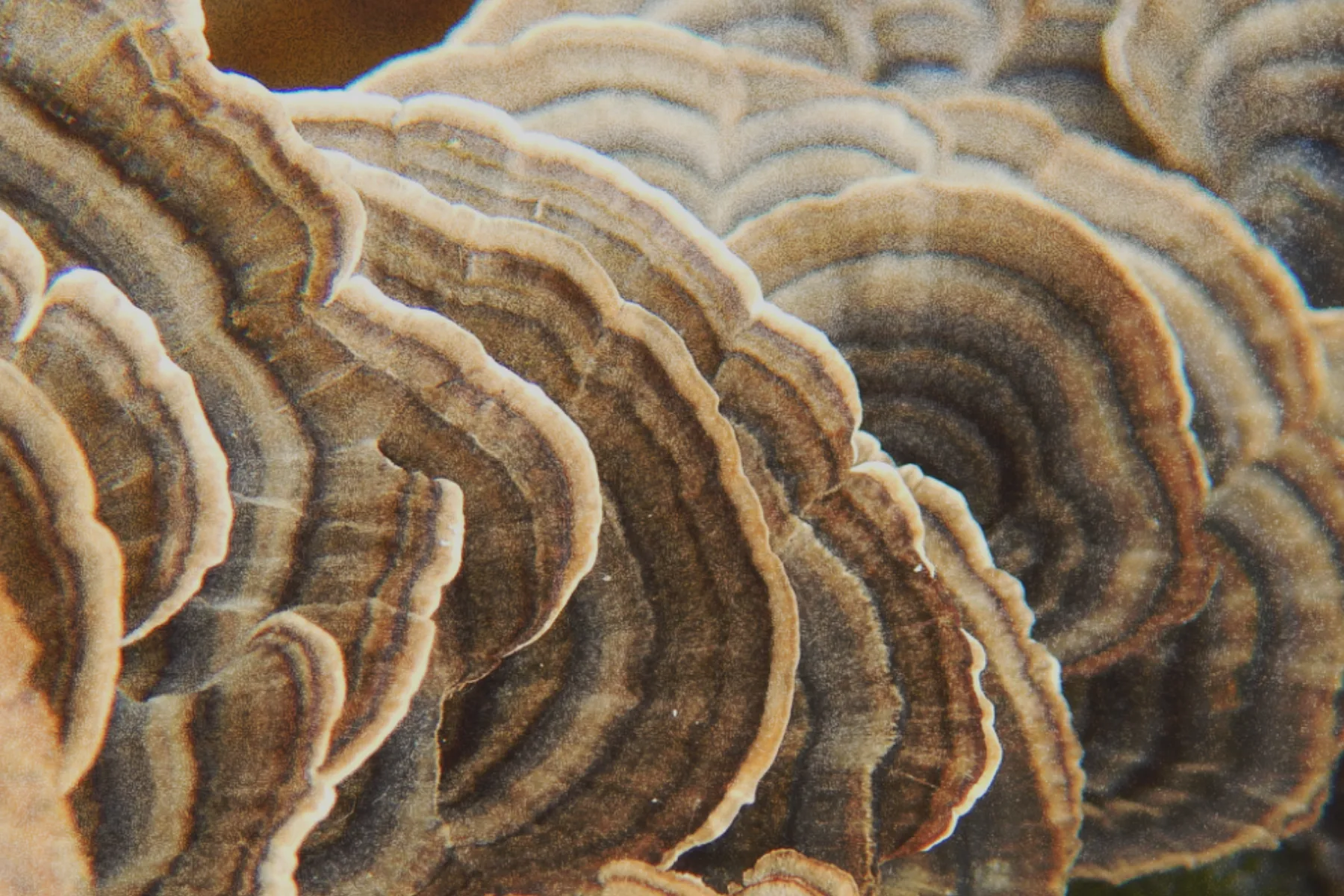
Many names, one species (and one nomenclatural history)
Yun Zhi (China, 雲芝 — "cloud mushroom", from the shape of concentric rings resembling clouds), Kawaratake (Japan, "roof-tile mushroom" — from the way the fruiting bodies layer like tiles on a roof), Turkey tail (English — from the fan-shaped bands on the fruiting body), wrośniak różnobarwny (Poland, official botanical name from "growing into" the host wood; regionally also skórzak różnobarwny, huba różnobarwna, huba-motyl). All these names refer to the same species: Trametes versicolor (synonym Coriolus versicolor, used in nomenclature until 2008 and still dominant in medical and marketing literature). In TCM tradition Yun Zhi is described in Ben Cao Gang Mu (Great Herbal, 1578) by Li Shizhen as a tonic for Spleen and Lung Qi. Polish research on Trametes versicolor is conducted by the team of Prof. Bożena Muszyńska from the Department of Biotechnology of Medicinal Plants and Mushrooms at the Collegium Medicum of Jagiellonian University — a PSK/PSP review in Postępy Fitoterapii 17(4):274-281 (Sułkowska-Ziaja, Muszyńska et al. 2016). We work with controlled cultivation on a beech sawdust-and-bran substrate; wild T. versicolor in Poland is unsuitable for supplementation due to accumulation of metals from the host wood.
What's in the extract
Trametes versicolor is among the most chemically characterised functional mushrooms. Two signature fractions come from two different strains: PSP (polysaccharopeptide) from strain COV-1, isolated in China, molecular weight approx. 100 kDa, contains 30-60% polysaccharide and 10-30% peptide linked via O- or N-glycosidic bonds. PSK (polysaccharide K, krestin) from strain CM-101, isolated in 1971 in Japan by Kureha Chemical, registered in 1977 in Japan as an adjuvant drug in oncology. Structurally similar to PSP, with a larger share of α-(1→4) glucosidic bonds. Standardisation of β-1,3/1,6-glucans (not peptide-bound) in our extract above 35%. Polysaccharide fractions CVPS-1 to CVPS-6 (chromatographic isolates of varying molecular weights and receptor specificities). Phenolic compounds and flavonoids with antioxidant activity. Ergosterol and provitamin D₂. Essential amino acids, trace elements (zinc, selenium).
Coriolus is the only functional mushroom in which one of the polysaccharide fractions (PSK / krestin) is officially registered as a drug — in Japan since 1977, administered as standard within certain chemotherapy protocols. The second signature fraction is PSP from the Chinese strain COV-1, chemically very similar to PSK. These two fractions are what distinguishes T. versicolor fruiting-body extract from mycelium grown on grain — mycelium on grain contains trace amounts of PSK/PSP, whereas fruiting-body extract from a beech substrate can have significant concentrations. At Aloha Fungi we use exclusively fruiting-body extract for this species.
Typical batch specification
Typical batch: β-glucans above 35% by Megazyme K-YBGL method (EUROFINS laboratory). PSP (polysaccharopeptide from strain COV-1) 10–20% by chromatographic fractionation with SEC-MALS verification and peptide analysis (protein content 10-30%). CVPS fractions: qualitative profile in the batch specification. Total polysaccharides 30–45%. Extraction ratio 10:1. Moisture ≤ 5%. Microbiology compliant with the European Pharmacopoeia (Ph.Eur.). Every batch comes with a full COA including test methodology. For partners requiring the highest precision we offer strain verification by DNA barcoding (ITS1/ITS2) with identification of whether the batch originates from COV-1 vs. other T. versicolor strains.
Premium variant
★ Co-brandingFor brands that want to create their own functional-mushroom product and base it on our raw-material standard. You use extracts selected by Aloha Fungi, and once the criteria are met you can add our quality seal to your packaging.
MOQ: 5 kg
Our logo on your product →Raw material
Mature Trametes versicolor fruiting bodies from controlled cultivation in non-industrial regions of China (strain COV-1, from which PSP was isolated), on a substrate of beech sawdust enriched with bran in sterile climate chambers. Cultivation time from inoculation to harvest: 90-120 days. Farms audited quarterly, including microbiological testing of the substrate and strain confirmation by DNA barcoding. Harvest at full maturity (concentric colour pattern fully developed, fruiting bodies 4-10 cm wide), from the young growing bands at the edge (where PSP concentration is highest). Wild T. versicolor from Polish forests is NOT used for supplementation — although the species is common here, it accumulates metals from the host wood (especially lead, cadmium, in roadside locations), the PSK/PSP profile is unpredictable, and correct identification requires mycological experience (it can be mistaken for other Trametes species).
Extraction process
Milling of dried fruiting bodies. Primary process: hot water extraction at 90-95°C, 4-8 hours, for optimal recovery of PSP, PSK-like peptide-polysaccharide fractions, β-glucans and CVPS fractions. PSK and PSP are polysaccharide-peptide complexes, so they require long extraction at high temperature (short "cold" extractions yield significantly lower content of active fractions). Chromatographic fractionation for PSP isolation (SEC molecular chromatography). Combining fractions, concentration at reduced temperature, drying to powder form without maltodextrin.
Trametes versicolor — fruiting body from our controlled cultivation
Mechanisms described in the literature
Research on the mechanism of Trametes versicolor spans more than 400 peer-reviewed publications — the strongest scientific base among functional mushrooms. Three main mechanistic directions, each with a human RCT (a rarity in the functional-mushroom group).
- 01
TLR2 and innate immunity
The best-described mechanism. PSK and PSP bind as agonists to the Toll-like receptor TLR2 on the surface of dendritic cells, macrophages and monocytes [Saleh et al. 2017, Front Immunol]. This triggers a signalling cascade via MyD88 and NF-κB, leading to the production of pro-inflammatory cytokines (IFN-γ, IL-12) and a shift of the immune response toward a Th1 profile. The phase I RCT by Torkelson et al. [2012, ISRN Oncol] with n=11 documented an increase in lymphocyte counts (doses of 6 and 9 g/day) and in functional NK cell activity (dose of 6 g/day). The mechanism is meaningfully different from the β-glucans of Reishi and Chaga (which act via Dectin-1/TLR4), which is an argument for complementary combining.
- 02
Gut microbiota and prebiotic action
The second mechanism with strong RCT support. PSP is not digested by human enzymes and reaches the large intestine unchanged, where it serves as a fermentation substrate for the microbiota. Pallav et al. [2014, Gut Microbes, Beth Israel Deaconess Medical Center Boston] conducted an 8-week RCT with n=24 healthy volunteers, comparing PSP at 3600 mg/day with amoxicillin at 250 mg/day: PSP increased the abundance of Bifidobacterium and Lactobacillus (prebiotic action, comparable to typical prebiotics); in the amoxicillin group PSP helped reconstitute the flora after antibiotic therapy. Yu et al. [2013, Plant Foods Hum Nutr] additionally showed in in vitro tests a reduction of pathogenic Clostridium and Staphylococcus genera. This is the only direct human RCT of a prebiotic vs. an antibiotic in the functional-mushroom literature.
- 03
Microbiota recovery after antibiotic therapy
A conclusion arising from combining the two previous mechanisms. In the Pallav 2014 study (amoxicillin group) PSP significantly shortened the dysbiosis period after antibiotic therapy and helped restore microbiota diversity. Gut microbiota is responsible for a substantial portion of the body's immune functions (around 70% of immune cells in the gut mucosa), so its restoration translates further into systemic immunity. Clinically: after every antibiotic course the microbiota returns to baseline within 2–8 weeks, and PSP may shorten that period. In addition, Coriolus is being studied in the context of Long COVID (the MACH-19 program at UC San Diego and UCLA, ClinicalTrials.gov NCT04667247, phase 1/2 with a mix of Trametes versicolor and Fomitopsis officinalis); RCT results specifically for long COVID are not yet available.
★ Coriolus in the Aloha Fungi brand
This is how Coriolus looks as a finished product
Aloha Fungi is not only a B2B raw material — it's also our consumer brand. Here's how we use the same Coriolus extract in our own products LONGEVITY and PRIME on alohafungi.pl. You can distribute these products or draw inspiration from their form and communication for your own brand.
 LONGEVITY
Coriolus proszek 50 g
Proszek 50 g
Ekstrakt z owocników Coriolus w proszku. Profil PSK i PSP jest opisany w specyfikacji produktu.
149,00 złShop → LONGEVITY
Coriolus krople 30 ml
Krople 30 ml
Płynny ekstrakt Coriolus z linii LONGEVITY. Butelka z pipetą ułatwia odmierzanie porcji.
169,00 złShop → LONGEVITY
Coriolus kapsułki 90 szt.
Kapsułki 90 szt.
Ekstrakt Coriolus z linii LONGEVITY w wygodnej formie kapsułkowej.
139,00 złShop → PRIME
PRIMECoriolus proszek 50 g
Proszek 50 g
Wielofrakcyjny ekstrakt PRIME w proszku. Profil polisacharydów peptydowych jest określony w specyfikacji.
189,00 złShop → PRIME
PRIMECoriolus kapsułki 90 szt.
Kapsułki 90 szt.
Wielofrakcyjny ekstrakt PRIME z profilem PSK i PSP, zamknięty w kapsułkach.
189,00 złShop →
Consumer communication — what's allowed, what to avoid
Health claims on finished products are regulated by EU rules (1924/2006 and 432/2012). Coriolus has no authorised EFSA claim, so any phrasing about the product's effect on the body requires particular care in consumer communication. SPECIAL NOTE: PSK from Trametes versicolor is registered in Japan as a DRUG used as an adjuvant in oncology (since 1977), which creates a unique regulatory situation — PSK is a drug, our extract is a food supplement; these two products have DIFFERENT legal statuses and that boundary must not be blurred in consumer communication. TCM tradition (Yun Zhi in Ben Cao Gang Mu 1578) and mechanisms described in peer-reviewed literature allow communication about Coriolus's traditional use — provided certain language boundaries are observed. Below are the boundaries that are legally permitted.
What works
Communication directions safe for partners
Traditional use in Traditional Chinese Medicine (Yun Zhi was traditionally used in the context of supporting general condition, clearing metabolites and as a tonic in recovery after long illnesses — from Ben Cao Gang Mu by Li Shizhen, 1578) — using the form "traditionally used in the context of X", not "supports X". Description of bioactive compounds (β-glucans above 35%, PSP, CVPS fractions). Description of the process (fruiting-body extract, hot water extraction at 90-95°C, chromatographic fractionation). Reporting research findings ("the Pallav 2014 RCT describes PSP's effect on the microbiota…", not "Coriolus regulates the microbiota"). Reference to the profile of functional markers (PSP as the signature polysaccharopeptide of this species) and to Polish research (Muszyńska, CM UJ).
What to avoid
Strictly prohibited communication
Attributing to the product the treatment, prevention or alleviation of specific disease entities (covered by the ICD-10 classification, including oncological, autoimmune, gastroenterological conditions, viral hepatitis, HPV, Long COVID, gut dysbiosis). Forbidden words: "treats", "cures", "prevents", "therapy", "natural oncology therapy", "PSK supplement" (PSK is a DRUG in JP; suggesting our supplement is PSK is inconsistent with the declaration), "chemo adjuvant" (without a prescription), "natural antibiotic", "microbiome restoration" (a functional claim), "HPV treatment", "Long COVID therapy", "clinical efficacy", "normalises", "dosage" (we use "recommended daily portion"). Regardless of any study quoted, research must not be cited in a way that suggests the product acts on a specific condition.
Critical for Coriolus
Four specific regulatory risks:
1) Association with PSK / krestin. PSK is a Japanese oncology drug (Krestin, since 1977). Suggesting that our supplement is PSK or has the same clinical action is a violation of 1924/2006 + a risk of medical communication.
2) Adjuvant oncology. The Eliza 2012 meta-analysis is scientifically strong, but citing it in supplement marketing is interpretable as an oncological claim.
3) Long COVID. The MACH-19 program is ongoing, no results yet. Communicating "Coriolus for Long COVID" is legally prohibited (ICD-10 U09.9).
4) HPV. Single small pilot studies do not justify "HPV prevention" (ICD-10 B97.7) or "natural defence against viruses" communication.
Extract applications
Coriolus extract works technologically in most formats. Capsules — standard fill 400-600 mg of extract (Coriolus requires larger doses than other functional mushrooms — typical protocols 1200-3600 mg/day). Powder — in blends (cacao, coffee, hot beverages), in soups and "immunity broth"-type sauces. Coriolus has a bland-sweet, lightly mushroomy, non-invasive flavour — it blends well in immune formulas with ginger, turmeric, rosehip. Liquid extract (tincture) — drops under the tongue for 30-60 seconds or into a drink. Chocolates and bars — flavour tolerance 1-2% by weight (higher concentrations introduce a distinct mushroomy aftertaste). Coffee and cacao — good flavour synergy, a popular ingredient in "mushroom coffee" formulas. Cold RTD beverages — medium solubility, requires an emulsifier or a "dissolve in hot water, cool down" formulation. "Gut health" and "immune support" supplements — Coriolus is a popular ingredient in combinations with prebiotics (FOS, inulin) — COMPLIANCE NOTE: "microbiota support" claims require EFSA authorisation.
Stability, storage and packaging
Stability: 24-36 months in original packaging, at room temperature, away from direct light. Inert packaging (nitrogen) on request. PSP and PSK are thermally stable up to about 90°C (above this they begin to degrade). Coriolus is moderately hygroscopic; we recommend airtight closure after sampling and storage below 60% relative humidity. The extract has a light beige colour; darkening during storage may indicate oxidation — this is a batch defect if the extract clearly darkens within the first few months.
Precautions
Coriolus has a long safety record (PSK in Japan administered as standard alongside chemotherapy since 1977); in the Eliza 2012 meta-analysis the safety profile was good even at doses of 9 g/day over many months. Nevertheless, because of strong immunostimulating action via TLR2, there are groups requiring particular caution.
Absolute contraindications: post-organ-transplant status with active immunosuppression (cyclosporin, tacrolimus, mycophenolate, everolimus, sirolimus) — Coriolus stimulates cellular immunity, risk of rejection. Active autoimmune diseases in flare (MS during a relapse, RA in an active phase, lupus, ulcerative colitis in exacerbation, Hashimoto's with active TSH fluctuation) — Th1 stimulation may worsen the condition. Children under 18. Known allergy to mushrooms of the Polyporaceae family.
Requires consultation with a physician: autoimmune diseases in remission (stable Hashimoto's, RA in remission, psoriasis without flare, stable MS) — Coriolus is sometimes used under rheumatology/immunology supervision, but requires marker monitoring. Anticoagulants and antiplatelet drugs (warfarin, NOACs, clopidogrel, ASA in cardiological doses) — mild effect on platelet adhesion, INR monitoring. Chemotherapy and radiotherapy in progress — standard in Japan, in the EU requires consultation with the treating oncologist. Pregnancy and breastfeeding — no adequate RCTs, we recommend waiting until breastfeeding ends. Planned surgeries — discontinue 14 days before the procedure.
Possible side effects: gastrointestinal disturbances in the first week (bloating, soft stool) from a rapid change in the microbiota — split the portion into 2-3 doses per day. Short-term "pre-infection" symptoms (fatigue, heavy head) in the 1-2nd week — a reaction of stimulated innate immunity. As standard, we include the key warnings on the consumer label of the final product and provide brands with specific wording compliant with EU food law.
Regulatory status
Trametes versicolor (syn. Coriolus versicolor) is traditionally present on the EU market as an ingredient in food supplements (documented use since the 16th century in TCM and the Ben Cao Gang Mu manual, 1578) and does not appear on the Novel Food list (regulation 2015/2283). Its pre-1997 status is based on historical use in TCM and European trade.
SPECIAL NOTE: PSK (krestin) is a drug in JP, not in the EU
PSK (krestin, polysaccharide K) from T. versicolor is registered in Japan as an adjuvant DRUG in oncology (since 1977), manufactured by Kureha Corp under the trade name Krestin. In the EU PSK is not registered as a drug, and our extract does not contain a purified PSK fraction at pharmaceutical standard — it is a food supplement, NOT a drug. This difference is critical and must be preserved in consumer communication.
Product notification to GIS (Polish Chief Sanitary Inspectorate) is required under the food safety act. We support partners with technical documentation, certificates of origin for the COV-1 strain and raw-material specification for notification — but we don't replace professional legal counsel.
★ Fastest path
Ready-made Aloha Fungi products for your business
Choose ready-made products from the LONGEVITY or PRIME line, or individual SKUs, and sell them under the Aloha Fungi brand in your channel.
This solution is for shops, clinics, practices and online partners who want to add functional mushrooms to their offer quickly, without building a product from scratch.
MOQ
1 500 PLN
Lead time
24h
First delivery
24h
Selected literature
12 sources
Selected literature
12 sources- Pallav K et al. (2014). RCT n=24, 8 weeks, PSP 3600 mg/day vs. amoxicillin, effect on gut microbiota. Beth Israel Deaconess Medical Center Boston. Gut Microbes. PMID: 25006989.
- Torkelson CJ et al. (2012). Phase I RCT, n=11 women post-breast cancer, Trametes versicolor 3-9 g/day, immune parameters (NK, lymphocytes). ISRN Oncol. PMID: 22745914.
- Saleh MH, Rashedi I, Keating A (2017). Molecular mechanism of PSP and PSK — TLR2 as the target receptor. Front Immunol. PMID: 28932226.
- Yu Z et al. (2013). PSP in in vitro tests — effect on human faecal microbiota, reduction of Clostridium and Staphylococcus. Plant Foods Hum Nutr. PMID: 23435630.
- Eliza WL, Fai CK, Chung LP (2012). Meta-analysis of 23 RCTs with PSK in adjuvant oncology. Recent Pat Inflamm Allergy Drug Discov. PMID: 22167330.
- Standish LJ et al. (2008). Trametes versicolor in adjuvant breast cancer therapy — clinical review. Integr Cancer Ther. PMID: 18815143.
- Wenner CA et al. (2012). PSK enhances docetaxel action in an animal model of prostate cancer. Int J Oncol. PMID: 22179060.
- Habtemariam S (2020). Trametes versicolor polysaccharides (PSK/PSP) — molecular targets and efficacy in cancer therapy. Biomedicines. PMID: 32466253.
- Cui J, Chisti Y (2003). PSK and PSP — physiological activity, applications and production. Biotechnol Adv. PMID: 14499133.
- Kidd PM (2000). Mushroom glucans and proteoglycans in cancer treatment. Altern Med Rev. PMID: 10696116.
- Sułkowska-Ziaja K, Muszyńska B, Sałaciak K, Gawalska A (2016). Trametes versicolor (L.) Lloyd as a source of biologically active compounds with a broad spectrum of action and applications. Postępy Fitoterapii 17(4):274-281 — Polish review of PSK/PSP, polysaccharides and terpenoids. Department of Biotechnology of Medicinal Plants and Mushrooms, Jagiellonian University Medical College.
- Knežević A et al. (2018). Trametes spp. from Serbia — antioxidant, antifungal and cytotoxic activities. PLoS One. PMID: 30169542.