
Chaga
Inonotus obliquus
Hydroalcoholic fruiting-body extract, with optional standardisation on β-glucans, polysaccharides and melanin
Chaga fruiting-body extract from certified, controlled harvesting in the forests of Siberia and Eastern Europe. Hydroalcoholic extraction matched to the species: water draws out β-glucans, while alcohol extracts melanin, polyphenols and triterpenoids. No mycelium grown on grain, no maltodextrin, no carrier beyond technical necessity. Every batch reaches the partner with a COA, full source documentation and transparent test methodology.
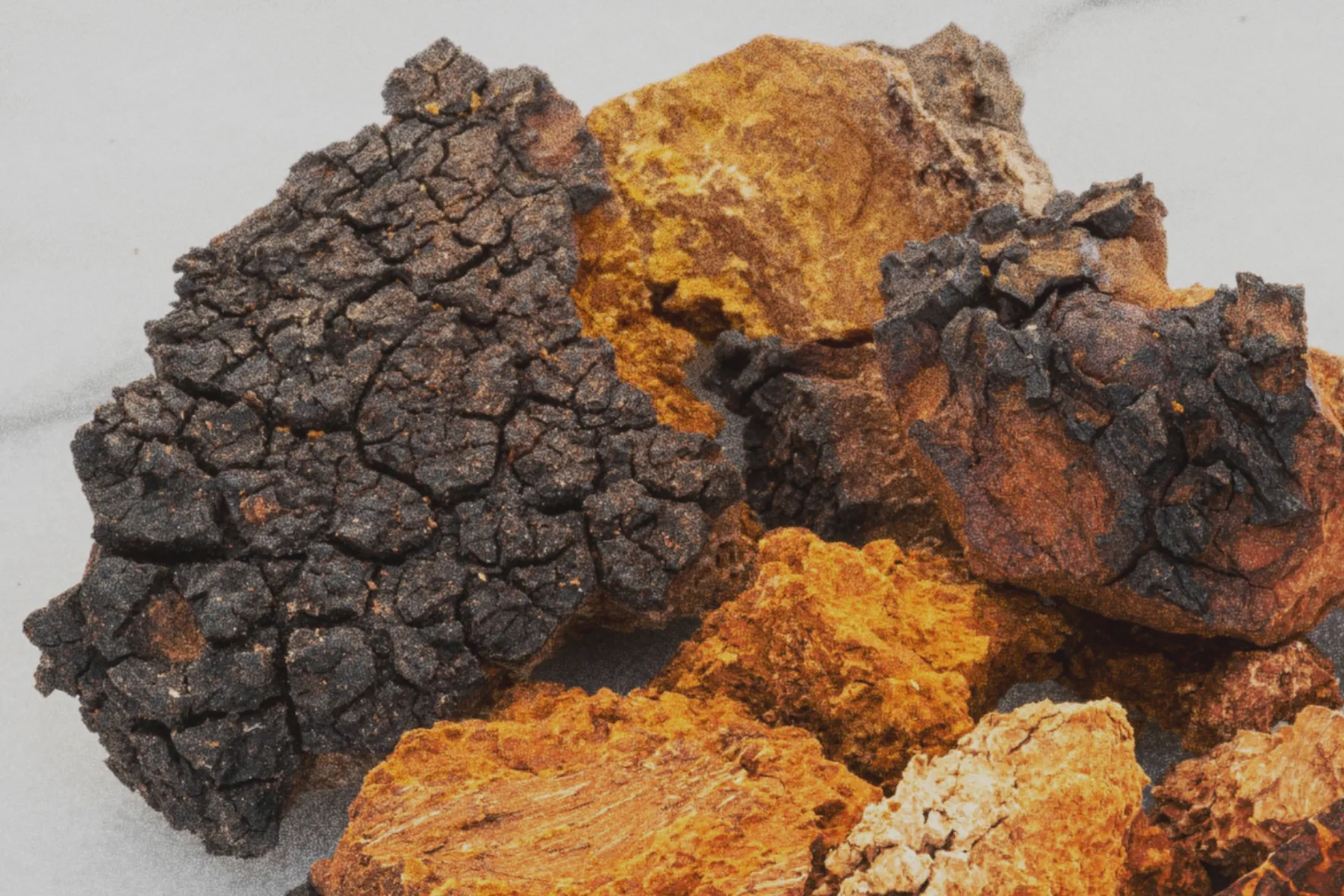
Many names, one species
Chaga (Russia and the Baltic countries, from the Old Russian word for the mushroom), czerniak brzozy (Poland, the official botanical name), błyskoporek podkorowy (Poland, an older systematic name), czyreń (regionally in north-eastern Poland), czarcie oko ("devil's eye", regionally, from the dark core). All these names refer to the same species: Inonotus obliquus. In Polish, Russian and Baltic folk tradition Chaga has been used since the 16th century as a tonic tea and a digestive aid. The first documented use comes from the Khanty people of Western Siberia [Saar 1991]. We work with raw material harvested under controlled conditions in the forests of Siberia and Eastern Europe, with a legal harvesting certificate.
What's in the extract
More than 200 bioactive compounds have been identified in Inonotus obliquus fruiting-body extract. β-1,3/1,6-glucans above 30% are the main polysaccharides responsible for activating Dectin-1 and TLR4 receptors on immune cells [Brown & Gordon 2003]. Melanin is a black fungal pigment (the same type of compound found in human skin) that in in vitro tests strongly scavenges free radicals. Polyphenols, betulinic acid and styrylpyrones act synergistically with melanin. Triterpenoids (inotodiol, lanosterol, ergosterol, trametenolic acid) provide a sterol profile characteristic of this species. Heteropolysaccharides (β-Glc, β-Xyl, α-Man, α-Rha) were described by Wold et al. [2018]. Betulin and betulinic acid originate from the birch host and are accumulated by the fungus.
The black outer shell of Chaga is not burnt wood. It is concentrated melanin, which the mushroom produces over 10–20 years of life on a birch trunk. The core under the shell, orange-russet in colour, contains the highest concentration of bioactive compounds. Mycelium grown on grain produces neither melanin nor the full profile of triterpenoids — these are the results of the fungus-host-time interaction. At Aloha Fungi we use exclusively fruiting-body extract for this species.
Typical batch specification
Typical batch: β-glucans above 30% by Megazyme K-YBGL method (EUROFINS laboratory). Total polyphenols 60–120 mg GAE/g by the Folin-Ciocalteu method. Melanin 5–12% by spectrophotometric method. Total triterpenoids 0.5–2.0% by HPLC. Extraction ratio 10:1. Moisture ≤ 5%. Oxalates ≤ 2.0 mg/g (a parameter relevant given recommendations for consumers predisposed to kidney stones). Microbiology compliant with the European Pharmacopoeia (Ph.Eur.). Every batch comes with a full COA including test methodology.

Premium variant
★ Co-brandingFor brands that want to create their own functional-mushroom product and base it on our raw-material standard. You use extracts selected by Aloha Fungi, and once the criteria are met you can add our quality seal to your packaging.
MOQ: 5 kg
Our logo on your product →Raw material
Whole sclerotia (black growths) of Inonotus obliquus from certified, controlled harvesting in the forests of Siberia and Eastern Europe. Chaga is a parasitic mushroom that grows on living birches over 10–20 years, which is why it cannot be cultivated under controlled conditions with the full profile of bioactive compounds preserved. We source raw material exclusively under legal harvesting certificates, from mature trees (over 40 years old). In Poland Chaga is under partial protection, so Aloha Fungi extracts never come from Polish forests. Source audit once per quarter. Every batch has full origin documentation (harvest region, host tree, date, certificate). After harvest, the core (orange-russet in colour) is separated from the outer melanin shell, with both used for extraction in precise proportions.
Extraction process
Milling of the raw material (core and melanin shell separately). Dual extraction: hot water extraction (β-glucans, heteropolysaccharides, part of the water-soluble polyphenols) and ethanol extraction (melanin, triterpenoids, betulinic acid, styrylpyrones, lipophilic polyphenols). Combining the fractions in a precise ratio, concentration, drying to powder form without maltodextrin.
Inonotus obliquus — Chaga from our controlled sourcing
Mechanisms described in the literature
Current research on Chaga (mainly in vitro and in animal models — large clinical RCTs in humans are not yet available) describes three principal mechanisms of action.
- 01
β-glucans and activation of innate immunity receptors
The best-described mechanism. Chaga β-1,3/1,6-glucans bind to Dectin-1 and TLR4 receptors on the surface of macrophages and dendritic cells, triggering NF-κB and MAPK signalling cascades [Brown & Gordon 2003; Sang et al. 2022]. Shen et al. [2022], working on RAW264.7 macrophage lines, report a bilateral effect: in the resting state (M0), Chaga extracts raise macrophage activity, while in the hyperactive state (M1, induced by LPS) they lower IL-1β and TNF-α production. Wold et al. [2018] identified specific polysaccharide fractions (the neutral IOE-WN) that, already at 10 μg/ml, induce NO production in J774.A1 macrophages. All results are in vitro and require confirmation in human RCTs.
- 02
Melanin and polyphenols — the antioxidant profile
Chaga has a combination of antioxidant compounds not found in other functional mushrooms. Melanin, in DPPH tests (in vitro), scavenges free radicals more strongly than vitamin E and Trolox. Polyphenols, betulinic acid and styrylpyrones show synergistic antioxidant activity. Glamočlija et al. [2015] described that Chaga extracts in in vitro tests activate the Nrf2 transcription factor responsible for the expression of phase II liver detoxification enzymes (glutathione S-transferase, SOD, catalase). All observations require human replication; large RCTs are not yet available.
- 03
Bilateral cytokine regulation
Bilateral cytokine regulation (Shen et al. 2022) suggests that Chaga, in in vitro tests, modifies TNF-α, IL-1β and IL-6 activity in a manner dependent on the cell's baseline state. In deficiency states it may raise activity, in hyperactive states it may lower it. Sang et al. [2022] described inhibition of the NF-κB pathway in cells with induced inflammation. Fang et al. [2020] observed, in an animal model, protection of hepatocytes from oxidative stress induced by carbon tetrachloride. The mechanism is fully described at the level of molecular biology and animal models; large human RCTs are not available.
★ Chaga in the Aloha Fungi brand
This is how Chaga looks as a finished product
Aloha Fungi is not only a B2B raw material — it's also our consumer brand. Here's how we use the same Chaga extract in our own products LONGEVITY and PRIME on alohafungi.pl. You can distribute these products or draw inspiration from their form and communication for your own brand.
 LONGEVITY
Chaga proszek 50 g
Proszek 50 g
Ekstrakt z całego surowca Chaga w proszku. Parametry jakościowe są opisane w dokumentacji produktu.
119,00 złShop → LONGEVITY
Chaga krople 30 ml
Krople 30 ml
Płynny ekstrakt z linii Młodość. Profil smakowy pasuje do kakao, herbaty i naparów korzennych.
169,00 złShop → LONGEVITY
Chaga kapsułki 90 szt.
Kapsułki 90 szt.
Limitowana seria ekstraktu Chaga w kapsułkach. Opakowanie zawiera 90 sztuk.
129,00 złShop → LONGEVITY
Chaga proszek 100 g
Proszek 100 g
Limitowana seria w większym opakowaniu 100 g. Proszek do samodzielnego odmierzania.
197,00 złShop → PRIME
PRIMEChaga proszek 50 g
Proszek 50 g
Wielofrakcyjny ekstrakt otrzymany przez podwójną ekstrakcję. Profil polifenoli i melanin jest podany w specyfikacji.
189,00 złShop → PRIME
PRIMEChaga kapsułki 90 szt.
Kapsułki 90 szt.
Wielofrakcyjny ekstrakt PRIME w kapsułkach. Opakowanie zawiera 90 sztuk.
189,00 złShop →
Consumer communication — what's allowed, what to avoid
Health claims on finished products are regulated by EU rules (1924/2006 and 432/2012). Chaga has no authorised EFSA claim — any phrasing about the product's effect on the body requires particular care in consumer communication. The Slavic and Siberian tradition (documented from the 16th century in Poland, Russia and the Baltic countries) and the mechanisms described in peer-reviewed literature allow communication about the traditional use of Chaga — provided certain language boundaries are observed. Below are the boundaries that are legally permissible.
What works
Communication directions safe for partners
Traditional use in Polish and Eastern European folk medicine (Chaga was traditionally used in the context of digestive support, general strengthening and as a seasonal tea) — using the form "traditionally used in the context of X", not "supports X". Description of bioactive compounds (β-glucans above 30%, melanin, polyphenols, triterpenoids). Description of the process (fruiting-body extract, hydroalcoholic extraction, certified source). Reporting research findings ("study X from year Y describes…", not "Chaga does Y"). Reference to Polish scientific publications (Lemieszek 2011, UMCS Lublin) as a context of local credibility.
What to avoid
Strictly prohibited communication
Attributing to the product the treatment, prevention or alleviation of specific disease entities (covered by the ICD-10 classification system, including oncological, autoimmune, hepatic, cardiovascular, metabolic and renal conditions). Forbidden words: "treats", "cures", "prevents", "therapy", "flushes out toxins", "detox", "clinical efficacy", "normalises", "immunomodulator" without the qualifier "traditionally", "dosage" (in consumer communication "recommended daily portion" is used). Regardless of any study quote, research must not be cited in a way that suggests the product acts on a specific ailment.
CRITICAL: In popular-science literature Chaga has strong associations with "cancer treatment" and "natural oncological therapy". These associations are Chaga's BIGGEST regulatory risk. GIS (Polish Chief Sanitary Inspectorate) and UOKiK (Polish Office of Competition and Consumer Protection) actively pursue such phrasing.
Extract applications
Chaga extract works technologically in most formats. Capsules — typically 300–500 mg extract per capsule. Powder — in sachets, blends with coffee and cacao, in hot beverages (natural synergy with bitter flavours). Liquid extract (tincture) — drops under the tongue for 30–60 seconds or into a drink. Chocolates, bars and coffee — flavour tolerance 1–3% by weight; Chaga has an earthy, slightly forest, somewhat bitter flavour. In Poland and Russia from the 19th century, Chaga was traditionally used as a "coffee substitute" in times of shortage, so it naturally fits coffee-like blends. Cold RTD beverages — low solubility in cold water; requires a technological solution (emulsifier or a "dissolve in hot water, then chill" formula). Cosmetics — extract with a dark colour (melanin) — needs to be factored into the formula's colour brief.
Stability, storage and packaging
Stability: 24–36 months in original packaging, at room temperature, away from direct light. Inert packaging (nitrogen) on request. Chaga is moderately hygroscopic; we recommend tight sealing after sampling and storage below 60% relative humidity. Melanin is thermally and photochemically stable, so the extract retains its dark colour throughout the shelf life (a desired feature, not a flaw).
Precautions
Chaga is traditionally well tolerated, but it carries one specific risk that cannot be omitted in communication.
Critical warning — oxalate kidney stones
Chaga contains relatively high concentrations of oxalates. The literature describes documented cases of acute kidney failure in people predisposed to oxalate stones after prolonged and intensive Chaga consumption [Kikuchi et al. 2014, Clin Nephrol]. Absolute contraindication for people with active oxalate kidney stones, a history of such stones or advanced kidney disease.
Chaga requires consultation with the treating physician in cases of: anticoagulants and antiplatelet drugs (warfarin, NOACs, acetylsalicylic acid in cardiac doses) — Chaga has a described anticoagulant action; hypoglycaemic drugs (insulin, metformin, sulfonylureas) — a possible additive effect, glycaemic monitoring; blood-pressure-lowering drugs — possible potentiation of the hypotensive effect; immunosuppressants after organ transplants. Before planned surgeries, discontinue Chaga for at least 14 days. Not recommended during pregnancy, breastfeeding or for people under 18 years of age. As standard, we include the key warnings on the consumer label of the final product — we provide brands with specific wording compliant with EU food law.
Regulatory status
Inonotus obliquus is traditionally present on the EU market as an ingredient in food supplements (documented use since the 16th century in Poland, Russia and the Baltic countries) and does not appear on the Novel Food list (regulation 2015/2283). Its pre-1997 status in the EU is based on historical use but is not formally confirmed by EFSA — member states interpret it differently. In Poland Chaga is under partial protection in the wild (Regulation of the Minister of the Environment on species protection of fungi), which means that wild harvesting from Polish forests is legally restricted. Raw material for Aloha Fungi products comes exclusively from legal, certified sources outside Poland. Product notification to GIS (Polish Chief Sanitary Inspectorate) is required under the food safety act. We support partners with technical documentation, certificates of origin and raw-material specification for notification — but we don't replace professional legal counsel.
★ Fastest path
Ready-made Aloha Fungi products for your business
Choose ready-made products from the LONGEVITY or PRIME line, or individual SKUs, and sell them under the Aloha Fungi brand in your channel.
This solution is for shops, clinics, practices and online partners who want to add functional mushrooms to their offer quickly, without building a product from scratch.
MOQ
1 500 PLN
Lead time
24h
First delivery
24h
Selected literature
11 sources
Selected literature
11 sources- Lemieszek MK et al. (2011). In vitro studies of Chaga fruiting-body fractions, Polish co-authorship (UMCS Lublin + Institute of Rural Medicine). Int J Med Mushrooms. PMID: 22135889.
- Saar M (1991). First documented folk use of Chaga (Khanty people, Western Siberia). J Ethnopharmacol.
- Wold CW et al. (2018). Structural characterisation of Chaga heteropolysaccharides (IOE-WN fractions), immunological activity in vitro. Carbohydr Polym. PMID: 29421057.
- Shen S et al. (2022). Immunomodulatory effects of Chaga extracts on RAW264.7 macrophage lines in the resting state and LPS-induced state. Evid Based Complement Alternat Med. PMID: 35497923.
- Glamočlija J et al. (2015). Chemical characterisation and biological activity of Chaga, in vitro antioxidant profiles. J Ethnopharmacol. PMID: 25576897.
- Brown GD, Gordon S (2003). Fungal β-glucans and mammalian immunity, Dectin-1 receptors. Nature. PMID: 12646903.
- Sang R et al. (2022). Immunomodulatory effects of Chaga polysaccharides on splenocytes (NF-κB and MAPK modulation). Front Cell Infect Microbiol.
- Fang J et al. (2020). Extracts from Phellinus, bamboo and Chaga — activity in an animal model. Nutrients.
- Kikuchi Y et al. (2014). Oxalate kidney stones induced by Chaga consumption, a single clinical case of acute kidney failure. Clin Nephrol.
- PMC11132974 (2024). Therapeutic properties of Inonotus obliquus — review.
- PMC11336990 (2024). Medical importance of Chaga, with Polish co-authorship (Poznań University of Medical Sciences).