
Reishi
Ganoderma lucidum
Hydroalcoholic fruiting-body extract, with optional standardisation on β-glucans and triterpenoids (ganoderic acid)
Extract from semi-wild Reishi fruiting bodies. Dual extraction matched to the species: water draws out β-glucans, ethanol the ganoderic acids.
Many names, one species
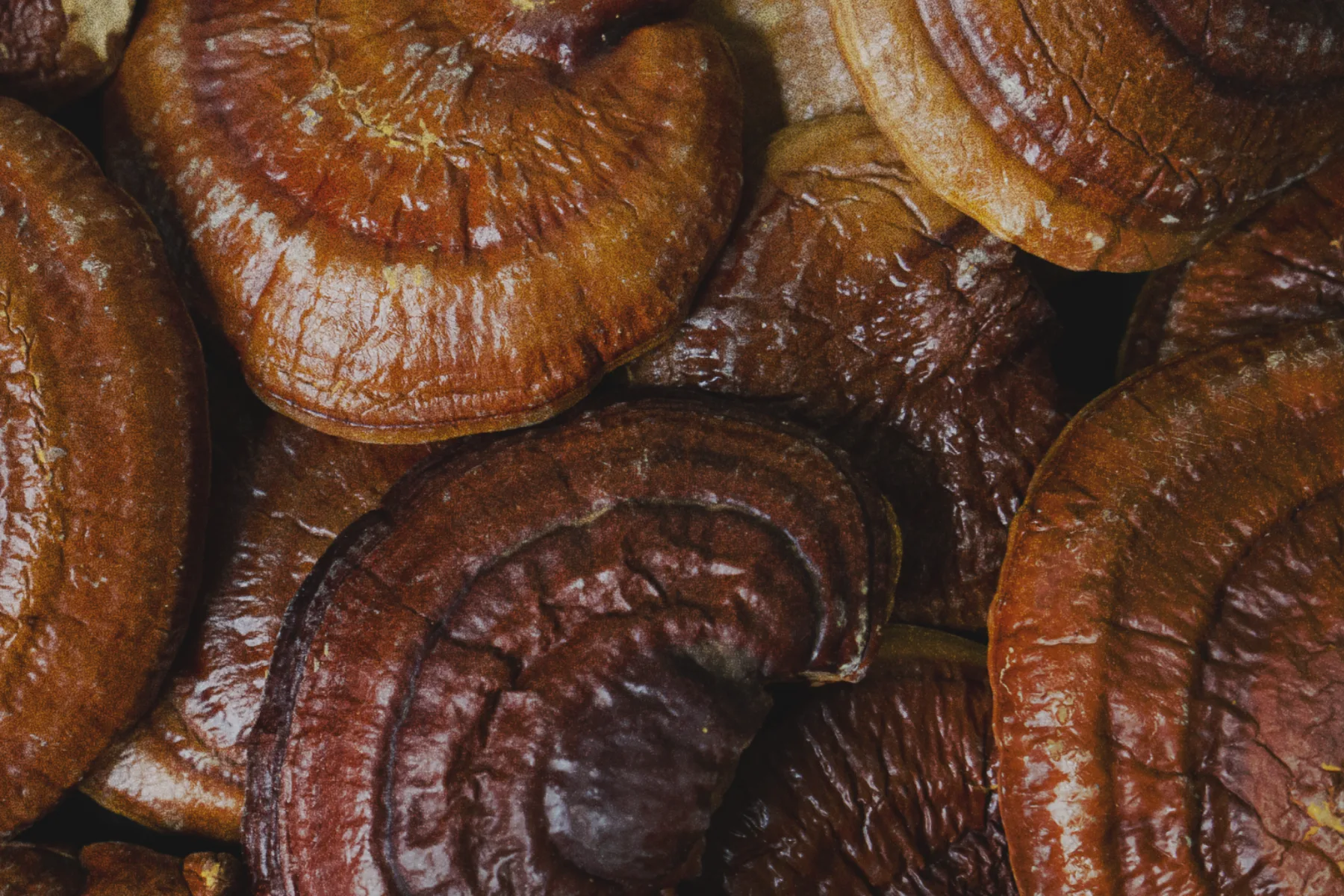
Reishi (Japan, 霊芝 — "divine mushroom"), Lingzhi (China, 灵芝 — "mushroom of immortality"), Mannentake (Japan — "10000-year mushroom"), lakownica żółtawa (Poland, rarely used). All these names refer to the same species: Ganoderma lucidum. Chinese tradition distinguishes six colours of Reishi — we work exclusively with the red variety, the most widely used in TCM and Japanese tradition.
What's in the extract?
Several hundred bioactive compounds have been identified in Reishi fruiting-body extract. The most important groups: ganoderic acids A–Z (more than 150 highly oxidised triterpenes responsible for the bitter taste; present mainly in the fruiting body), β-1,3/1,6-glucans (the main polysaccharides responsible for immunomodulation; above 30% in our standard batch), GLPS polysaccharides, adenosine, ergosterol (a vitamin D2 precursor after the fruiting body's UV exposure), peptidoglycans.
An important distinction: fruiting-body extract vs. mycelium grown on grain. The fruiting body contains ganoderic acids and a fuller β-glucan profile. Mycelium cultivated on grain contains 70–85% grain substrate and minimal ganoderic acids. At Aloha Fungi we use exclusively fruiting-body extract for this species.
Typical batch specification
Typical batch: β-glucans above 30% by Megazyme K-YBGL method (EUROFINS laboratory). Ganoderic acids 1.5–3.0% by HPLC. Extraction ratio 10:1. Moisture ≤ 5%. Microbiology compliant with Ph.Eur. Every batch comes with a full COA including test methodology.
Premium variant
★ Co-brandingFor brands that want to create their own functional-mushroom product and base it on our raw-material standard. You use extracts selected by Aloha Fungi, and once the criteria are met you can add our quality seal to your packaging.
MOQ: 5 kg
Our logo on your product →Raw material
Mature red Reishi fruiting bodies (Ganoderma lucidum) from semi-wild cultivation in non-industrial, mountainous regions of China. Dual-wood cultivation in managed forest conditions, audited quarterly. Harvest at full maturity.
Extraction process
Milling of the raw material. Dual extraction: hot water extraction (β-glucans, GLPS, peptidoglycans) and ethanol extraction (ganoderic acids and other triterpenes). Combining the extracts in a precise ratio, concentration, drying to powder form without maltodextrin.
Mechanisms described in the literature
Current research (mainly in vitro and in animal models, with one significant clinical RCT) describes three principal mechanisms of Reishi action.
- 01
HPA-axis and circadian rhythm regulation
Cui et al. [2012] showed that a Reishi extract given to rats for 28 days shortened sleep latency and prolonged NREM sleep. Chu et al. [2007] pointed to a GABAergic mechanism: Reishi potentiated pentobarbital's action but did not alter sleep architecture in healthy animals. The authors interpret this as regulation, not sedation.
- 02
Dectin-1 and TLR4 receptor binding (in vitro)
Reishi β-glucans (β-1→3, 1→6 structure) bind Dectin-1 and TLR4 receptors on macrophages and dendritic cells [Brown & Gordon 2003, Nature]. Peptide-polysaccharides (Ganopoly) were tested in the clinical RCT Tang 2005 (n=132, 8 weeks) — a 28.3% reduction in fatigue and a 38.7% increase in well-being vs. placebo. The study needs replication — n=132 is a small cohort.
- 03
Hepatic and anti-inflammatory mechanisms (animal models)
Animal-model studies describe ganoderic acid A as potentially supporting phase II liver detoxification. In cell cultures, ganoderic acids modulate NF-κB and inhibit histamine release from mast cells. Large human RCTs in these indications are still lacking — all observations require human replication.
★ Reishi in the Aloha Fungi brand
This is how Reishi looks as a finished product
Aloha Fungi is not only a B2B raw material — it's also our consumer brand. Here's how we use the same Reishi extract in our own products LONGEVITY and PRIME on alohafungi.pl. You can distribute these products or draw inspiration from their form and communication for your own brand.
 LONGEVITY
Reishi proszek 50 g
Proszek 50 g
Połączenie ekstraktu 10:1 i sproszkowanego owocnika. Proszek do odmierzania i mieszania z napojem.
119,00 złShop → LONGEVITY
Reishi krople 30 ml
Krople 30 ml
Płynny ekstrakt otrzymany w procesie potrójnej ekstrakcji. Butelka z pipetą ułatwia odmierzanie porcji.
169,00 złShop → LONGEVITY
Reishi kapsułki 90 szt.
Kapsułki 90 szt.
Ekstrakt z Reishi w kapsułkach. Opakowanie zawiera 90 sztuk i nie wymaga odmierzania proszku.
129,00 złShop → PRIME
PRIMEReishi kapsułki 90 szt.
Kapsułki 90 szt.
Skoncentrowany ekstrakt PRIME w kapsułkach. Parametry i markery są podane w specyfikacji produktu.
189,00 złShop → PRIME
PRIMEReishi proszek 50 g
Proszek 50 g
Wielofrakcyjny ekstrakt 10:1 otrzymany przez podwójną ekstrakcję. Forma proszkowa do samodzielnego porcjowania.
189,00 złShop →
Consumer communication — what's allowed, what to avoid
Health claims on finished products are regulated by EU rules (1924/2006 and 432/2012). Reishi has no authorised EFSA claim — any phrasing about the product's effect on the body requires particular care in consumer communication. TCM tradition and mechanisms described in peer-reviewed literature allow communication about Reishi's traditional use — provided certain language boundaries are observed. Below are the boundaries that work well for us.
What works
Communication directions safe for partners
Traditional use in Traditional Chinese and Japanese Medicine (Reishi was traditionally used in the context of evening ritual, winding down, recovery) — using the form "traditionally used in the context of X", not "supports X". Description of bioactive compounds (β-glucans above 30%, ganoderic acids). Description of the process (fruiting-body extract, dual extraction). Reporting research findings ("study X from year Y describes…", not "Reishi does Y").
What to avoid
Strictly prohibited communication
Attributing to the product the treatment, prevention or alleviation of specific disease entities (depression, insomnia as a clinical diagnosis, autoimmune diseases, cardiovascular conditions, metabolic disorders, oncological conditions, neurodegenerative diseases). Forbidden words: "treats", "cures", "prevents", "therapy", "clinical efficacy", "normalises", "dosage" (in consumer communication "recommended daily portion" is used). Regardless of any study quote, research must not be cited in a way that suggests an effect.
Extract applications
Reishi extract works technologically in most formats. Capsules — typically 300–500 mg extract per capsule. Powder — in sachets, blends with cacao or matcha, hot beverages (typically as a component of an evening ritual). Liquid extract (tincture) — drops directly under the tongue or into a drink. Chocolates and bars — flavour tolerance usually requires 5–10% by weight. Coffee/cacao — Reishi is naturally bitter and blends well with ceremonial cacao, coffee and spices. Weak for cold RTD beverages without an emulsifier (low solubility in cold water without technological support).
Stability, storage and packaging
Stability: 24–36 months in original packaging, at room temperature, away from direct light. Inert packaging (nitrogen) on request.
Precautions
Reishi has documented platelet-aggregation-inhibiting action and may enhance the effect of anticoagulants and antiplatelet drugs (warfarin, NOACs, acetylsalicylic acid). Caution is also required with: immunosuppressants, hypotension, hypoglycaemic drugs, active autoimmune diseases, before planned surgeries (discontinue for at least 14 days). Not recommended during pregnancy, breastfeeding or for people under 18 years of age. As standard, we include the key warnings on the consumer label of the final product — we provide brands with specific wording compliant with EU food law.
Regulatory status
Ganoderma lucidum is traditionally present on the EU market as an ingredient in food supplements and does not appear on the Novel Food list (regulation 2015/2283). Its pre-1997 status in the EU is not formally confirmed by EFSA — member states interpret this more loosely or more strictly (e.g. Germany is more restrictive than Poland). Product notification to GIS (Polish Chief Sanitary Inspectorate) is required under the food safety act. We support partners with technical documentation and raw-material specification for notification — but we don't replace professional legal counsel.
★ Fastest path
Ready-made Aloha Fungi products for your business
Choose ready-made products from the LONGEVITY or PRIME line, or individual SKUs, and sell them under the Aloha Fungi brand in your channel.
This solution is for shops, clinics, practices and online partners who want to add functional mushrooms to their offer quickly, without building a product from scratch.
MOQ
1 500 PLN
Lead time
24h
First delivery
24h
Selected literature
7 sources
Selected literature
7 sources- Tang W et al. (2005). RCT with a 5400 mg daily portion in patients with neurasthenia, n=132, 8 weeks. J Med Food. PMID: 15857210.
- Cui XY et al. (2012). Reishi extract prolongs sleep duration in rats. J Ethnopharmacol. PMID: 22207209.
- Chu QP et al. (2007). GABAergic mechanism. Pharmacol Biochem Behav. PMID: 17383716.
- Wachtel-Galor S et al. (2011). Monograph: Ganoderma lucidum in Herbal Medicine. NCBI: NBK92757.
- Brown GD, Gordon S (2003). Dectin-1 and β-glucan receptors. Nature.
- Jin X et al. (2016). Cochrane review — insufficient evidence for anti-tumour action.
- Sułkowska-Ziaja K, Zengin G, Gunia-Krzyżak A, Popiół J, Szewczyk A, Jaszek M, Rogalski J, Muszyńska B (2022). Bioactivity and Mycochemical Profile of Extracts from Mycelial Cultures of Ganoderma spp. Molecules 27(1):275 — Polish quantification of indole compounds in Ganoderma lucidum mycelium (11.56 mg/100 g d.m., the highest among 6 Ganoderma species studied), tyrosinase and acetylcholinesterase inhibition. Department of Pharmaceutical Botany, Jagiellonian University Medical College.