
Shiitake
Lentinula edodes (syn. Lentinus edodes)
Hydroalcoholic fruiting-body extract with optional standardisation on β-glucans, lentinan and eritadenine
Extract from Lentinula edodes fruiting bodies from certified organic cultivation (Poland, China or Japan, depending on the batch). Shiitake is the 2nd most cultivated mushroom in the world after the button mushroom, so the availability of standardised, certified raw material is the best of all functional mushrooms in the portfolio. Hot water extraction as the basis for lentinan and β-glucans (lentinan as a β-1,3 glucan with β-1,6 branching and a triple-helix structure requires extraction at 90°C). Low-temperature ethanol fraction for eritadenine (a compound structurally unique to Shiitake, an adenosine analogue).
Many names, one species
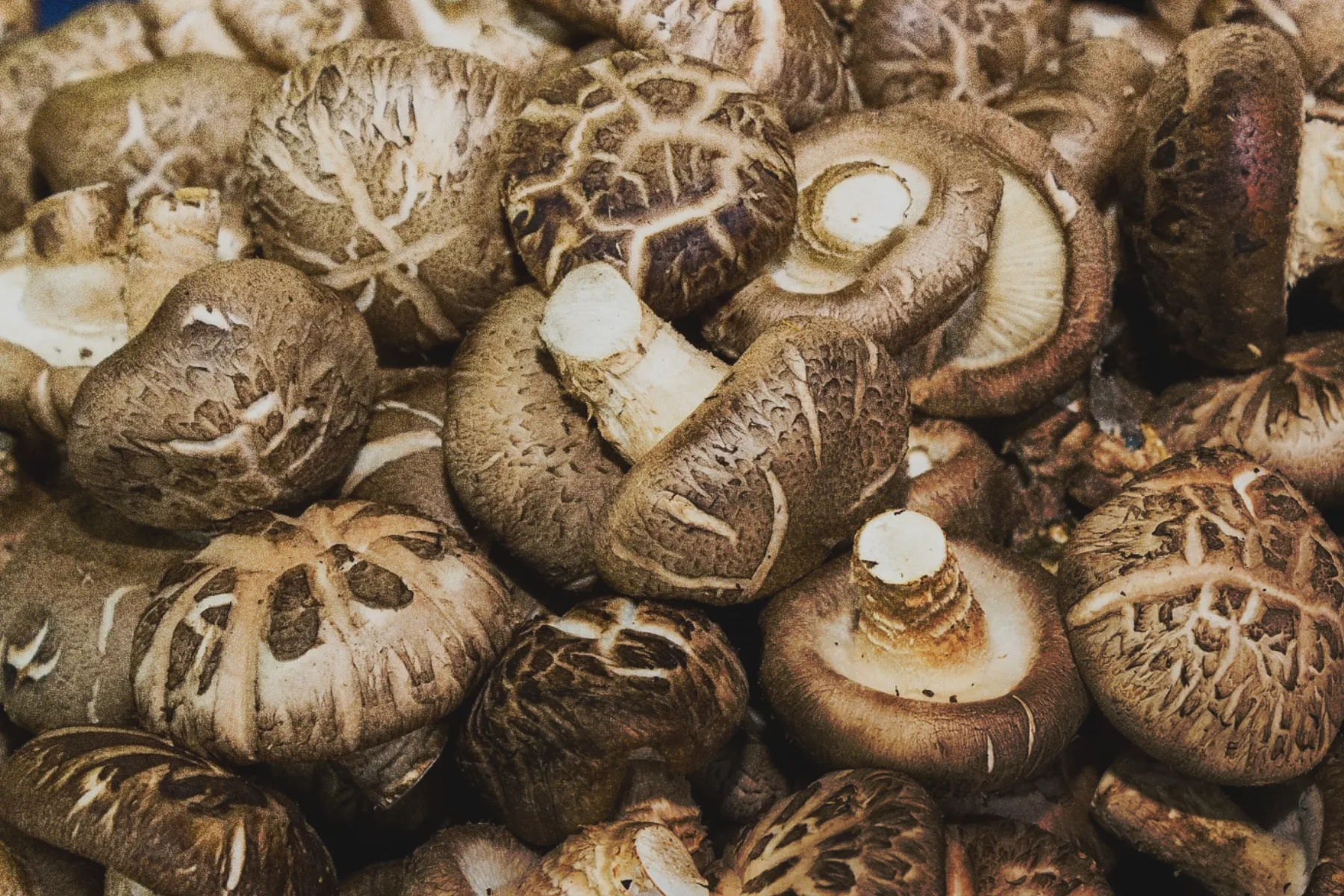
Shiitake (Japan, 椎茸, from shii - a Japanese oak of the Castanopsis genus, and take - mushroom, literally "oak mushroom"), xiānggū (China, 香菇 - "aromatic mushroom"), dōnggū (China, 冬菇 - "winter mushroom"), hua gu, qua gu (China), Black forest mushroom, Chinese black mushroom, Oak mushroom (English), twardnik japoński (Poland, the official scientific name given by the mycologist Władysław Wojewoda in 1998), twardziak jadalny, twardziak uprawny (regionally). All these names refer to the same species: Lentinula edodes (synonym Lentinus edodes). Shiitake originates from East and Southeast Asia (China, Japan, Korea, Vietnam). In Chinese imperial cuisine it belonged to the "eight treasures" (ba zhen 八珍). The first written Japanese mentions date to 199 CE (a gift from the Kyushu tribe to the emperor). During the Yuan dynasty (14th century) Wu Rui described Shiitake in Daily Use Materia Medica as a longevity tonic. In Chinese Materia Medica it is classified in the shang yao (上藥, "higher herbs") category - a category of life-sustaining herbs suitable for long-term use without adverse effects. Modern scientific history began in 1969, when Goro Chihara of the National Cancer Institute of Japan isolated lentinan and published the results in Nature.
What's in the extract?
Shiitake is one of the most chemically well-characterised functional mushrooms (more than 6000 peer-reviewed publications). Lentinan (Chihara 1969, Nature) is a β-1,3 glucan with β-1,6 branches, molecular mass about 500-1000 kDa, triple-helix structure. The main immunoactive compound - in Japan registered as a prescription drug since 1985 in intravenous injection for gastric cancer. Eritadenine [2(R),3(R)-4-(9-adenyl)-butyric acid] is an adenosine analogue structurally UNIQUE to Shiitake (it does not occur in any other mushroom or medicinal plant). It inhibits S-adenosylhomocysteine hydrolase (SAHH), modifying methionine and homocysteine metabolism and hepatic phospholipids - a mechanism completely different from statins. Ergosterol and provitamin D₂ - Shiitake has one of the HIGHEST ergosterol contents among functional mushrooms (up to 9.61 mg/g d.m.). LEM (Lentinula Edodes Mycelium extract) with described hepatoprotective action, in Japan an adjuvant in chronic hepatitis B. AHCC (Active Hexose Correlated Compound), a low molecular-weight α-glucan (≤ 5 kDa). Lentin, a protein with antibacterial and antiviral activity (effective in vitro against MRSA, Bacillus subtilis, Escherichia coli). B vitamins (B₂, B₃, B₅, B₆, traces of B₁₂), selenium (at a relatively high concentration), copper, zinc. Standardisation of β-1,3/1,6-glucans in our extract above 30%.
Shiitake is one of the few functional mushrooms in which a structurally UNIQUE compound (eritadenine) has been isolated - it does not occur in any other mushroom or medicinal plant, acts on the lipid profile through the SAHH mechanism (completely different from statins). The second signature fraction is lentinan, registered in Japan as an adjuvant oncology drug since 1985. It is these two compounds - eritadenine and lentinan - that define the value of the fruiting-body extract and distinguish it from mycelium grown on grain (where the content of both is negligible). Plus a bonus: ergosterol at the highest content among functional mushrooms - a natural provitamin D₂ after UV exposure. At Aloha Fungi we use exclusively fruiting-body extract in the EU. In countries outside the EU we also offer mycelium extracts for this species.
Typical batch specification
Typical batch: β-glucans above 30% by Megazyme K-YBGL method (EUROFINS laboratory). Lentinan (β-1,3/1,6 glucan, 500-1000 kDa) 5–10% by chromatographic fractionation with SEC-MALS verification and triple-helix structure analysis (key for biological activity). Eritadenine 0.2–1.0 mg/g by HPLC (a structurally unique compound, marker of species authenticity). Ergosterol 5–9 mg/g d.m. by HPLC. Total polysaccharides 30–40%. Extraction ratio 10:1. Moisture ≤ 5%. Microbiology compliant with the European Pharmacopoeia (Ph.Eur.). Every batch comes with a full COA including test methodology.
Premium variant
★ Co-brandingFor brands that want to create their own functional-mushroom product and base it on our raw-material standard. You use extracts selected by Aloha Fungi, and once the criteria are met you can add our quality seal to your packaging.
MOQ: 5 kg
Our logo on your product →Raw material
Mature Lentinula edodes fruiting bodies from certified organic cultivation. Shiitake is the 2nd most cultivated mushroom in the world (annual production in China alone exceeds 7 million tonnes, FAO 2022 data), so the availability of standardised raw material is the best in the portfolio. We work with cultivation in China, Poland or Japan depending on the batch on oak-beech sawdust under controlled conditions. Cultivation time from inoculation to harvest: 90-150 days. Farm audits once per quarter, including microbiological tests of the substrate. Harvest at full maturity (caps 4-10 cm in diameter, brown colour with a characteristic white pattern on the surface), traditionally by the dong fang fa method (东方法, "eastern method") described in Wuchung Records (ca. 1209) or by modern methods of sterile climatic chambers. Poland also has well-developed Shiitake cultivation on oak-beech sawdust under certified conditions (availability of fresh Shiitake in Polish shops for about 15 years).
Extraction process
Milling of the dried fruiting bodies. Main process: hot water extraction at 90°C, duration 4-8 hours, for optimal extraction of lentinan (β-1,3/1,6 glucan; the triple-helix structure requires long extraction at high temperature to preserve biological activity), β-glucans and high-molecular-weight polysaccharides. Low-temperature hydroethanolic extraction (40°C) for eritadenine (an adenosine analogue, better extracted at low temperatures). Optional ethanol extraction for ergosterol (a lipophilic steroid). Combining the fractions in a precise ratio, concentration at reduced temperature, drying to powder form without maltodextrin, with parameters that protect the triple-helix structure of lentinan.
Mechanisms described in the literature
Research on Shiitake comprises more than 6000 peer-reviewed publications - the second-strongest scientific base, after Coriolus, among functional mushrooms. UNIQUE: an RCT in HEALTHY people at a dietary dose (Dai 2015), a rarity in the functional-mushroom group. Three main mechanisms of action.
- 01
Lentinan, Dectin-1 and innate immunity
The best-described mechanism. Lentinan as a β-1,3 glucan with β-1,6 side branches and a triple-helix structure binds as an agonist to the Dectin-1 receptor and, as a co-receptor, to CR3 (complement receptor 3, integrin CD11b/CD18) on dendritic cells, macrophages and monocytes [Brown & Gordon 2003; Xu et al. 2016, Sci Rep]. This triggers a signalling cascade through Syk and NF-κB, leading to dendritic-cell maturation, T-helper 1 activation, increased production of IL-12, IFN-γ and TNF-α, and stimulation of NK-cell activity. In Japanese medicine injectable lentinan has been an official adjuvant drug in gastric cancer chemotherapy since 1985. The Yin et al. meta-analysis [2015, Indian J Cancer, n=950 patients, 12 RCTs] showed that adding injectable lentinan to chemotherapy regimens in non-small-cell lung cancer improves the response rate (RR=1.31, 95% CI 1.14-1.52). Important caveat: this concerns injectable lentinan, not oral extract. The Dai et al. RCT [2015, J Am Coll Nutr, n=52 healthy adults, 4 weeks, 5-10 g dried Shiitake daily] showed improved γδ T-cell function, a shift in the cytokine profile towards an anti-inflammatory pattern and a significant reduction in CRP - a rarity in the functional-mushroom group: an RCT in HEALTHY people at a dietary dose.
- 02
Eritadenine and cardioprotection via SAHH
A mechanism that makes Shiitake UNIQUE among functional mushrooms. Eritadenine as an adenosine analogue binds at the active site of the enzyme S-adenosylhomocysteine hydrolase (SAHH) with nanomolar affinity [Sugiyama et al. 1995, J Nutr]. SAHH catalyses the hydrolysis of S-adenosylhomocysteine (SAH) to adenosine and homocysteine. Inhibiting SAHH raises intracellular SAH, shifting the SAM:SAH ratio and modifying methionine and hepatic phospholipid metabolism. Specifically: the phosphatidylcholine-to-phosphatidylethanolamine ratio in liver membranes changes, modifying cholesterol transport from liver to plasma. Clinically observed effect: lowering of total cholesterol, LDL and triglycerides, without a significant effect on HDL [Sugiyama 1995; Yang et al. 2013, Exp Ther Med]. The mechanism is entirely different from statins (which inhibit HMG-CoA reductase), which makes Shiitake potentially complementary support in hypercholesterolaemia. In animal-model studies an eritadenine dose of 0.005% in the diet (corresponding to about 30-50 g dried Shiitake/day in a human) is enough to produce a measurable cholesterol reduction. Solid animal models, limited human RCTs, larger trials needed.
- 03
Food medicine, ergosterol and prebiotic
The third mechanism is less "spectacular" than lentinan, but in practice the most important for daily supplementation. Shiitake as a functional food provides ergosterol at exceptionally high concentration (up to 9.61 mg/g d.m., the highest among functional mushrooms), which converts to vitamin D₂ after UV exposure. B vitamins (especially B₂, B₃, B₅) support energy metabolism. β-glucans from the fruiting body act as a prebiotic, fermenting in the large intestine to short-chain fatty acids (SCFA: butyrate, acetate, propionate), which support gut-epithelium health [Xu et al. 2015]. Vitamin D₂, however, has lower bioavailability than D₃, so Shiitake is a natural supplement to, not a replacement for, a D₃ supplement in people with a deficiency.
★ Shiitake in the Aloha Fungi brand
This is how Shiitake looks as a finished product
Aloha Fungi is not only a B2B raw material — it's also our consumer brand. Here's how we use the same Shiitake extract in our own products LONGEVITY and PRIME on alohafungi.pl. You can distribute these products or draw inspiration from their form and communication for your own brand.
 LONGEVITY
Shiitake krople 30 ml
Krople 30 ml
Płynny ekstrakt Shiitake z linii LONGEVITY. Zawartość lentinanu jest opisana w specyfikacji produktu.
169,00 złShop → LONGEVITY
Shiitake kapsułki 90 szt.
Kapsułki 90 szt.
Ekstrakt Shiitake z linii LONGEVITY w wygodnej formie kapsułkowej.
129,00 złShop → LONGEVITY
Shiitake proszek 100 g
Proszek 100 g
Limitowana seria proszku Shiitake w większym opakowaniu 100 g.
197,00 złShop →
Consumer communication - what's allowed, what to avoid
Health claims on finished products are regulated by EU rules (1924/2006 and 432/2012). Shiitake has no authorised EFSA claim, so any phrasing about the product's effect on the body requires particular care in consumer communication. SPECIAL NOTE: lentinan from Lentinula edodes is registered in Japan as a DRUG used adjuvantly in oncology (since 1985, gastric cancer and non-small-cell lung cancer), which creates a unique regulatory situation - injectable lentinan is a drug, our oral extract is a food supplement; these two products have DIFFERENT legal statuses. Plus: Shiitake is at the same time a functional food (Japanese cuisine for centuries) and a supplement - an additional communication subtlety. The TCM tradition (Shiitake as shang yao in Bencao Gangmu 1578, RCT Dai 2015) allows communication about Shiitake's traditional use and about reporting specific studies, provided certain language boundaries are observed. Below are the boundaries that are legally permissible.
What works
Communication directions safe for partners
Traditional use in Traditional Chinese Medicine and Far-Eastern cuisine (Shiitake was traditionally used in the context of supporting general vitality, as a longevity tonic and as part of a diet strengthening the constitution - from Li Shizhen's Bencao Gangmu 1578) - using the form "traditionally used in the context of X", not "supports X". Description of bioactive compounds (β-glucans above 30%, lentinan, eritadenine as a structurally unique compound, ergosterol as a provitamin D₂). Description of the process (fruiting-body extract, hot water extraction at 90°C, preservation of the triple-helix structure of lentinan). Reporting studies ("the Dai 2015 RCT with 52 healthy adults describes the effect of dietary Shiitake on γδ T-cell function…", not "Shiitake strengthens immunity"). Referring to the shang yao status in classical TCM (the category of life-sustaining herbs, suitable for long-term use). Positioning as "food medicine" / "functional food" is SAFE and legally permissible (Shiitake is widely consumed as food).
What to avoid
Strictly prohibited communication
Attributing to the product the treatment, prevention or alleviation of specific disease entities (covered by the ICD-10 classification system, including hypercholesterolaemia, lipid disorders, oncological, autoimmune and viral hepatitis conditions, HPV, atopic dermatitis). Forbidden words: "treats", "cures", "prevents", "therapy", "natural statin", "plant statin replacement", "natural oncology therapy", "lentinan supplement" (injectable lentinan is a DRUG in JP; suggesting that our supplement is lentinan is inconsistent with the declaration), "chemo adjuvant" (without a prescription), "HPV treatment", "natural cholesterol drug", "clinical efficacy", "normalises", "dosage" (we use "recommended daily portion"). Regardless of any study quote, research must not be cited in a way that suggests an effect of the product on a specific condition.
Critical for Shiitake
Three specific regulatory risks:
1) Association with lentinan / the Japanese drug. Injectable lentinan is a Japanese oncology drug (since 1985). Suggesting that our oral supplement is lentinan or has the same clinical effect is a breach of 1924/2006 + a risk of medical communication. Lentinan as a compound MAY be listed as an ingredient, but WITHOUT implying that the product has an oncological application.
2) Association with statins / hypocholesterolaemia. Eritadenine is a STRONG scientific argument (a unique compound, the SAHH mechanism), but communicating "Shiitake lowers cholesterol" or "natural statin" is a functional claim referring to ICD-10 E78 (hypercholesterolaemia). UOKiK and GIS actively prosecute such phrasing.
3) Adjuvant oncology. The Yin 2015 meta-analysis is scientifically strong, but it concerns INJECTABLE lentinan, not an oral extract. Citing this in supplement marketing is interpretable as an oncological claim.
Extract applications
Shiitake extract is one of the most technologically versatile in the functional-mushroom portfolio - a consequence of its dual status (food + supplement). Capsules - typically 300-500 mg extract per capsule (typical protocols 500-2000 mg/day, daily long-term supplementation). Powder, in blends for miso soups, broths, udon noodles, sauces, rice - Shiitake has an intense umami flavour with smoky and earthy notes, naturally complementing salty Asian and European dishes. Liquid extract (tincture), drops under the tongue for 30-60 seconds or into a drink. Chocolates and bars, flavour tolerance 1-2% by weight (stronger concentrations introduce a noticeable umami). Coffee and cacao, weaker flavour synergy (umami clashes with bitter, as with Maitake), requires appropriate formulations. "Immune support", "heart health", "cholesterol balance" supplements - popular positioning. Functional beverages, broths, RTD soups, mushroom coffees - Shiitake naturally fits these categories. "Food medicine" / "functional food" as culinary positioning is UNIQUE to Shiitake in the portfolio (Reishi/Chaga/Polyporus are not food). NOTE: claims of "lowers cholesterol", "natural statin", "immune system support" in the EU require EFSA authorisation - section H.
Stability, storage and packaging
Stability: 24-36 months in original packaging, at room temperature, away from direct light. Inert packaging (nitrogen) on request. Lentinan is thermally stable up to 90°C (the triple-helix structure may degrade above 100°C, which matters for production in high-temperature processes). Eritadenine is thermally stable up to 80°C (above this it begins to degrade). Ergosterol is sensitive to oxidation and UV light - paradoxically: UV exposure converts ergosterol to vitamin D₂ (desirable for vitamin supplements), but under storage conditions without UV control it causes undesirable oxidation. Therefore: dark, hermetic packaging + optional UV exposure as a dedicated production step. Shiitake is moderately hygroscopic; we recommend tight sealing after sampling and storage below 60% relative humidity.
Precautions
Shiitake has ONE OF THE BEST safety profiles among functional mushrooms thanks to centuries of culinary consumption in East Asia. In the Dai 2015 RCT (5-10 g dried daily for 4 weeks) no adverse effects were reported. Nonetheless, for a concentrated extract there are groups that require attention.
Specific warning: shiitake dermatitis
In 2-3% of the population, consumption of RAW or undercooked Shiitake causes an itchy, streak-like rash on the trunk (24-48 hours after exposure, resolving spontaneously in 1-2 weeks). The reaction is linked to lentinan acting on mast cells. Prevention: always heat-treat (cook for at least 5 minutes). Extract that has been heat-treated in production does NOT trigger this reaction in the vast majority of sensitive individuals, but for people with a documented reaction in their history we recommend a different functional mushroom.
Absolute contraindications: a documented history of shiitake dermatitis. Known allergy to mushrooms of the Omphalotaceae family. Post organ-transplant status with active immunosuppression (ciclosporin, tacrolimus, mycophenolate, everolimus, sirolimus) - lentinan activates innate immunity. Active autoimmune diseases in flare-up (systemic lupus, severe RA, active ulcerative colitis) - activation of Dectin-1 and Th1 may worsen the condition. Children under 18 years of age for concentrated extract (Shiitake as culinary food has no age restrictions).
Consultation with a doctor required: anticoagulants and antiplatelet drugs (warfarin, NOACs, clopidogrel, ASA at cardiological doses) - β-glucans may mildly affect platelet aggregation. INR monitoring with warfarin. Statins and other lipid-lowering drugs - Shiitake acts hypocholesterolaemically through a mechanism different from statins (SAHH instead of HMG-CoA reductase), so theoretically complementarily. In Japanese protocols some cardiologists combine Shiitake with statins under lipid-profile monitoring. The decision to modify the statin dose belongs to the cardiologist. Chemotherapy and radiotherapy in progress - in Japan injectable lentinan is routinely combined with chemotherapy. Oral Shiitake extract as integrative support requires individual consultation with the attending oncologist. Immunosuppressants (other than post-transplant): methotrexate, biologics (anti-TNF), JAK inhibitors. Consultation with a rheumatologist. Autoimmune diseases in remission - Shiitake's mild immunomodulation should not worsen the condition in remission, but caution in people with labile disease. Hyperhomocysteinaemia - eritadenine via SAHH affects homocysteine metabolism. In people with isolated hyperhomocysteinaemia, monitoring of homocysteine levels in the first weeks. Pregnancy and breastfeeding - culinary intake is considered safe (Japanese tradition), but for concentrated extract there is a lack of adequate RCTs; we recommend discontinuation until breastfeeding ends. Planned surgeries - discontinue 14 days before the procedure.
Possible adverse effects (rarely reported): shiitake dermatitis with consumption of raw or undercooked mushroom (2-3% of the population). Mild bloating or loose stools in the first week (prebiotic effect of β-glucans). Isolated allergic reactions (itching, rash). Eosinophilia (rarely, mainly with very high consumption of dried mushroom, above 30 g/day). As standard we include the key warnings on the consumer label of the final product.
Regulatory status
Lentinula edodes is traditionally present on the EU market as an ingredient in food supplements and as a food (Shiitake is the 2nd most cultivated mushroom in the world, available in shops as fresh and dried food) and does not appear on the Novel Food list (regulation 2015/2283). Pre-1997 status is based on widespread culinary use in East Asia for centuries.
SPECIAL NOTE: lentinan as a drug in JP + AHCC as a separate product
1) Lentinan as a drug in Japan. Lentinan from Lentinula edodes is registered in Japan as a DRUG used adjuvantly in oncology (since 1985, gastric cancer and non-small-cell lung cancer), manufactured by Ajinomoto Co. under the brand name Lentinan Ajinomoto. In the EU lentinan is not registered as a drug, and our oral extract does not contain a purified lentinan fraction to pharmaceutical standard - it is a food supplement, NOT a drug. Plus: lentinan as a drug in Japan is administered EXCLUSIVELY by injection; the oral form has a different bioavailability. This difference is critical.
2) AHCC as a separate product. AHCC (Active Hexose Correlated Compound) from Shiitake mycelium is registered in Japan as an adjuvant in selected indications (HPV, oncology) - this is a SEPARATE product with its own production standard, NOT our fruiting-body extract. Suggesting that our extract is AHCC would be inconsistent with the declaration.
Product notification to GIS is required under the food safety act. We support partners with technical documentation, certificates of origin and raw-material specification for notification, but we don't replace professional legal counsel.
★ Fastest path
Ready-made Aloha Fungi products for your business
Choose ready-made products from the LONGEVITY or PRIME line, or individual SKUs, and sell them under the Aloha Fungi brand in your channel.
This solution is for shops, clinics, practices and online partners who want to add functional mushrooms to their offer quickly, without building a product from scratch.
MOQ
1 500 PLN
Lead time
24h
First delivery
24h
Selected literature
12 sources
Selected literature
12 sources- Dai X et al. (2015). RCT n=52 healthy adults, 4 weeks, 5-10 g dried Shiitake/day, improvement in γδ T-cells, reduction in CRP. J Am Coll Nutr. PMID: 25866155.
- Chihara G et al. (1969). First isolation of lentinan and its anti-tumour activity in mice. Nature 222:687-688.
- Xu H et al. (2016). Mechanism of anti-tumour activity of β-glucan from L. edodes - Dectin-1, CR3. Sci Rep.
- Yin X et al. (2015). Meta-analysis of 12 RCTs (n=950) - injectable lentinan + chemotherapy in non-small-cell lung cancer. Indian J Cancer. PMID: 26548936.
- Sugiyama K et al. (1995). Hypocholesterolaemic mechanism of eritadenine - modification of hepatic phospholipid metabolism via SAHH. J Nutr. PMID: 7643249.
- Yang H et al. (2013). L. edodes promotes fat removal in hypercholesterolaemic mice. Exp Ther Med.
- Israilides C et al. (2008). Cytostatic and immunomodulatory activity of L. edodes in vitro. Phytomedicine. PMID: 18242970.
- Bisen PS et al. (2010). L. edodes - a macrofungus with pharmacological activities (review). Curr Med Chem. PMID: 20491636.
- Ahmad I et al. (2023). Therapeutic and nutraceutical values of Shiitake (review). Trends Food Sci Technol.
- Xu X et al. (2014). Polysaccharides in L. edodes - isolation, structure, immunomodulatory activity (review). Crit Rev Food Sci Nutr. PMID: 24237001.
- Brown GD, Gordon S (2003). Fungal β-glucans and mammalian immunity, Dectin-1. Nature. PMID: 12646903.
- Muszyńska B et al. (2018). Anti-inflammatory properties of edible mushrooms - a review. Food Chem. PMID: 29146352. Department of Pharmaceutical Botany of Medicinal Plants and Mushrooms, Collegium Medicum Jagiellonian University.