
Polyporus
Polyporus umbellatus (syn. Grifola umbellata)
Hydroalcoholic sclerotium extract with optional standardisation on β-glucans, PPS and polyporusterones
Extract from the sclerotium of Polyporus umbellatus from controlled cultivation in symbiosis with honey mushrooms of the Armillaria genus - a cultivation system that is unique and requires specialised infrastructure. Unlike the other functional mushrooms, the raw material is the sclerotium (the underground part of the mycelium), not the fruiting body. Hydroalcoholic extraction matched to the species: water draws out PPS (polysaccharide-peptide) and β-glucans, alcohol draws out polyporusterones and ergon (a steroid with anti-aldosterone activity).
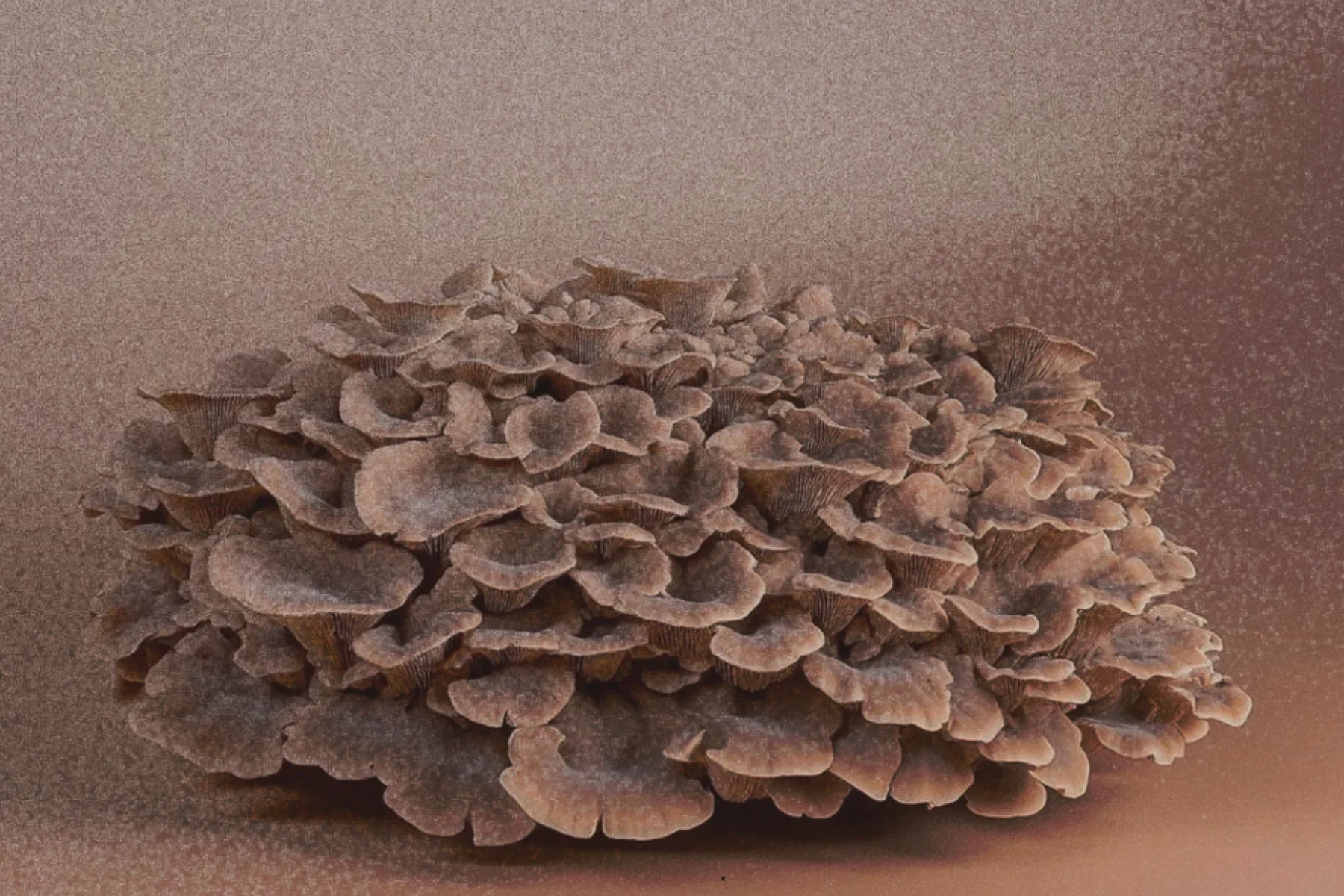
Many names, one species
Zhu Ling (China, 猪苓 - "pig mushroom", from the resemblance of the sclerotium to a piece of pig skin), chorei (Japan), umbrella polypore or lumpy bracket (English - from the shape of the above-ground fruiting body), żagiew wielogłowa (Poland, the official botanical name), żagwica wielogłowa, chropiatka wielogłowa, huba okółkowa (regionally). All these names refer to the same species: Polyporus umbellatus (synonym Grifola umbellata). In Poland żagiew wielogłowa is a rare species, under STRICT protection since 2014 (previously also protected) - the strictest protective status of all the mushrooms in the Aloha Fungi portfolio. Practical consequence: wild Polyporus from Polish forests is NOT PERMITTED for supplementation. All raw material on the European market comes from controlled cultivation in China and some European countries. The first written mention of Zhu Ling comes from Shen Nong Ben Cao Jing (The Divine Farmer's Materia Medica Classic), dated to the Han dynasty period (2nd century BCE - 2nd century CE), where it was classified in the category of "water-draining" mushrooms. It is a classic ingredient of two traditional TCM formulas: Zhu Ling Tang (Polyporus Decoction, described in Zhang Zhongjing's "Shang Han Lun", ca. 220 CE) and Wu Ling San (Five-Ingredient Powder with Hoelen).
What's in the extract?
Sclerotium extract of Polyporus umbellatus contains several groups of bioactive compounds whose actions have been separately characterised. PPS (Polyporus Polysaccharide), a β-1,3 and β-1,6 glucan-peptide complex with a molecular mass in the 30-100 kDa range - the main immunomodulating compound, activates TLR4 on macrophages [Li 2010, 2011]. Polyporusterones A-G - sterols specific to the species, described in 1992 (Ohsawa). Polyporusterones C, D, E, F and G show cytotoxic activity in vitro on the L1210 leukaemia line. Ergon (ergosta-5,7,22-trien-3-one), a steroid with described anti-aldosterone activity in vitro - the probable main "diuretic" component, acting through the renin-angiotensin-aldosterone system [Yuan 2004]. Ergosterol and provitamin D₂. Biotin at an exceptionally high concentration for a mushroom (historically important, as P. umbellatus was one of the first mushrooms in which it was detected). Standardisation of β-1,3/1,6-glucans in our extract above 30%.
Polyporus is one of the few functional mushrooms in which the phytotherapeutic raw material is the sclerotium, not the fruiting body. The sclerotium is a hard, underground tuber-like structure in which the mycelium stores reserves. It forms only in the presence of a host tree and a symbiotic mushroom of the Armillaria genus. Without this symbiosis the sclerotium does not form properly. The above-ground fruiting bodies are edible, but in classical TCM and Western phytotherapy what matters is mainly the sclerotium, because it is there that polyporusterones and PPS accumulate. At Aloha Fungi we work exclusively with sclerotium extract for this species.
Typical batch specification
Typical batch: β-glucans above 30% by Megazyme K-YBGL method (EUROFINS laboratory). PPS (polysaccharide-peptide, 30-100 kDa) 5–10% by chromatographic fractionation with SEC-MALS verification. Total polyporusterones 0.05–0.20% by HPLC. Ergon 0.1–0.5 mg/g by HPLC. Extraction ratio 10:1. Moisture ≤ 5%. Microbiology compliant with the European Pharmacopoeia (Ph.Eur.). Every batch comes with a full COA including test methodology. For partners requiring the highest precision, we offer DNA barcoding species verification (ITS1/ITS2) (Polyporus is confused with other Polyporus species with significantly different bioactive profiles).
Premium variant
★ Co-brandingFor brands that want to create their own functional-mushroom product and base it on our raw-material standard. You use extracts selected by Aloha Fungi, and once the criteria are met you can add our quality seal to your packaging.
MOQ: 5 kg
Our logo on your product →Raw material
Mature sclerotia (underground structures of the mycelium) of Polyporus umbellatus from controlled cultivation in non-industrial regions of China (Yunnan or Shaanxi), in symbiosis with honey mushrooms of the Armillaria genus. Without this two-species symbiosis the sclerotium does not form properly, so Polyporus cultivation requires specialist infrastructure (controlled oak or birch host trees, controlled colonisation by Armillaria, drained substrate). The sclerotia are dug up in autumn or early spring (vegetative season 18-24 months), sliced and dried at 40-50°C. Farm audits once per quarter, with microbiological tests of the substrate and species confirmation. In Poland Polyporus umbellatus has been under strict protection since 2014 (previously also protected), so wild harvesting from Polish forests is ABSOLUTELY not permitted - raw material for Aloha Fungi products comes exclusively from legal controlled cultivation, with a certificate of origin.
Extraction process
Milling of the dried sclerotia. Dual extraction: hot water extraction (β-glucans, PPS, high-molecular-weight polysaccharides) and ethanol extraction (polyporusterones, ergon, lipophilic sterols). PPS as a high-molecular-weight polysaccharide-peptide requires hot water (90°C, 4-6 hours). Polyporusterones and ergon as sterols are better extracted by low-temperature ethanol extraction (40°C). Combining the fractions in a precise ratio, concentration at reduced temperature, drying to powder form without maltodextrin.
Mechanisms described in the literature
The mechanisms of action of Polyporus umbellatus are, in a nephrological sense, better described than for most functional mushrooms, owing to the registration of PPS as an adjuvant drug in China. Three main lines of evidence.
- 01
Diuresis via aquaporins and the renin-angiotensin-aldosterone system
The best-described and most characteristic mechanism of Polyporus. Water extract of the sclerotium increases diuresis in animals and humans, but unlike pharmacological loop diuretics (furosemide) or thiazide diuretics (hydrochlorothiazide) it does not cause hypokalaemia or significant sodium loss. The mechanism is twofold: ergon exhibits anti-aldosterone activity (inhibiting sodium reabsorption in the distal tubules) [Yuan 2004]; polyporusterones and the aqueous fraction modify the expression of aquaporins AQP1, AQP2 and AQP3 in the renal medulla and the activity of the vasopressin V2 receptor [Zhang G et al. 2010, J Ethnopharmacol]. The Zhang 2010 study in Wistar rats showed that oral administration of the aqueous extract increases urine production without the loss of potassium and sodium typical of loop diuretics. Clinically: the diuresis is milder and more physiological than with pharmacological diuretics.
- 02
Immunomodulation via PPS and TLR4 activation
The second most important mechanism. PPS (Polyporus Polysaccharide) binds as an agonist to the TLR4 receptor on dendritic cells and macrophages [Li X et al. 2010, Cell Immunol 265(1):50-56; Li X & Xu W 2011, J Ethnopharmacol 135(1):1-6]. This activates NF-κB and MyD88 cytokine cascades, leading to polarisation of macrophages towards the M1 phenotype (pro-inflammatory, "attacking") and increased production of IL-1β, TNF-α, iNOS. PPS additionally activates the T-helper 1 response and NK cells. The mechanism is significantly different from the β-glucans of Reishi and Chaga (which act via Dectin-1), which is an argument for complementary combination. In China injectable PPS is registered as an adjuvant drug in chronic viral hepatitis B and in therapy of urinary-bladder cancer recurrence (as support after BCG therapy) [Zhang 2015]. This is analogous to PSK / krestin in Japan for Coriolus - the regulatory difference: injectable PPS is a DRUG in China, our oral extract is a food SUPPLEMENT in the EU.
- 03
Nephroprotection in preclinical models
The third mechanism. Polyporus shows a protective effect on the nephron in animal models of nephrotoxicity (ischaemia, nephrotoxic drugs), likely through modulation of inflammatory cytokines and oxidative stress in the renal tubules. In Italy, therapeutic mycology (the Stamets-Brigatti school) uses Polyporus as support in post-operative lymphoedema (especially after mastectomy), in lower-limb oedema and in mild premenstrual water retention - all observations are open clinical series; large RCTs are lacking. All observations require confirmation in larger clinical RCTs in humans.
★ Polyporus in the Aloha Fungi brand
This is how Polyporus looks as a finished product
Aloha Fungi is not only a B2B raw material — it's also our consumer brand. Here's how we use the same Polyporus extract in our own products LONGEVITY and PRIME on alohafungi.pl. You can distribute these products or draw inspiration from their form and communication for your own brand.

Consumer communication - what's allowed, what to avoid
Health claims on finished products are regulated by EU rules (1924/2006 and 432/2012). Polyporus has no authorised EFSA claim, so any phrasing about the product's effect on the body requires particular care in consumer communication. SPECIAL NOTE: injectable PPS (Polyporus Polysaccharide) is registered in China as an adjuvant DRUG in oncology (urinary-bladder cancer) and in chronic hepatitis B, which creates a unique regulatory situation - injectable PPS is a drug, our oral extract is a food supplement; these two products have DIFFERENT legal statuses and this boundary must not be blurred in consumer communication. The TCM tradition (Zhu Ling in Shen Nong Ben Cao Jing, 2nd century BCE) and the mechanisms described in peer-reviewed literature allow communication about Polyporus's traditional use, provided certain language boundaries are observed. Below are the boundaries that are legally permissible.
What works
Communication directions safe for partners
Traditional use in Traditional Chinese Medicine (Zhu Ling was traditionally used in the context of supporting the body's water drainage and toning the cleansing function, as a classic ingredient of the Zhu Ling Tang and Wu Ling San formulas) - using the form "traditionally used in the context of X", not "supports X". Description of bioactive compounds (β-glucans above 30%, PPS, polyporusterones, ergon). Description of the process (sclerotium extract, cultivation in symbiosis with honey mushrooms, hydroalcoholic extraction). Reporting studies ("the Zhang 2010 study describes the effect of the extract on aquaporin expression…", not "Polyporus increases diuresis"). Referring to the profile of functional markers (PPS as the signature polysaccharide-peptide) and to the position in the Chinese Pharmacopoeia (2020) as an official plant ingredient.
What to avoid
Strictly prohibited communication
Attributing to the product the treatment, prevention or alleviation of specific disease entities (covered by the ICD-10 classification system, including kidney disorders, heart failure, hypertension, nephrolithiasis, urinary-tract infections, viral hepatitis, urinary-bladder cancer, lymphoedema). Forbidden words: "treats", "cures", "prevents", "therapy", "natural pharmacological diuretic", "natural furosemide", "replaces diuretics", "flushes out toxins", "kidney detox", "PPS supplement" (injectable PPS is a DRUG in China, suggesting that our supplement is PPS is inconsistent with the declaration), "bladder-cancer adjuvant", "HBV hepatoprotector", "natural lymphoedema treatment", "clinical efficacy", "normalises", "dosage" (we use "recommended daily portion"). Regardless of any study quote, research must not be cited in a way that suggests an effect of the product on a specific condition.
Critical for Polyporus
Three specific regulatory risks:
1) Association with pharmacological diuretics. Many brands write "natural furosemide", "plant diuretic", "replaces diuretic drugs". This is inadmissible - diuretics are prescription drugs, and suggesting interchangeability of supplement and drug is a breach of 1924/2006.
2) Association with PPS / the Chinese drug. Injectable PPS is a Chinese oncology and hepatology drug. Suggesting that our oral extract is a "PPS supplement" is inconsistent with the declaration and misleading for the consumer.
3) Adjuvant oncology (bladder cancer). Chinese studies suggest PPS support after BCG therapy, but citing this in supplement marketing is interpretable as an oncological claim (ICD-10 C67). GIS and UOKiK actively prosecute such phrasing.
Extract applications
Polyporus is a specialist mushroom with a stronger pharmacological profile than most mushrooms in the portfolio, so its applications are narrower than for Reishi/Lion's Mane/Shiitake. Capsules - typically 300-500 mg extract per capsule (typical protocols 500-2000 mg/day, cycles of 4-8 weeks). Powder, in classic TCM formulas (Zhu Ling Tang, Wu Ling San - multi-component compositions), in infusions with other diuretic herbs (nettle, birch, couch grass). Polyporus has a sweetish-bland, slightly bitter, non-invasive flavour. Liquid extract (tincture), drops under the tongue for 30-60 seconds or into a drink. Chocolates and bars - Polyporus is rarely used in culinary products owing to its pharmacological profile (it is not a "food medicine" like Shiitake). "Lymph support", "edema relief", "kidney detox" supplements - typical positioning in the Western industry. NOTE: these claims in the EU require EFSA authorisation - section H. Polyporus is a mushroom of SHORT COURSES (4-8 weeks, cycles 2-3 times per year), not multi-year daily supplementation - this distinguishes it from Reishi/Lion's Mane/Shiitake.
Stability, storage and packaging
Stability: 24-36 months in original packaging, at room temperature, away from direct light. Inert packaging (nitrogen) on request. PPS is thermally stable up to about 90°C. Polyporusterones and ergon (sterols) are sensitive to oxidation - the extract should be packaged hermetically, without exposure to oxygen and UV light. The extract is moderately hygroscopic; we recommend tight sealing after sampling and storage below 60% relative humidity.
Precautions
Polyporus belongs to mushrooms with a STRONGER pharmacological profile than most functional mushrooms, so the list of precautions is longer. Safety in classical TCM use (short courses, low doses in formulas with other herbs) is good, but standalone use of a concentrated extract requires particular attention.
Absolute contraindications: pregnancy and breastfeeding (classical TCM advises against Polyporus in pregnancy due to strong draining action; lack of adequate RCTs). Renal insufficiency stage 3 and above (eGFR below 60 ml/min/1.73 m²) - Polyporus increases the filtration load on the nephron. Active heart failure with oedema requiring pharmacological treatment - Polyporus as a mild diuretic does not replace treatment for this patient group and may cloud the clinical picture. Children under 18 years of age (no safety studies). Known allergy to mushrooms of the Polyporaceae family. Post organ-transplant status with active immunosuppression - PPS activates TLR4 and innate immunity.
Consultation with a doctor required: antihypertensive drugs and diuretics (ACE inhibitors, sartans, beta blockers, thiazides, furosemide) - Polyporus is additive with pharmacological diuretics, which may lead to excessive diuresis, orthostatic hypotension and electrolyte disturbances. Blood-pressure and electrolyte monitoring, possible adjustment of drug dose by the attending physician. Anticoagulants and antiplatelet drugs (warfarin, NOACs, clopidogrel, ASA) - polysaccharides may mildly affect platelet aggregation. INR monitoring with warfarin. Chemotherapy and radiotherapy in progress - in China injectable PPS is used as an adjuvant, but oral Polyporus extract outside China requires consultation with the attending oncologist. Antidiabetic drugs - isolated studies describe a mild hypoglycaemic effect. Autoimmune diseases in remission - TLR4 activation may affect immunological activity. Predisposition to nephrolithiasis with a specific stone type (oxalate, struvite) - Polyporus increases diuresis (physiologically reducing the risk of stones), but requires concurrent good hydration (1.5-2 L of water daily). Planned surgeries - discontinue 14 days before the procedure.
Possible adverse effects: excessive diuresis and nocturia (passing urine at night) at too high a dose or with evening intake - which is why Polyporus is always taken in the morning or before noon, never in the evening. Orthostatic hypotension (dizziness on standing) when combined with antihypertensives without supervision. Mild electrolyte disturbances (rare, mainly with long-term use at high doses or in combination with loop diuretics) - which is why Polyporus is a mushroom of SHORT COURSES. As standard we include the key warnings on the consumer label of the final product, providing brands with specific wording compliant with EU food law.
Regulatory status
Polyporus umbellatus is traditionally present on the EU market as an ingredient in food supplements (documented use in TCM since the 2nd century BCE, registered in Chinese Pharmacopoeia 2020) and does not appear on the Novel Food list (regulation 2015/2283). Pre-1997 status is based on historical use in TCM and European trade.
SPECIAL NOTE: two regulatory situations
1) PPS as a drug in China. Injectable PPS (Polyporus Polysaccharide) is registered in China as an adjuvant DRUG (official Chinese Pharmacopoeia). In the EU PPS is not registered as a drug, and our oral extract does not contain a purified PPS fraction to pharmaceutical standard - it is a food supplement, NOT a drug. This difference is critical and must be preserved in consumer communication.
2) Strict protection in Poland since 2014. In Poland Polyporus umbellatus is under STRICT protection (previously also protected); the practical consequence for B2B: wild harvesting from Polish forests is ABSOLUTELY NOT PERMITTED. Raw material for Aloha Fungi products comes exclusively from legal controlled cultivation, with a certificate of origin.
Product notification to GIS is required under the food safety act. We support partners with technical documentation, certificates of origin and raw-material specification for notification, but we don't replace professional legal counsel.
★ Fastest path
Ready-made Aloha Fungi products for your business
Choose ready-made products from the LONGEVITY or PRIME line, or individual SKUs, and sell them under the Aloha Fungi brand in your channel.
This solution is for shops, clinics, practices and online partners who want to add functional mushrooms to their offer quickly, without building a product from scratch.
MOQ
1 500 PLN
Lead time
24h
First delivery
24h
Selected literature
10 sources
Selected literature
10 sources- Zhang G et al. (2010). Diuretic activity and expression of aquaporins AQP1/AQP2/AQP3 in the renal medulla, Wistar rat model. J Ethnopharmacol. PMID: 20083182.
- Zhang G et al. (2011). Inhibition of urinary-bladder carcinogenesis by aqueous extract and PPS of Polyporus umbellatus. Am J Chin Med. PMID: 21213404.
- Li X, Xu W, Chen J (2010). Polysaccharide from Polyporus umbellatus activates dendritic-cell maturation via TLR4. Cell Immunol. PMID: 20673881.
- Li X, Xu W (2011). Macrophage activation by the polysaccharide fraction of Polyporus umbellatus via TLR4. J Ethnopharmacol. PMID: 20600755.
- Zhang GW et al. (2015). Efficacy of Polyporus polysaccharide with BCG in inhibiting bladder cancer. Carbohydr Polym. PMID: 25542103.
- Ohsawa T et al. (1992). Characterisation of polyporusterones A-G and their cytotoxic activity in vitro. Chem Pharm Bull. PMID: 1571753.
- Yuan D et al. (2004). Anti-aldosterone component (ergon) in the sclerotium of Polyporus umbellatus. Biol Pharm Bull. PMID: 15187433.
- Zhao YY (2013). Traditional uses, phytochemistry and pharmacology of Polyporus umbellatus - a review. J Ethnopharmacol. PMID: 23811047.
- Liu L et al. (2025). Different Armillaria species in symbiosis affect yield and active-compound content of Polyporus umbellatus. Microorganisms.
- Brown GD, Gordon S (2003). Fungal β-glucans and mammalian immunity, Dectin-1 receptors. Nature. PMID: 12646903.