
Lion's Mane
Hericium erinaceus
Hydroalcoholic fruiting-body extract, with optional standardisation on β-glucans, hericenones and erinacines
Extract from Lion's Mane fruiting bodies from controlled semi-wild cultivation, audited regularly. Fractional hydroalcoholic extraction matched to the species: water draws out β-glucans and erinacines, while ethanol at lower temperatures extracts hericenones, which are aromatic and lipophilic.
Many names, one species
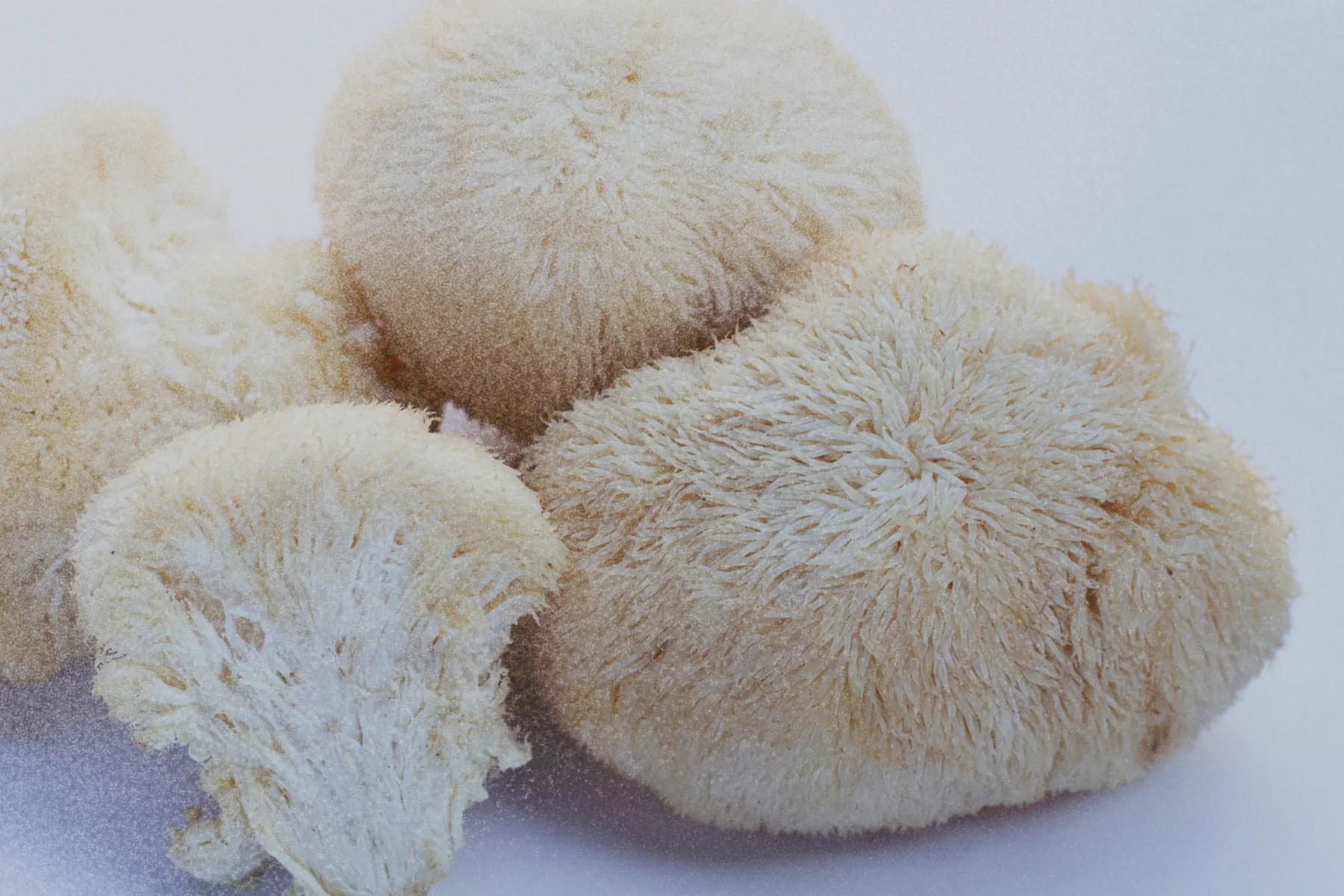
Yamabushitake (Japan, 山伏茸, "yamabushi monks' mushroom" — from the ascetic monks of the Shugendō tradition who included it in classical recipes), Hou tou gu (China, 猴頭菇, "monkey's head" — from the shape of the fruiting body), Lion's Mane (English, from the white cascading structure of spines resembling a lion's mane), soplówka jeżowata (Poland, the official botanical name). All these names refer to the same species: Hericium erinaceus. In Poland the species is strictly protected in the wild, so every extract on the European market comes from controlled cultivation, not from forest harvesting. We work with the traditional variety of H. erinaceus, cultivated on substrates of oak and beech sawdust, which delivers reproducibility in the profile of active compounds.
What's in the extract
Several groups of bioactive compounds with different polarities and different technological requirements have been identified in Hericium erinaceus fruiting-body extract. Hericenones A–K are aromatic compounds present mainly in the fruiting body. They are lipophilic, so hot water does not extract them, and high temperatures degrade them. They are best obtained through ethanol extraction at lower temperatures. Four variants (C, D, E and H) most strongly stimulate NGF synthesis in astrocyte cells in vitro [Kawagishi 1991]. Erinacines A–K are diterpenoids present mainly in the mycelium, and in measurable quantities also in the fruiting body. Erinacine A is one of the few mushroom compounds that crosses the blood-brain barrier in an animal model [Lai 2013]. β-1,3/1,6-glucans above 30% activate Dectin-1 and TLR4 on dendritic cells [Brown & Gordon 2003]. Additionally: ergosterol (vitamin D₂ precursor), ergothioneine (a natural antioxidant protecting mitochondria), essential amino acids, trace elements (zinc, selenium, copper).
Lion's Mane is the only functional mushroom in which two key classes of bioactive compounds are split between the fruiting body and the mycelium. The fruiting body provides hericenones and the full β-glucan profile. Mycelium grown on grain contains erinacines only partially and is 70–85% grain substrate, which dilutes the final effect. At Aloha Fungi we use exclusively fruiting-body extract in the EU. Outside the EU we also offer mycelium extracts of this species.
Typical batch specification
Typical batch: β-glucans above 30% by Megazyme K-YBGL method (EUROFINS laboratory). Hericenones 0.3–1.0% by HPLC if the batch is tested for this marker. Erinacines: not declared for fruiting-body extract, available only for a separate mycelial batch. Extraction ratio 10:1. Moisture ≤ 5%. Microbiology compliant with the European Pharmacopoeia (Ph.Eur.). Every batch comes with a full COA including test methodology.
Premium variant
★ Co-brandingFor brands that want to create their own functional-mushroom product and base it on our raw-material standard. You use extracts selected by Aloha Fungi, and once the criteria are met you can add our quality seal to your packaging.
MOQ: 5 kg
Our logo on your product →Raw material
Mature Lion's Mane fruiting bodies (Hericium erinaceus) from controlled cultivation in non-industrial, mountainous regions of China. Lion's Mane is not suitable for wild harvesting at production scale, so we work with cultivation on substrates of oak and beech sawdust enriched with bran. The composition of the woody raw material directly influences the profile of aromatic compounds in the fruiting body, which is why this type of substrate delivers reproducible hericenone content. Audit once per quarter. Harvest at full maturity, before sporulation (spines at full length, white colour without yellowing).
Extraction process
Milling of the raw material. Dual extraction: ethanol extraction at lower temperatures (hericenones are aromatic and lipophilic, hot water does not extract them and high temperatures degrade them) and hot water extraction (β-glucans, erinacines, ergothioneine). Combining the fractions in a precise ratio, concentration, drying to powder form without maltodextrin.
Hericium erinaceus — fruiting body from our controlled cultivation
Mechanisms described in the literature
Current research on Lion's Mane (mainly in vitro and in animal models, with a few clinical RCTs in humans) describes three principal mechanisms of action.
- 01
Hericenones and NGF synthesis in glial cells
The best-described and historically first mechanism. In Kawagishi's 1991 studies, hericenones C, D, E and H isolated from Hericium erinaceus stimulated NGF (Nerve Growth Factor) synthesis in mouse astrocyte cultures in a dose-dependent manner, releasing 10 to 45 pg/ml. NGF is a protein essential for the differentiation, maturation and survival of cholinergic neurons. Mori et al. [2009] conducted an RCT (n=30, 16 weeks, 3 g of powdered fruiting body daily) measuring the HDS-R scale, with the authors reporting an increase of 1.55 points vs. placebo (p<0.05). Four weeks after discontinuation, the difference faded. n=30 is a small group and the study requires replication.
Limitation of the mechanism: hericenones poorly cross the blood-brain barrier after oral administration. The central effect probably proceeds indirectly, through modulation of the peripheral nervous system or via influence on gut wall cells.
- 02
Erinacines, BDNF and crossing the blood-brain barrier
A mechanism discovered a few years after hericenones, described under a distinct biological profile. Erinacines are small-molecule diterpenoids that, unlike hericenones, cross the blood-brain barrier in an animal model. In the Lai 2013 study (rats), oral supplementation with Lion's Mane increased NGF levels in the hippocampus after 7 days. Erinacine A also showed an effect on BDNF (Brain-Derived Neurotrophic Factor), the second neurotrophic factor relevant for neurogenesis and synaptic plasticity. The mechanism is fully described in animal models — large human RCTs in this specific context are not yet available.
- 03
β-glucans, the gut-brain axis and microbiota modulation
The newest in the literature, the fastest-growing direction of research. Lion's Mane β-1,3/1,6-glucans activate Dectin-1 and TLR4 receptors on dendritic cells of the gut wall [Brown & Gordon 2003]. This triggers cytokine cascades which, via the vagus nerve and metabolic signalling, may influence central neurotransmission. Lion's Mane also shows prebiotic action towards Lactobacillus and Bifidobacterium. Nagano et al. [2010] conducted an RCT in a group of women (n=30, 4 weeks, 1.5 g/day) with the authors reporting changes on standardised self-rating scales of mood and tension. The sample is small and narrowly defined by gender — larger RCTs are required.
★ Lion's Mane in the Aloha Fungi brand
This is how Lion's Mane looks as a finished product
Aloha Fungi is not only a B2B raw material — it's also our consumer brand. Here's how we use the same Lion's Mane extract in our own products LONGEVITY and PRIME on alohafungi.pl. You can distribute these products or draw inspiration from their form and communication for your own brand.
 LONGEVITY
Lion's Mane proszek 50 g
Proszek 50 g
Ekstrakt z owocnika Soplówki Jeżowatej w proszku. Nadaje się do odmierzania i mieszania z napojem.
119,00 złShop → LONGEVITY
Lion's Mane krople 30 ml
Krople 30 ml
Płynny ekstrakt o łagodnym profilu smakowym. Można odmierzać pipetą i dodawać do kawy lub matchy.
169,00 złShop → LONGEVITY
Lion's Mane kapsułki 90 szt.
Kapsułki 90 szt.
Ekstrakt z Lion's Mane z linii LONGEVITY w wygodnej formie kapsułkowej.
129,00 złShop → PRIME
PRIMELion's Mane proszek 50 g
Proszek 50 g
Wielofrakcyjny ekstrakt PRIME w proszku. Profil markerów i ich wartości są określone w specyfikacji partii.
189,00 złShop → PRIME
PRIMELion's Mane kapsułki 90 szt.
Kapsułki 90 szt.
Wielofrakcyjny ekstrakt PRIME w kapsułkach. Opakowanie zawiera 90 sztuk.
189,00 złShop →
Consumer communication — what's allowed, what to avoid
Health claims on finished products are regulated by EU rules (1924/2006 and 432/2012). Lion's Mane has no authorised EFSA claim — any phrasing about the product's effect on the body requires particular care in consumer communication. The TCM tradition, the Japanese Shugendō tradition and the mechanisms described in peer-reviewed literature allow communication about the traditional use of Lion's Mane — provided certain language boundaries are observed. Below are the boundaries that are legally permissible.
What works
Communication directions safe for partners
Traditional use in Traditional Chinese Medicine and the Japanese Shugendō tradition (Lion's Mane was traditionally used in the context of mental work and stomach condition, in the classical recipes of yamabushi monks) — using the form "traditionally used in the context of X", not "supports X". Description of bioactive compounds (β-glucans above 30%, hericenones, erinacines). Description of the process (fruiting-body extract, fractional hydroalcoholic extraction). Reporting research findings ("study X from year Y describes…", not "Lion's Mane does Y").
What to avoid
Strictly prohibited communication
Attributing to the product the treatment, prevention or alleviation of specific disease entities (covered by the ICD-10 classification system, including neurodegenerative conditions, attention disorders, mood disorders, post-infectious syndromes and autoimmune diseases). Forbidden words: "treats", "cures", "prevents", "therapy", "regenerates nerves", "boosts IQ", "clinical efficacy", "replaces medicines", "normalises", "dosage" (in consumer communication "recommended daily portion" is used). Regardless of any study quote, research must not be cited in a way that suggests the product acts on a specific ailment.
Extract applications
Lion's Mane extract works technologically in most formats. Capsules — typically 300–500 mg extract per capsule. Powder — in sachets, blends with coffee, cacao or matcha, in oatmeal and smoothies. Hericenones are lipophilic, so they are better absorbed in the presence of fat (MCT, ghee, nut butter, avocado, plant cream), which is worth communicating to consumers of powders and blends. Liquid extract (tincture) — drops under the tongue for 30–60 seconds or into a drink. Chocolates and bars — flavour tolerance 1–3% by weight; Lion's Mane has a mild flavour (slightly milky, without the bitterness characteristic of Reishi), so it changes little in the final recipe. Coffee and cacao — natural flavour synergy, blends without any obvious bitterness signal. Cold RTD beverages — low solubility in cold water without an emulsifier; requires a technological solution.
Stability, storage and packaging
Stability: 24–36 months in original packaging, at room temperature, away from direct light. Inert packaging (nitrogen) on request. Lion's Mane is slightly hygroscopic (attracts moisture from the air), so we recommend tight sealing after sampling and storage below 60% relative humidity, particularly in the production of bulk powders.
Precautions
A known allergy to mushrooms of the Hericiaceae family is an absolute contraindication. The literature describes a single case of acute respiratory distress syndrome (ARDS) after consumption of a raw fruiting body [Nakatsugawa 2003] — the mechanism is probably allergic and individual. Lion's Mane requires caution in people after organ transplants with active immunosuppression (cyclosporine, tacrolimus, mycophenolate) and in autoimmune diseases in an active flare (β-glucans activate Dectin-1 and TLR4). With anticoagulants and antiplatelet drugs, consultation with the treating physician is recommended. With hypoglycaemic drugs, glycaemic monitoring is recommended. SSRI/SNRI antidepressants — no clinically significant interactions have been described, but given Lion's Mane's effect on NGF and central neurotransmission, we recommend consulting the treating psychiatrist before including it in a protocol. Before planned surgeries, discontinue for at least 14 days. Not recommended during pregnancy, breastfeeding or for people under 18 years of age. As standard, we include the key warnings on the consumer label of the final product — we provide brands with specific wording compliant with EU food law.
Regulatory status
Hericium erinaceus is traditionally present on the EU market as an ingredient in food supplements and does not appear on the Novel Food list (regulation 2015/2283). Its pre-1997 status in the EU is not formally confirmed by EFSA — member states interpret this more loosely or more strictly (e.g. Germany is more restrictive than Poland, but Lion's Mane is stably available there). Product notification to GIS (Polish Chief Sanitary Inspectorate) is required under the food safety act. We support partners with technical documentation and raw-material specification for notification — but we don't replace professional legal counsel.
★ Fastest path
Ready-made Aloha Fungi products for your business
Choose ready-made products from the LONGEVITY or PRIME line, or individual SKUs, and sell them under the Aloha Fungi brand in your channel.
This solution is for shops, clinics, practices and online partners who want to add functional mushrooms to their offer quickly, without building a product from scratch.
MOQ
1 500 PLN
Lead time
24h
First delivery
24h
Selected literature
9 sources
Selected literature
9 sources- Mori K et al. (2009). RCT n=30, 16 weeks, 3 g of powdered fruiting body daily, HDS-R measurement, increase of 1.55 pts vs. placebo. Phytother Res. PMID: 19133611.
- Nagano M et al. (2010). RCT n=30 women, 4 weeks, 1.5 g/day, self-rating scale measurement. Biomed Res. PMID: 20834180.
- Docherty S et al. (2023). RCT n=41 healthy young adults, single 1.8 g dose, Stroop test after 60 minutes. Nutrients. PMID: 38004235.
- Kawagishi H et al. (1991). Hericenones C, D and E with stimulation of NGF synthesis. Tetrahedron Letters.
- Lai PL et al. (2013). Neurotrophic properties of Lion's Mane, erinacine A crosses the blood-brain barrier in a rat model. Int J Med Mushrooms. PMID: 24266378.
- Brown GD, Gordon S (2003). Fungal β-glucans and mammalian immunity, Dectin-1 receptors. Nature. PMID: 12646903.
- Nakatsugawa M et al. (2003). ARDS after raw Hericium erinaceus fruiting body, a single case of allergy. Intern Med. PMID: 14714960.
- Friedman M (2015). Chemistry and health-promoting properties of Hericium erinaceus fruiting bodies and mycelia. J Agric Food Chem. PMID: 26244378.
- Kała K, Cicha-Jeleń M, Sułkowska-Ziaja K et al., Muszyńska B (2025). Influence of Plant-Based Substrate Composition and Extraction Method on Accumulation of Bioactive Compounds in Hericium erinaceus. Molecules — Polish research on the influence of plant-based substrate composition (including grain substrate) on the accumulation of bioactive compounds. Department of Pharmaceutical Botany, Jagiellonian University Medical College.