
Maitake
Grifola frondosa
Aqueous fruiting-body extract with optional standardisation on β-glucans, D-fraction and SX-fraction
Extract from Grifola frondosa fruiting bodies grown under controlled conditions on substrates of beech and oak sawdust enriched with bran. Fractional water extraction as the basis, with the option of isolating the D fraction (a polysaccharide-peptide of ~1000 kDa) and SX fraction (a peptidoglycan of ~20 kDa).
Many names, one species
Maitake (Japan, 舞茸 — "dancing mushroom", from the historical tradition of dancing with joy upon finding a rare fruiting body in the forest), Hui shu hua (China, 灰树花 — "grey tree flower"), Hen of the woods, Ram's head, King of mushrooms (English — forest hen, ram's head, king of mushrooms, after the shape of the fruiting body and its rarity), żagwica listkowata (Poland, the official botanical name from the "leaf-like" arrangement of caps in a rosette on a common stem). The Latin Grifola comes from the Italian grifone (the mythical griffin, half lion, half eagle), frondosa means "leafy". All these names refer to the same species: Grifola frondosa. In Poland the species was first identified by Stanisław Domański in 1967. Since 2014, żagwica listkowata has been partially protected with status V (endangered with extinction) on the Polish Red List of plants and fungi. This means all extracts on the European market come from controlled cultivation, never from Polish forests.
What's in the extract
Grifola frondosa is among the most chemically well-characterised functional mushrooms. D-fraction (and its purified form MD-fraction) is a polysaccharide-peptide with a mass of ~1000 kDa, structurally a β-1,6 glucan with β-1,3 side branches bound to peptides. It is the main immunoactive fraction, described by Hiroaki Nanba from Kobe Pharmaceutical University in the years 1986–1993. SX-fraction is a glycoprotein of ~20 kDa, studied since 2001 by S. Konno of New York Medical College, described as affecting the insulin signalling pathway in skeletal muscle cells [Konno 2013, Int J Gen Med]. Grifolan (GRN) is a high-molecular-weight β-glucan (500–800 kDa), the second-most-important activator of innate immunity after D-fraction. X-fraction is a peptidoglycan described in 1994 (Kubo). Standardisation of β-1,3/1,6-glucans in our extract is above 30%. Ergosterol and provitamin D₂ (fungal sterols). Trehalose (a disaccharide with prebiotic action toward Bifidobacterium and Lactobacillus). Essential amino acids, including glutamic and aspartic acids responsible for the umami taste. Trace elements (zinc, copper, phosphorus, magnesium), B vitamins.
Maitake is one of the few functional mushrooms in which TWO different polysaccharides with different mechanisms have been isolated and characterised: D-fraction (β-glucan-peptide, ~1000 kDa, immunomodulation via Dectin-1) and SX-fraction (a peptidoglycan, ~20 kDa, modulation of insulin signalling in muscle cells). This duality is why a premium Maitake extract is not a single process but fractionation with different extraction protocols. Mycelium grown on grain does not contain both fractions in the appropriate profile. At Aloha Fungi we use exclusively fruiting-body extract for this species.
Typical batch specification
Typical batch: β-glucans above 30% by Megazyme K-YBGL method (EUROFINS laboratory). D-fraction (polysaccharide-peptide ~1000 kDa) 5–10% by chromatographic fractionation with SEC-MALS verification. SX-fraction (peptidoglycan ~20 kDa) 1–3% by fractionation. Total polysaccharides 30–40%. Extraction ratio 10:1. Moisture ≤ 5%. Microbiology compliant with the European Pharmacopoeia (Ph.Eur.). Every batch comes with a full COA including test methodology. For partners requiring the highest precision, we offer DNA barcoding ITS1/ITS2 species verification on request.

Premium variant
★ Co-brandingFor brands that want to create their own functional-mushroom product and base it on our raw-material standard. You use extracts selected by Aloha Fungi, and once the criteria are met you can add our quality seal to your packaging.
MOQ: 5 kg
Our logo on your product →Raw material
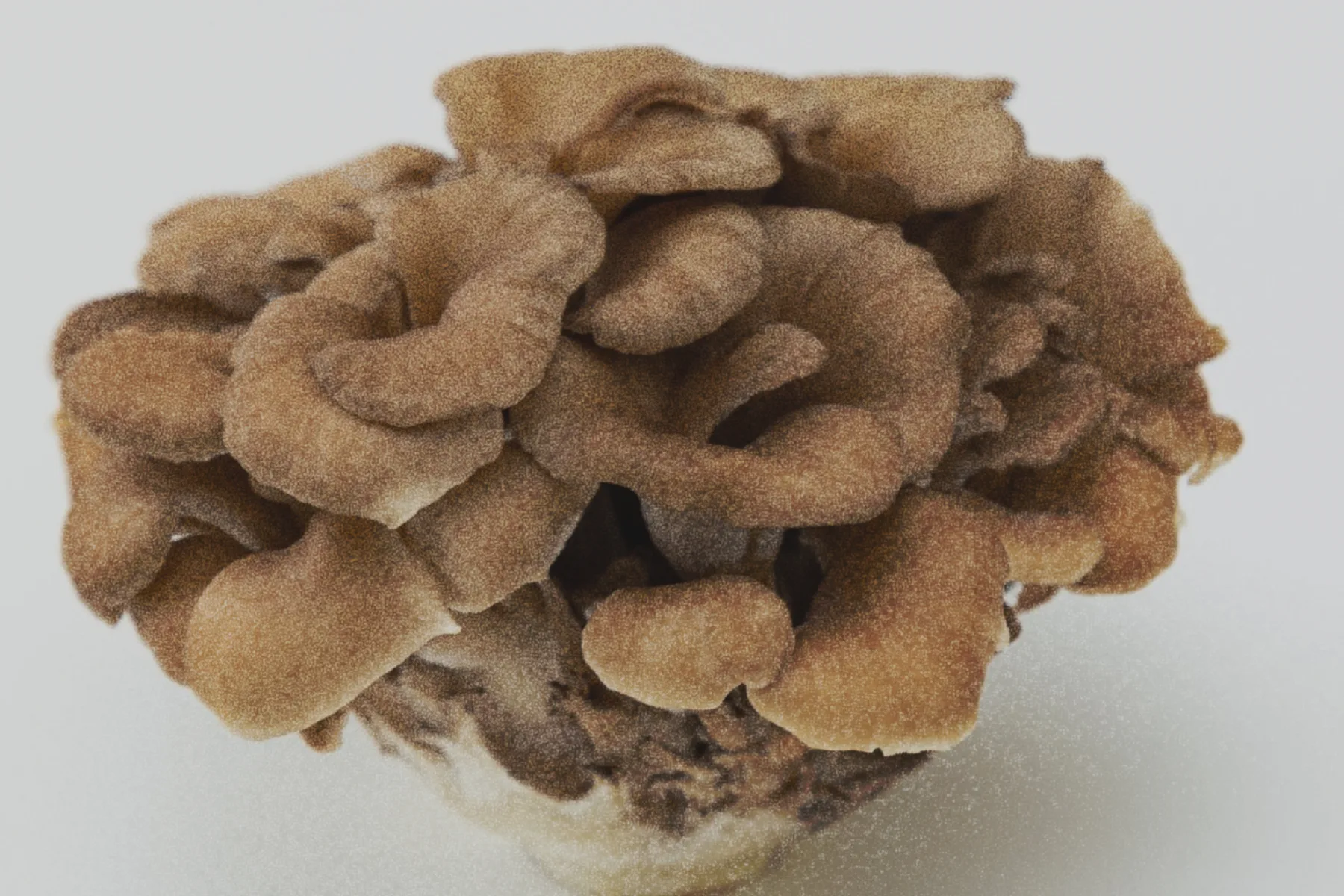
Mature Maitake fruiting bodies (Grifola frondosa) from controlled cultivation in non-industrial regions of China. Maitake is not suitable for wild harvesting at production scale — in Poland it is under partial protection since 2014, and in Japan and the USA wild Maitake is rare and extremely expensive (historically called "mushroom worth its weight in silver"). Cultivation on substrates of beech or oak sawdust enriched with bran, in sterile climate chambers. Cultivation time from inoculation to harvest: 60–90 days. Farms are audited quarterly, with substrate microbiology testing. Harvest at full maturity (the rosette of caps fully developed, grey-brown to brown in colour), before spore release.
Extraction process
Milling of dried fruiting bodies. Main process: hot water extraction as the base for β-glucans, D-fraction, MD-fraction, grifolan and other high-molecular-weight polysaccharides. Additional chromatographic fractionation for isolation of SX-fraction (peptidoglycan, 20 kDa, requires a separate protocol). Combining the fractions in a precise ratio depending on the product grade, concentration at reduced temperature, drying to powder form without maltodextrin.
Grifola frondosa — fruiting body from our controlled cultivation
Mechanisms described in the literature
Current research on Grifola frondosa (more than 1500 peer-reviewed publications, including in vitro, animal models, and a few small clinical RCTs in humans) describes three principal mechanisms of action.
- 01
D-fraction and innate immunity
The best-described mechanism. D-fraction (a β-1,6 glucan with β-1,3 side branches bound to peptides, ~1000 kDa) binds to the Dectin-1 receptor and, as a co-receptor, TLR2 on dendritic cells, macrophages and monocytes [Brown & Gordon 2003]. This triggers the NF-κB signalling cascade, dendritic cell maturation and antigen presentation to T lymphocytes. A mechanism unique to D-fraction (unlike most other fungal polysaccharides, e.g. lentinan from Shiitake) is efficacy after ORAL administration — it does not require an injectable form. The phase I/II RCT by Deng et al. [2009, Memorial Sloan Kettering Cancer Center] in 34 women after breast cancer treatment (3 weeks, dose escalation from 0.1 to 5 mg/kg twice daily) noted a statistically significant effect on immunological parameters (p<0.0005), with a non-linear, inverted-U-shaped dose-response curve. The sample is small and the study needs replication in larger groups.
- 02
SX-fraction and the insulin signalling pathway
The second most important mechanism, and from the perspective of contemporary clinical dietetics often the most relevant. SX-fraction (a peptidoglycan of ~20 kDa) influences the insulin signalling pathway in in vitro studies on L6 skeletal muscle cells: it improves insulin receptor function, increases the activity of IRS-1 (Insulin Receptor Substrate 1) and Akt (protein kinase B), which leads to GLUT4 translocation and uptake of glucose from blood into the cell [Konno et al. 2013, Int J Gen Med 6:181-187]. In animal models SX-fraction reduced fasting glycaemia in type 2 diabetes. Evidence in humans is preliminary: a pilot by Konno 2001 (n=6 patients with type 2 diabetes, 2 months, reduction of glycaemia and HbA1c). An open-label trial by Chen et al. 2010 (n=80 women, the mechanism studied by the researchers in the context of hormonal-metabolic disorders), without randomisation or placebo, requires replication in controlled RCTs. The molecular mechanism is well described in vitro; strong clinical RCTs in humans are not yet available.
- 03
Modulation of the lipid profile and blood pressure
The third mechanism. In animal-model studies SX-fraction mildly lowered systolic blood pressure, probably through modulation of the renin-angiotensin-aldosterone system and increased nitric oxide (NO) activity. Open-label observations in humans (Manohar 2002, Mayell 2001) described changes in the lipid profile (LDL cholesterol, triglycerides) after 8–12 weeks of supplementation. β-glucans additionally serve as a prebiotic, fermenting in the large intestine into short-chain fatty acids that further influence lipid metabolism in the liver. All observations require confirmation in larger clinical RCTs in humans.
★ Maitake in the Aloha Fungi brand
This is how Maitake looks as a finished product
Aloha Fungi is not only a B2B raw material — it's also our consumer brand. Here's how we use the same Maitake extract in our own products LONGEVITY and PRIME on alohafungi.pl. You can distribute these products or draw inspiration from their form and communication for your own brand.

Consumer communication — what's allowed, what to avoid
Health claims on finished products are regulated by EU rules (1924/2006 and 432/2012). Maitake has no authorised EFSA claim, so any phrasing about the product's effect on the body requires particular care in consumer communication. The Japanese Kampo tradition (an adaptation of TCM from the 7th century) and, since Nanba's 1986 research, contemporary phytotherapy, allow communication about Maitake's traditional use, provided certain language boundaries are observed. Below are the boundaries that are legally permitted.
What works
Communication directions safe for partners
Traditional use in the Japanese Kampo tradition and modern phytotherapy (Maitake was traditionally used in the context of supporting digestion, overall condition in the second half of life, and as a tonic during periods of convalescence) — using the form "traditionally used in the context of X", not "supports X". Description of bioactive compounds (β-glucans above 30%, D-fraction, SX-fraction, grifolan). Description of the process (fruiting-body extract, fractional extraction, isolation of D-fraction and SX-fraction). Reporting research findings ("study X from year Y describes…", not "Maitake does Y"). Reference to the profile of functional markers (D-fraction and SX-fraction as polysaccharides unique to the genus).
What to avoid
Strictly prohibited communication
Attributing to the product the treatment, prevention or alleviation of specific disease entities (covered by the ICD-10 classification system, including type 1 and 2 diabetes, insulin resistance, metabolic syndrome, polycystic ovary syndrome, oncological conditions, autoimmune diseases, hypercholesterolaemia, arterial hypertension). Forbidden words: "treats", "cures", "prevents", "therapy", "lowers blood sugar", "replaces insulin", "replaces metformin", "treats PCOS", "oncology adjuvant" (without prescription and supervision), "clinical efficacy", "normalises", "dosage" (in consumer communication "recommended daily portion" is used). Regardless of any study quote, research must not be cited in a way that suggests an effect of the product on a specific condition.
Critical for Maitake
Three specific regulatory risks:
1) Association with diabetes. Many brands write "Maitake for diabetes" or "natural metformin". This is impermissible — diabetes is an ICD-10 disease entity E10-E14, treated by a diabetologist. UOKiK and GIS actively pursue such phrasings.
2) Oncology association. In Japanese oncology Maitake is used as a chemotherapy adjuvant, BUT in the EU it has no oncology authorisation. Phrasings such as "support in cancer", "chemo adjuvant", "cancer treatment" are prohibited.
3) PCOS association. Chen 2010 is an open-label study without randomisation — writing "Maitake for PCOS" is a functional claim toward ICD-10 E28.2.
Extract applications
Maitake extract works technologically in most formats. Capsules — standard fill 300–500 mg of extract — the most popular format for metabolic protocols. Powder — in pre-meal blends (15–30 min before the main carbohydrate meal), in soups (a classic Japanese application), broths, sauces. Maitake has an umami taste (from glutamate and aspartate) and naturally complements savoury dishes. Liquid extract (tincture) — drops under the tongue for 30–60 seconds or into a drink. Chocolates and bars — flavour tolerance 1–3% by weight, the taste does not interfere with sweet products. Coffee and cacao — weaker flavour synergy than Reishi/LM/Chaga (umami and bitter clash) — requires appropriate compositions. Cold RTD beverages — medium solubility in cold water. Maitake is a popular ingredient in products positioned as "metabolic support", "blood sugar balance" (NOTE: these claims in the EU require EFSA authorisation — section H).
Stability, storage and packaging
Stability: 24–36 months in original packaging, at room temperature, away from direct light. Inert packaging (nitrogen) on request. Maitake is moderately hygroscopic — we recommend tight closure after sampling and storage below 60% relative humidity, especially in the production of loose powders. D-fraction and SX-fraction are thermally stable up to about 80°C (above which they start to degrade). This matters for the production of broths and soups — add after cooking, not before.
Precautions
Maitake has a long history of safety as an edible mushroom, but because of the hypoglycaemic mechanism of SX-fraction and the immunoactive D-fraction it requires specific warnings.
Critical warning — diabetes with pharmacological treatment
Patients with type 1 and type 2 diabetes taking insulin, metformin, sulfonylureas, gliptins or GLP-1 agonists must consult a diabetologist BEFORE starting supplementation. Maitake potentially adds to hypoglycaemic drugs — glycaemic monitoring is mandatory, the drug dose may need adjustment under physician supervision. DO NOT start on your own.
Absolute contraindications: status post organ transplant with active immunosuppression (cyclosporine, tacrolimus, mycophenolate), active autoimmune diseases in flare (systemic lupus, severe RA, active ulcerative colitis), children under 18 years of age (no safety studies), known allergy to mushrooms of the polypore family.
Require consultation with a physician: reactive hypoglycaemia without diabetes (careful start from a low dose), anticoagulants and antiplatelet drugs (warfarin, NOACs — INR monitoring), antihypertensive drugs (ACE inhibitors, sartans, beta-blockers, diuretics — blood pressure monitoring), ongoing chemotherapy and radiotherapy (standard in Japan; in the EU requires consultation with an oncologist). Pregnancy and breastfeeding — no adequate RCTs, we recommend waiting until breastfeeding has ended. Before planned surgeries, discontinue Maitake for at least 14 days before the procedure. As standard, we include the key warnings on the consumer label of the final product — we provide brands with specific wording compliant with EU food law.
Regulatory status
Grifola frondosa is traditionally present on the EU market as an ingredient in food supplements (documented use in the Japanese Kampo tradition since the 7th century AD, in European phytotherapy since the 1990s) and does not appear on the Novel Food list (regulation 2015/2283). The pre-1997 status is based on historical use, but is not formally confirmed by EFSA — different member states interpret this differently. NOTE: In Poland Grifola frondosa is under partial species protection with status V (endangered with extinction) on the Polish Red List of plants and fungi (since 2014; previously, 1983–2014, it was strictly protected). Practical consequence for B2B: wild harvesting from Polish forests is NOT PERMITTED. Raw material for Aloha Fungi products comes exclusively from controlled cultivation with a legal certificate. Product notification to GIS (Polish Chief Sanitary Inspectorate) is required under the food safety act. We support partners with technical documentation, certificates of origin and raw-material specification for notification — but we don't replace professional legal counsel.
★ Fastest path
Ready-made Aloha Fungi products for your business
Choose ready-made products from the LONGEVITY or PRIME line, or individual SKUs, and sell them under the Aloha Fungi brand in your channel.
This solution is for shops, clinics, practices and online partners who want to add functional mushrooms to their offer quickly, without building a product from scratch.
MOQ
1 500 PLN
Lead time
24h
First delivery
24h
Selected literature
9 sources
Selected literature
9 sources- Deng G et al. (2009). Phase I/II RCT, n=34 women after breast cancer treatment, 3 weeks, dose escalation, immunological parameters. J Cancer Res Clin Oncol. PMID: 19253021.
- Konno S (2020). SX-fraction: molecular mechanisms and research directions. World J Diabetes. PMID: 33384765.
- Konno S et al. (2013). Hypoglycaemic mechanism of SX-fraction, insulin signalling pathway. Int J Gen Med. PMID: 23569395.
- Konno S et al. (2001). Pilot, n=6, type 2 diabetes, 2 months, HbA1c reduction. Diabet Med. PMID: 11903406.
- Kubo K et al. (1994). First described hypoglycaemic activity of Maitake. Biol Pharm Bull. PMID: 7820117.
- Chen JT et al. (2010). Open-label trial, n=80 women, ovulation induction, combination with clomiphene. J Altern Complement Med.
- Kodama N et al. (2003). D-fraction and NK activity in oncology patients. J Med Food. PMID: 14977447.
- Brown GD, Gordon S (2003). Fungal β-glucans and mammalian immunity, Dectin-1. Nature. PMID: 12646903.
- Wu JY et al. (2021). Bioactive constituents and medicinal values of Grifola frondosa. Foods.