
Drying and carriers in mushroom extracts
A concentrated aqueous mushroom extract is sticky, viscous and hygroscopic, it won't turn into a dry powder on its own. A carrier is sometimes technologically necessary. The problem starts when a technical solution becomes a way to dilute the product.
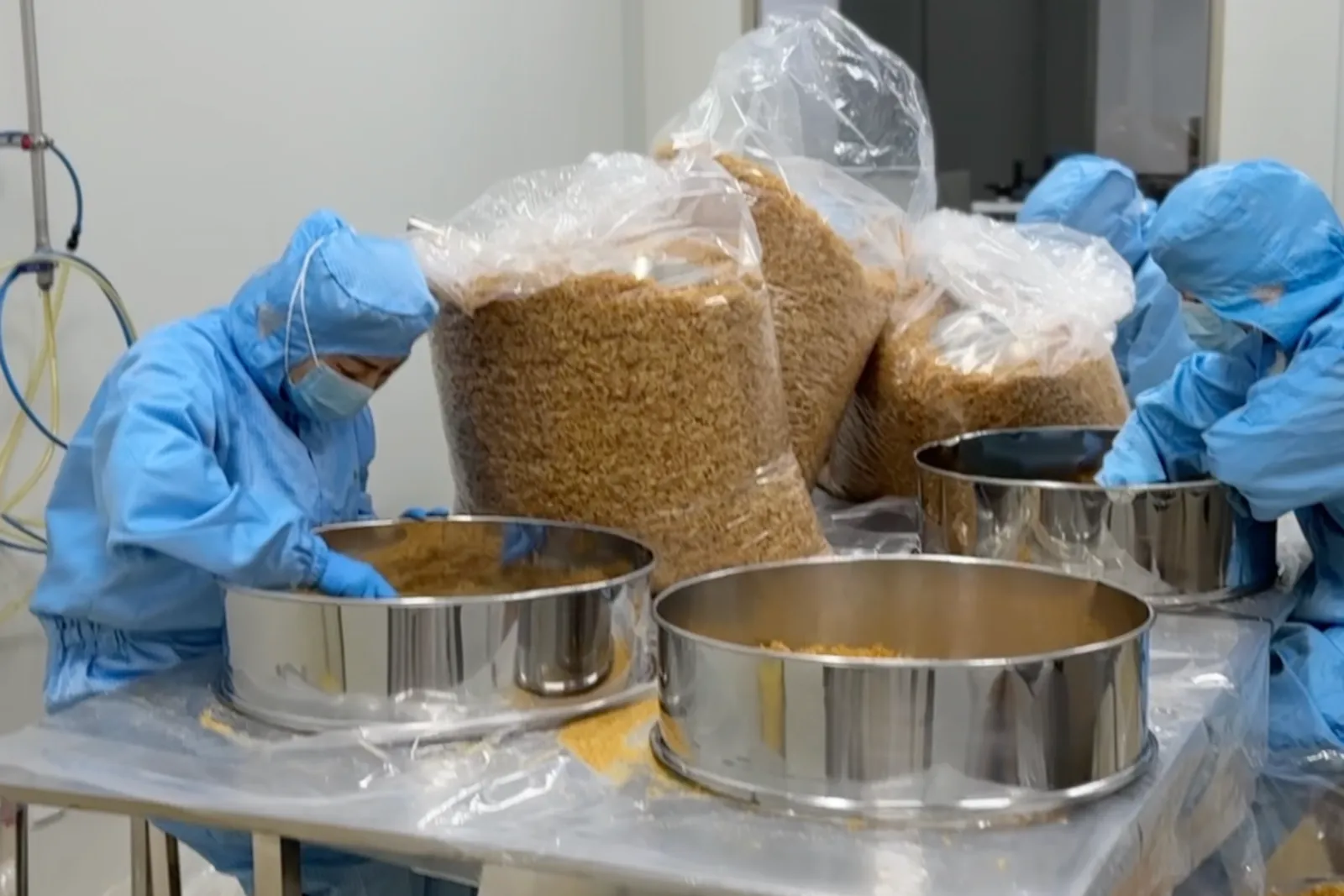
Maltodextrin is the most common carrier in mushroom extracts.
Version 1.0 · Published: 25.05.2026
Subject-matter reviewer: Aloha Fungi Team
A concentrated aqueous mushroom extract doesn’t look like the dry powder on the label. It’s viscous, sticky and hygroscopic · it attracts water and resists drying. That’s why a carrier enters the production process: maltodextrin, starch, gum arabic. The carrier in itself isn’t the problem. The problem starts when a technical solution becomes a margin lever · and the customer buys a powder in which the extract is a minority of the mass.
In short (60 seconds)
- 🥄 Extract doesn’t emerge as a powder. After water extraction and concentration we get a sticky, hygroscopic material · drying requires technology.
- ⚗️ A carrier is sometimes necessary. Maltodextrin, starch and gum arabic assist spray drying, improve flowability and stabilise the powder.
- ⚠️ The line is thin. 5–10% carrier for a technological purpose ≠ a product in which 30%+ of the mass is filler.
- 📊 Carriers change the numbers. A 500 mg capsule with 30% maltodextrin = effectively 350 mg of extract and 150 mg of filler.
- 🔬 They also affect analytics. Additional carbohydrates from a carrier can obscure the results of general polysaccharide assays (if a brand doesn’t distinguish mushroom β-glucans).
- 🔍 The key questions: How much carrier? Which one? Why was it used? Does the label say so?
Why doesn’t an extract emerge as a powder?
In marketing communication, mushroom extracts often look very simple.
Mushroom. Extraction. Powder. Capsule. Label.
In reality, the process is more complex.
If we’re talking about water extraction, the mushroom raw material is exposed to water under defined time and temperature conditions. The aim is to obtain water-soluble fractions, including part of the polysaccharides and beta-glucans.
After extraction we get a liquid.
That liquid has to be filtered, purified and concentrated. Only then does the stage that’s critical for the final product’s quality begin: drying.
And here comes the challenge.
A concentrated mushroom extract often doesn’t behave like a material that can be easily turned into a beautiful, dry, stable powder.
It’s sticky. It’s hard to handle. It can adhere to surfaces. It can absorb moisture from the air. It can clump. It can be hard to dose evenly.
That’s why drying technology matters.
Why is a carrier added?
A carrier is added to help transform a concentrated extract into a stable powder.
In practice a carrier can:
- improve drying efficiency,
- reduce material viscosity,
- limit adhesion to equipment,
- improve powder flowability,
- reduce hygroscopicity,
- make encapsulation easier,
- improve product stability,
- help achieve a reproducible production result.
These are real technological functions.
Without a carrier, some extracts would be difficult or very expensive to dry. Production could yield high losses, low reproducibility and problems with the physical quality of the powder.
That’s why the mere presence of a carrier isn’t automatically a sign of poor quality. The question isn’t: “is there a carrier?”
The question is:
💡 How much is there, what kind of carrier is it, and does the customer know it’s in the product?
Carrier as technology vs carrier as dilution
There’s a big difference between a carrier used honestly and a carrier used as a way to lower the product’s cost.
In the first case the carrier is a technological addition. There’s only as much as needed to dry the extract, stabilise it and continue production. The manufacturer knows why they use it. The brand knows how much there is. The documentation describes the composition. Communication doesn’t pretend the product is something it isn’t.
In the second case the carrier becomes a way to dilute the extract. The more cheap carrier, the lower the cost per kilogram of finished powder. The product looks like an extract, smells like an extract and may carry attractive claims on the label. But the real amount of mushroom material in a serving can be significantly lower than the communication suggests.
That’s the problem.
Not the technology. The lack of transparency.
Which carriers are most common in extracts?
In plant and mushroom extracts you can find various carriers. Most often they’re carbohydrate substances that help with drying and improve the physical properties of the powder.
Typical carriers include:
- maltodextrin,
- starch,
- gum arabic,
- fibre,
- dextrins,
- other process-specific technological carriers.
Each has a different function, a different price and a different impact on the final product.
Maltodextrin is one of the most commonly encountered carriers because it’s cheap, easily available and technologically convenient. That doesn’t automatically mean every product with maltodextrin is bad.
But it does mean it’s worth asking: how much maltodextrin is in the product?
Because 5–10% of carrier used for a specific technological purpose is a completely different situation from a product in which the carrier makes up a significant share of the mass.
To the customer, both products may look similar. From a quality standpoint · they’re two different things.
Why does a carrier affect the numbers?
A carrier affects the product not just technologically, but also analytically and economically.
If an extract is diluted with a carrier, the real concentration of mushroom compounds per serving changes.
The example is simple.
If we have 500 mg of powder in a capsule but 30% of that mass is carrier, the customer isn’t taking 500 mg of pure mushroom extract. They’re taking 350 mg of extract and 150 mg of carrier.
If communication doesn’t explain this clearly, the customer may form the mistaken impression that the entire capsule mass is extract.
A carrier can also complicate the interpretation of test results, especially when general polysaccharide assays are used. Additional carbohydrates in the product can blur the picture if a brand doesn’t precisely distinguish mushroom β-glucans from general polysaccharides.
That’s why with mushroom extracts you have to look at the whole picture:
- the real amount of extract,
- the type of carrier,
- the percentage of carrier,
- the standardisation method,
- testing of the specific batch,
- clarity of the label.
The single number on the front of the package isn’t enough.
Spray drying, vacuum drying and other processes
The drying method matters for the quality of the finished extract.
One popular method is spray drying. A concentrated extract is sprayed into a stream of hot air; water evaporates quickly and a dry powder forms. It’s an efficient and widely used technology. But with viscous extracts it often requires a carrier that improves the material’s behaviour during the process.
Another option is vacuum drying or other methods carried out under gentler conditions. They can be more expensive, slower or less convenient in production, but in some cases they allow the amount of technological additives to be reduced.
This isn’t about one method always being good and another always being bad.
It’s about the process being chosen deliberately.
A good manufacturer should know:
- why they use a particular drying method,
- whether a carrier is necessary,
- how much carrier they add,
- how the process affects active compounds,
- whether the finished powder is stable,
- whether the batch meets the quality parameters.
Technology is part of quality, not an add-on to marketing.
The problem with “pure extract”
Many brands like to communicate “pure extract”.
That’s understandable · the customer wants a simple, strong, natural product.
But in practice the term “pure extract” should be used with care.
If a product contains a carrier, even one that’s technologically justified, the composition is worth communicating transparently. The point isn’t to scare the customer with carriers. The point is not to create the impression that a product is 100% extract if it isn’t.
A transparent description can look different from aggressive marketing.
Instead of saying only: “Reishi extract 10:1”, it’s better to know and clearly state:
- whether it’s a fruiting-body extract,
- what the extraction method was,
- whether a carrier was used,
- what share of the product is extract,
- what the product is standardised on,
- whether the test refers to the specific batch.
This doesn’t take value away from the product. It builds trust.
When is a carrier a red flag?
A carrier should attract particular attention when:
- it isn’t listed in the composition,
- the supplier won’t disclose its share,
- the product has a very low price alongside high declarations,
- the result is based on general polysaccharides rather than β-glucans,
- the brand doesn’t know whether the extract contains maltodextrin,
- the specification says one thing and the label suggests another,
- the serving is communicated as if it were entirely extract.
💡 The biggest problem isn’t the carrier itself. The biggest problem is the situation in which no one can say how much there is.
If a brand doesn’t know the carrier share, it doesn’t have full control over its own product.
If it knows but doesn’t communicate it, a transparency question arises.
What should a manufacturer know?
A manufacturer of a mushroom supplement should know more than just the extract name and the price per kilogram.
They should know:
| Question | Why it matters |
|---|---|
| What carrier was used? | Allows assessment of the product’s composition and technology |
| How much carrier is in the extract? | Affects the real amount of mushroom material |
| Why was the carrier used? | Distinguishes technological need from dilution |
| How was the extract dried? | The process affects powder stability and quality |
| Does the result refer to the finished powder? | Testing should refer to the actual product |
| Does the label tell the truth? | The customer needs to know what they’re actually buying |
These are basic quality questions.
Without them, a brand buys a product “on faith”. And in functional mushrooms, faith shouldn’t replace documentation.
How do we look at this at Aloha Fungi?
At Aloha Fungi we don’t treat carriers as a taboo subject.
We understand they can be technologically necessary in extracts.
At the same time, we believe the customer and the brand should know when a carrier is part of the product, what its purpose is, and whether it isn’t excessively diluting the real amount of extract.
For us what counts isn’t only what’s written on the front of the package.
What counts is what’s in the documents, in the specification, in the process and ultimately · in the product serving.
A carrier can be a tool of technology. It shouldn’t be a tool of hidden margin.
FAQ
Why is maltodextrin in a mushroom extract?
A concentrated water extract is sticky and hygroscopic and will not turn into a dry powder on its own. A carrier (maltodextrin, starch, gum arabic) enables spray drying, improves flowability, limits caking and stabilises the powder.
How much carrier is still technology, and how much is dilution?
5 to 10% of carrier for a specific technological purpose is a different situation from a product where the carrier makes up 30% or more of the mass. A 500 mg capsule with 30% carrier is really 350 mg of extract and 150 mg of filler.
Does a carrier affect test results?
It can. Extra carbohydrates from the carrier blur the results of general polysaccharide assays if the brand does not precisely distinguish mushroom beta-glucans from total polysaccharides.
When is a carrier a red flag?
When it is not listed in the composition, the supplier will not disclose its share, the price is very low against high claims, or the serving is communicated as if it were entirely extract.
Read also
- The number on the label vs. real extract quality
- Fruiting body, mycelium, mycelium grown on grain
- Water or alcohol: what extraction actually pulls out
Summary
A concentrated aqueous mushroom extract is a difficult material.
It’s sticky, hygroscopic and technologically demanding. That’s why a carrier can be necessary to transform it into a stable, dry powder.
But the presence of a carrier demands transparency.
The key questions are:
- How much is there?
- What kind of carrier is it?
- Why was it used?
- Does the customer know it’s in the product?
- Does the declared amount of extract refer to the real mushroom mass, or to a mixture of extract and carrier?
A carrier in itself isn’t the problem. The problem is a hidden carrier.
Because in functional mushrooms, quality doesn’t end at extraction.
Quality only ends when the finished product tells the truth.
Have specific requirements?
Build a procurement brief: catalog match, missing inputs and a ready inquiry draft. Nothing is sent.