
Fruiting body, mycelium, mycelium grown on grain
Fruiting body, mycelium and mycelium grown on grain are three different materials. Each has a different chemical profile, a different production logic and a different research history, and yet they often appear under the same mushroom name.
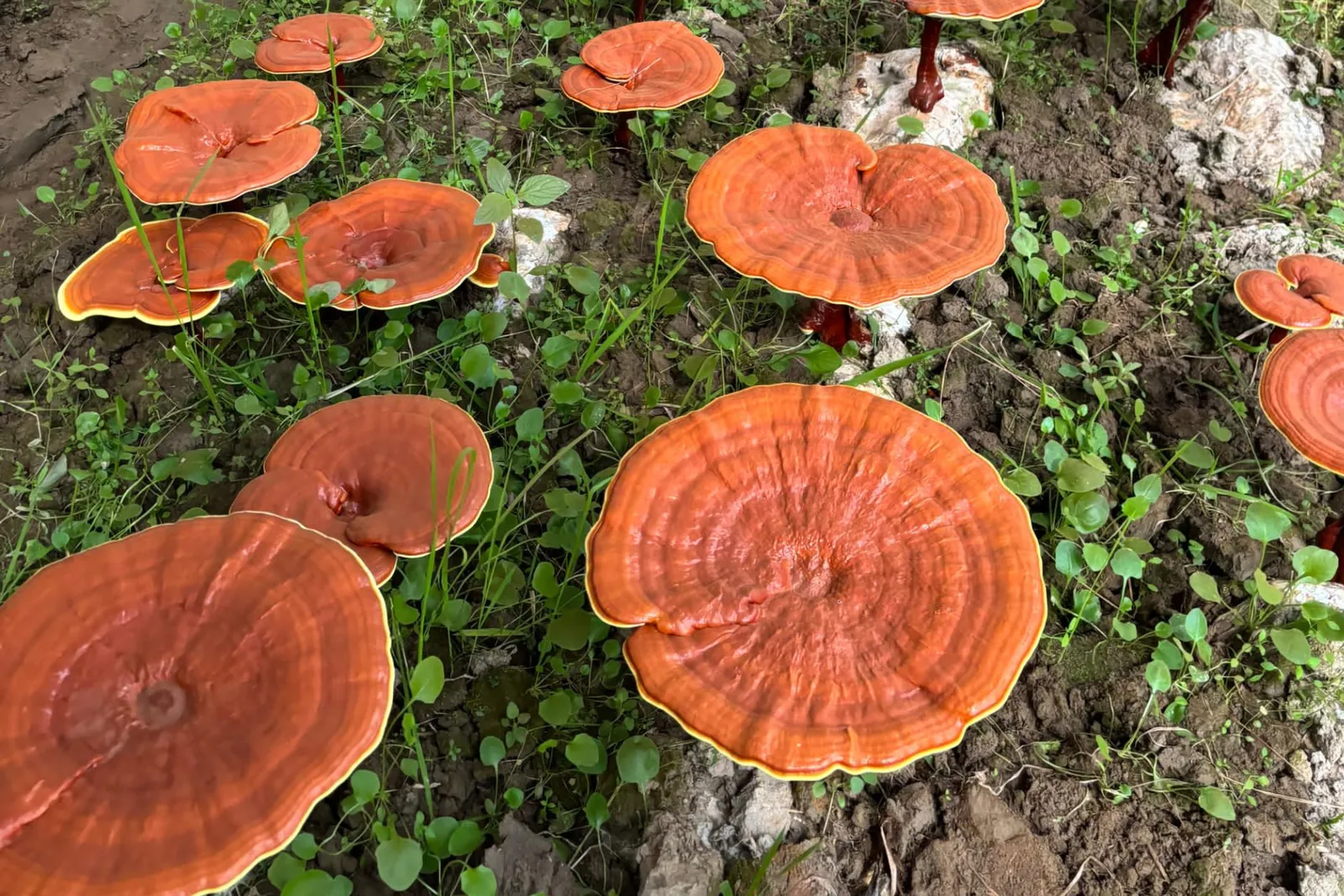
The fruiting body is the first word to ask about with any mushroom supplement.
Version 1.0 · Published: 25.05.2026
Subject-matter reviewer: Aloha Fungi Team
Fruiting body, mycelium and mycelium grown on grain are three different materials. Each has a different chemical profile, a different production logic and a different research history · and yet they often appear under the same mushroom name. The customer sees “Reishi”, “Lion’s Mane” or “Cordyceps” on a label and assumes it’s a single product. Meanwhile, behind these names can stand raw materials that differ in what’s actually in the jar.
In short (60 seconds)
- 🍄 Fruiting body is the visible structure of the mushroom (Reishi, Lion’s Mane, Shiitake) · the most classical and transparent material, the one most traditional applications refer to.
- 🌱 Mycelium is a network of hyphae, the “living” part of the mushroom. It can be valuable, but it has a different chemical profile than the fruiting body · research can’t be transferred 1:1.
- 🌾 Mycelium grown on grain is a mixture of mycelium and a grain substrate (rice, oats). Often 70–85% of the mass is grain, not mushroom.
- ⚠️ The label “full spectrum” sometimes signals a deliberate product design, and sometimes is a nice way of saying “the whole cultivation mass milled together with the grain”.
- 📊 The label should clearly state whether it’s a fruiting body, mycelium or mycelium grown on grain · and what the input material actually was.
- 🔬 Research refers to a specific material. Transferring conclusions from a fruiting-body extract to a mycelium-on-grain product is a communication error.
Why isn’t a mushroom a single material?
In everyday language we say: “Reishi”, “Lion’s Mane”, “Cordyceps”.
But technologically and biologically, different parts of the organism · or different production forms · can stand behind those names.
We can talk about:
- the fruiting body,
- the mycelium,
- mycelium grown on grain,
- fruiting-body extract,
- mycelium extract,
- powder from the whole cultivation mass,
- a mixture of mycelium and substrate.
To someone buying a supplement, this may sound like a nuance.
But it’s not a nuance.
It’s the difference between materials with different compositions, different production processes and often a different level of documentation.
That’s why the question isn’t simply: “Which mushroom is in the product?”
The real question is:
💡 Which part of the mushroom · or which cultivation form · was used?
What is a fruiting body?
The fruiting body is the part of the mushroom most people recognise intuitively.
It’s the “body” of the mushroom visible above the substrate. With Reishi this will be the lacquered, hard fruiting body. With Lion’s Mane · a white structure resembling icicles. With Shiitake · the classic cap and stem.
The fruiting body is the structure the mushroom produces at a specific stage of its development.
In functional supplements, the fruiting body is often treated as the most classical and most transparent material, because many traditional applications and many raw-material analyses refer specifically to this part of the mushroom.
A fruiting body can be dried and milled. It can also be subjected to water, alcohol or dual extraction, depending on which fractions we want to obtain.
In practice, the fruiting body gives a brand and a customer a fairly clear reference point.
We know which part of the organism we’re working with. We know what the raw material looks like. We can assess its quality visually and analytically. We can test specific batches. We can communicate the product simply and honestly.
This doesn’t mean every fruiting body is automatically excellent. A fruiting body can also be of poor quality · badly dried, contaminated, old, badly stored or badly extracted. But at least we know what the input material is.
What is mycelium?
Mycelium is a network of hyphae · the actual, living structure of the mushroom that develops within a substrate.
You could say the fruiting body is the visible form, and the mycelium is the mushroom’s “system” · the part that grows, explores its environment and absorbs nutrients.
Mycelium in itself isn’t a bad thing. In some species and contexts it can be a very interesting material. Some compounds characteristic of particular mushrooms can be associated specifically with the mycelium. For example, in the discussion of Lion’s Mane there’s often talk of differences between compounds present in the fruiting body and those that may occur in the mycelium.
The problem isn’t that “mycelium is bad”. The problem is a lack of precision.
If a product is made from mycelium, it should clearly say so. If research refers to a fruiting body, it shouldn’t be automatically transferred to a mycelium product. If an extract was made from mycelium, you need to know whether the mycelium was separated from the substrate, or whether the product contains the entire cultivation mass.
And here we arrive at the most important distinction.
Mycelium grown on grain: why all the confusion?
Mycelium grown on grain is not the same as pure mycelium.
In many production processes mycelium grows on a grain substrate · for example, rice, oats, sorghum or other plant material. After cultivation is complete, the entire mass can be dried and milled.
In that case the final product isn’t pure mycelium. It’s a mixture of mycelium and the substrate it grew on. And if the substrate hasn’t been separated, a significant portion of the product may simply be grain.
This matters enormously.
Because grain brings starch and other carbohydrates. It can affect the results of simple polysaccharide analyses. It can dilute the actual content of compounds characteristic of the mushroom. It can also make the product look “mushroomy” on the label while in practice being something closer to a fermented substrate with added mycelium.
That’s why the phrase “the product contains mycelium” isn’t enough. You have to ask:
- whether the mycelium has been separated from the substrate,
- what it was cultivated on,
- how much real mushroom biomass is in the product,
- how much grain has remained in the product,
- what testing supports the declarations,
- whether the label clearly informs about the input material.
Without these answers, the customer doesn’t know what they’re actually buying.
💡 Mycelium grown on grain can contain 70–85% grain and only marginal amounts of active mushroom compounds.
Why can “full spectrum” be misleading?
In products made from mycelium grown on grain, the label full spectrum often appears.
It sounds attractive. It suggests fullness, completeness and naturalness. But in practice it can mean very different things.
Sometimes “full spectrum” means a deliberate product concept containing different fractions of the mushroom. Sometimes it means an extract or powder that hasn’t been heavily purified because the manufacturer wants to preserve a broad compound profile.
But sometimes “full spectrum” is used as a nicer way of saying: “we milled the entire cultivation mass together with the substrate”.
That’s a very big difference.
If a product contains a fruiting body, mycelium and clearly described fractions · you can talk about a broad spectrum. If a product mainly contains grain with mycelium grown through it · the customer should know.
Transparency begins where a brand doesn’t hide its technology behind a pretty word.
The same mushroom name, a different research history
One of the biggest errors in the communication of mushroom supplements is transferring research from one material to another.
If a study referred to a Reishi fruiting-body extract, it doesn’t automatically mean its conclusions can be applied to a product made from Reishi mycelium grown on grain.
If a study referred to a specific Hericium erinaceus extract, it doesn’t mean every product labelled “Lion’s Mane” will have the same profile.
If a study referred to an isolated fraction or a specific preparation, it doesn’t mean an ordinary powder with the same name works the same way.
The species name isn’t enough.
In research what matters is:
- which part of the mushroom was used,
- what the preparation method was,
- whether it was a powder, extract, fraction or isolated compound,
- what doses were used,
- what the chemical profile of the material was,
- whether the final product resembles the one sold to the customer.
That’s why an honest brand shouldn’t support a mycelium-on-grain product with research concerning a fruiting-body extract, unless it can clearly justify such a reference.
This isn’t an academic detail. It’s a matter of honesty toward the customer.
Why does the chemical profile matter?
Fruiting body, pure mycelium and mycelium grown on grain can differ in their chemical profile.
Depending on species and process, they can differ in content of beta-glucans, other polysaccharides, triterpenes, phenolic compounds, nucleosides, proteins, enzymes, secondary metabolites and substrate-derived components.
That’s why it’s not enough to say: “this is Reishi”. You need to know which Reishi.
A Reishi fruiting body follows a different logic than mycelium. A fruiting-body extract standardised on beta-glucans and triterpenes is something different from a powder made from mycelium grown on grain. A product from pure mycelium is yet another category.
The same goes for Lion’s Mane. The fruiting body and the mycelium can be interesting for different reasons, but they need to be communicated precisely. You can’t lump all products together just because they share the same trade name.
How to read a label?
The simplest rule is: if the label only states the mushroom name but doesn’t say which part or form the product came from · that’s not enough.
A good label should answer the basic questions:
| Question | Why it matters |
|---|---|
| Is it a fruiting body, mycelium or mycelium grown on grain? | Defines the actual input material |
| Is the product a powder or an extract? | Shows the level of processing and concentration |
| Is the Latin species name given? | Helps avoid commercial ambiguity |
| Is standardisation indicated? | Shows which compounds the product was controlled on |
| Are there batch tests? | Confirm declarations for the actual product |
| Is it known what the mycelium was cultivated on? | Reveals the substrate share and possible carbohydrate source |
If this information is missing, the product may still be good. But the customer doesn’t have a sufficient basis to assess it.
Is mycelium always worse?
No. It’s important to say this clearly.
Mycelium isn’t worse by definition. In some cases it can be a valuable material. It can contain interesting metabolites. It can make technological sense. It can be used in research and in specific types of products.
But mycelium has to be called mycelium. And mycelium grown on grain has to be called mycelium grown on grain · or at least a product containing mycelium and a cultivation substrate.
The problem isn’t the technology itself. The problem is hiding the differences.
If a customer buys a fruiting-body product, they should get a fruiting body. If they buy a mycelium product, they should know it’s mycelium. If they buy a mycelium-on-grain product, they should know the jar also contains plant material.
Transparency isn’t about always choosing one type of raw material. It’s about not pretending all types are the same thing.
How do we look at this at Aloha Fungi?
At Aloha Fungi we start from a simple premise: the customer should know what’s in the product.
If we work with a fruiting body, we talk about a fruiting body. If a product is an extract, we describe it as an extract. If standardisation matters, we show what the product is standardised on. If we test a batch, we want the documents to refer to the actual product, not an abstract declaration.
We’re not interested in lumping every mushroom form into one bucket.
Because “mushroom supplement” can mean very different things. It can mean a simple fruiting-body powder. It can mean a potent extract. It can mean pure mycelium. It can mean a milled cultivation mass with a high share of grain.
Each of these products should be assessed according to its own logic. And each one should be honestly described.
FAQ
How does a fruiting body differ from mycelium?
The fruiting body is the visible structure of the mushroom, the material most traditional uses and raw-material analyses refer to. Mycelium is the network of hyphae growing in the substrate, with a different chemical profile. Findings from fruiting-body research cannot be transferred 1:1 to mycelium products.
How much grain can a mycelium-on-grain product contain?
If the substrate has not been separated, 70 to 85% of the product mass can be grain (rice, oats, sorghum). Grain adds starch, which can inflate simple polysaccharide assays and dilute the real content of mushroom compounds.
What does “full spectrum” really mean?
Sometimes a deliberate product concept with different mushroom fractions, and sometimes a prettier way of saying the whole cultivation mass was milled together with the substrate. Without a clear description of the input material, the phrase guarantees nothing.
Is mycelium always worse?
No. It can be a valuable material with its own profile, but it must be labelled as mycelium, and mycelium on grain as exactly that. The problem is not the technology, it is hiding the differences on the label.
Read also
- The number on the label vs. real extract quality
- Drying and carriers in mushroom extracts
- A technical brief on Lion’s Mane extract, point by point
Summary
Fruiting body, mycelium and mycelium grown on grain aren’t three names for the same thing. They’re three different materials.
The fruiting body is the visible structure of the mushroom · often the most recognisable and the easiest for the customer to understand. Mycelium is a network of hyphae that can have its own, interesting profile. Mycelium grown on grain is a material that can contain a significant amount of substrate, which is why it demands particularly clear communication.
In the world of functional mushrooms, precision matters.
Because the customer isn’t buying just the name of a species. They’re buying a specific material, a specific process and a specific level of quality.
And if the label doesn’t show that, even the prettiest word “mushroom” isn’t enough.
Have specific requirements?
Build a procurement brief: catalog match, missing inputs and a ready inquiry draft. Nothing is sent.