
Agaricus Blazei
Agaricus subrufescens
Fruiting-body extract or powder standardised on β-glucans, with particular cadmium control for the EU
Fruiting-body extract of Agaricus subrufescens (known as Agaricus blazei Murrill) from controlled cultivation, from sources selected for low cadmium risk. A species high in β-glucans, where quality begins with the raw-material source and heavy-metal testing.
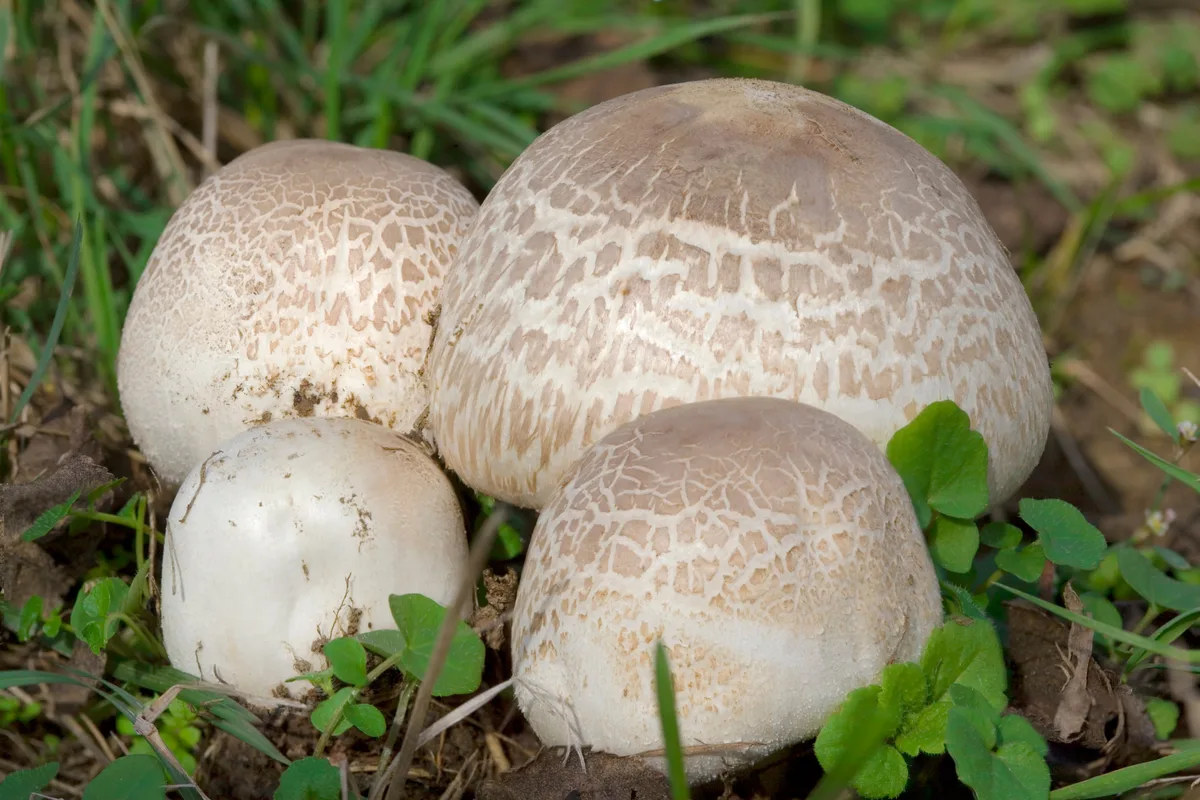
Many names, one species
Agaricus blazei Murrill (the most common trade name), Agaricus subrufescens (the correct modern scientific name), Agaricus brasiliensis (a synonym used in part of the literature), Cogumelo do Sol (Brazil, "mushroom of the sun", after the Piedade region where it was first cultivated commercially), Himematsutake (Japan, 姫松茸), almond mushroom (after its characteristic almond aroma), ABM (industry abbreviation). All of these names refer to the same species. Its origin is linked to Brazil, and it first gained popularity as a supplement ingredient in Japan. It is a heat-loving species that does not occur naturally in the Polish climate, so wild foraging from Polish forests is out of the question.
What is in the extract
The main functional marker of Agaricus Blazei that we focus on is β-glucans with a (1→3),(1→6) structure, activating Dectin-1 and TLR receptors. Alongside them, the fruiting body contains protein-polysaccharide complexes (described as biological response modifiers), other polysaccharides, ergosterol (provitamin D₂), amino acids and trace elements. Our extract is standardised on β-glucans by the Megazyme K-YBGL method (the value depends on the form: extract higher, fruiting-body powder lower).
Agaricus blazei can accumulate cadmium from the substrate. This is not a detail but a critical parameter: the same species from different sources can differ significantly in cadmium content. That is why quality is decided first by the raw-material source, and only then by β-glucan standardisation. At Aloha Fungi we use exclusively the extract (or powder) from the fruiting body.
Typical batch specification
Typical batch: β-glucans 20-40% by the Megazyme K-YBGL method (depending on the form). Total polysaccharides 30-50% by the phenol-sulfuric method. Cadmium and heavy metals (lead, cadmium, mercury, arsenic) tested by ICP-MS and controlled against EU limits (cadmium as the critical parameter for this species). Pesticides: multi-residue panel. Microbiology compliant with the European Pharmacopoeia (Ph.Eur.). Extraction ratio 10:1 for the extract form. Moisture ≤ 5%. Every batch has a full COA with test methodology, with particular attention to cadmium.
Premium variant
★ Co-brandingFor brands that want to create their own functional-mushroom product and base it on our raw-material standard. You use extracts selected by Aloha Fungi, and once the criteria are met you can add our quality seal to the packaging.
MOQ: set individually
Our logo on your product →Raw material
Fruiting bodies of Agaricus subrufescens from controlled cultivation, from sources selected for low cadmium risk (the substrate and cultivation conditions directly affect accumulation of this metal). No grain-grown mycelium. A heat-loving species requiring high temperature and humidity, so cultivation takes place in a suitable climate rather than in European conditions. Harvested at maturity, controlled drying, source audit with emphasis on the heavy-metal profile.
Process
For the extract form: hot-water extraction from the fruiting bodies, standardisation on β-glucans, concentration and drying to a powder without maltodextrin. For the fruiting-body powder: milling of the dried fruiting body and sterilisation, without water solubility. The choice of form (fruiting-body powder vs extract) depends on the intended application, the required concentration and solubility. Regardless of the form, cadmium is tested on every batch by ICP-MS.
Mechanisms described in the literature
Studies on Agaricus blazei (in vitro, animal models and clinical work) describe above all the immunological direction linked to β-glucans, as well as aspects of genoprotection and safety. Below are the three best-documented areas, given as mechanistic literature, not as claims about the product's action.
- 01
Immunomodulation via (1→3),(1→6) β-glucans
The best-described direction in the literature. Agaricus blazei (subrufescens) contains β-glucans with a (1→3),(1→6) structure and protein-polysaccharide complexes, described as biological response modifiers. Mushroom β-glucans bind to Dectin-1 and TLR receptors on immune cells. The review by Hetland et al. [2008, Scand J Immunol] collected preclinical and clinical data on the effect of A. blazei on NK cell activity, interleukin levels and immunoglobulin titres. This is mechanistic and preclinical literature, not a basis for health claims about the product.
- 02
Genome protection (genoprotection) in in vitro models
A second direction described in in vitro work. A β-glucan isolated from A. blazei protected human hepatoma HepG2 cells against the genotoxic effects of benzo[a]pyrene, without showing genotoxic or mutagenic activity of its own [Angeli et al. 2009]. Later work in this strand [da Silva et al. 2013] analysed the effect of A. blazei β-glucan on ERCC5, CASP9 and CYP1A1 gene expression and the metabolic profile in HepG2. These are cell-line results describing a mechanism, not a clinical effect in humans.
- 03
Safety profile and cadmium as a critical parameter
A third aspect, crucial for raw-material selection. Agaricus blazei can accumulate cadmium from the substrate, so the source and cultivation conditions have a real impact on EU-limit compliance. In a phase I clinical study in patients in remission, cadmium exposure from an A. blazei supplement amounted to about 25% of the tolerable daily intake from food, and doses of up to 5.4 g per day for 6 months caused no laboratory abnormalities [phase I clinical study, PMC3092499]. The practical conclusion: Agaricus safety begins with a controlled source and cadmium testing by ICP-MS on every batch.
Consumer communication - what is allowed, what to avoid
Health claims on finished products are regulated in the EU (1924/2006 and 432/2012). Agaricus blazei has no authorised EFSA claim. In addition, part of the literature on this species concerns the oncology context, which makes communication particularly sensitive. Below are the boundaries that are legally permitted.
What is allowed
Safe directions for a partner
Describing the bioactive ingredients ((1→3),(1→6) β-glucans, protein-polysaccharide complexes). Describing the process (fruiting-body extract, standardisation on β-glucans, cadmium control by ICP-MS). Reporting research neutrally ("the Hetland 2008 review collected data on the effect of A. blazei on NK cells…", not "Agaricus strengthens immunity"). Referring to the marker profile (β-glucans as a functional marker) and to quality rigour (cadmium testing on every batch) as a real differentiator of this raw material.
What to avoid
Categorically prohibited communication
Attributing to the product the treatment, prevention or alleviation of diseases (especially any oncology references, "anticancer", "supports cancer treatment", "immunotherapy"). Prohibited words: "treats", "cures", "prevents", "therapy", "anticancer", "strengthens immunity" (as a product claim), "clinical efficacy", "dosage" (we use "portion recommended for consumption during the day"). Despite the rich oncology literature on the species, it must not be cited in a way that suggests the product acts on a disease.
Critical for Agaricus
Cadmium and agaritine. This is a species with a real risk of cadmium accumulation and the presence of agaritine in the raw material. Communication must rest on quality documentation (COA with cadmium), not on an oncology narrative. For a partner, the greatest value here is precisely the control of the raw material, not health promises.
Application of the extract
Capsules and tablets: standard filling with extract or fruiting-body powder (for powdered forms, density, flowability and filling efficiency matter). Functional-mushroom blends: Agaricus as an ingredient high in β-glucans. Drink powders: the extract form, more soluble. We match the form and specification to the target application. Whatever the format, the foundation remains documented cadmium control.
Stability, storage and packaging
Stability: 24 months in a sealed, dry and dark place, away from moisture, at room temperature. Packaging: 1 / 5 / 25 kg bags, other formats on request. Inert (nitrogen) packaging on request. MOQ and lead time set individually once the form and specification are confirmed.
Caution
Contraindications and special groups: do not use in children, pregnant or breastfeeding women. Post-organ-transplant state with active immunosuppression (cyclosporine, tacrolimus, mycophenolate) - β-glucans activate Dectin-1 and TLR. Autoimmune diseases in an active phase - consider with caution.
Requires consultation with a doctor: people taking medication or coping with chronic diseases should consult a doctor before use. Cadmium and agaritine: because of the species profile we pay particular attention to controlling cadmium content against EU limits - this is the fundamental element of Agaricus raw-material safety. As standard we put the most important warnings on the label of the final consumer product.
Regulatory status
The status of Agaricus subrufescens as a food-supplement ingredient in the EU is interpreted differently in individual member states, and in some cases may require assessment in the Novel Food context (Regulation 2015/2283). Before placing a product on the market we recommend confirming the status for the target market and application.
NOTE: cadmium
Agaricus blazei accumulates cadmium. Regardless of the regulatory route, it is essential to test cadmium content (ICP-MS) on every batch and to adjust the specification and extraction method so that the final product meets EU requirements.
We support partners with technical documentation, certificates of origin and raw-material specifications, but we do not replace professional legal guidance.
★ The fastest path
Ready-made Aloha Fungi products for your business
Choose ready-made products from the LONGEVITY or PRIME line, or individual SKUs, and sell them under the Aloha Fungi brand in your channel.
See distribution terms → Selected literature
6 sources
Selected literature
6 sources- Hetland G et al. (2008). Effects of the Medicinal Mushroom Agaricus blazei Murill on Immunity, Infection and Cancer (review). Scand J Immunol.
- Wisitrassameewong K et al. (2012). Agaricus subrufescens: a review. Saudi J Biol Sci. PMID: 23961172.
- Angeli JPF et al. (2009). Beta-glucan extracted from Agaricus blazei prevents the genotoxic effects of benzo[a]pyrene in HepG2. PMID: 18528685.
- da Silva AF et al. (2013). Effects of β-glucan from Agaricus blazei on ERCC5, CASP9 and CYP1A1 expression and metabolic profile in HepG2 cells. Toxicol Ind Health.
- Ohno N et al. Antitumor β-glucan from the cultured fruit body of Agaricus blazei (preclinical work). Biol Pharm Bull.
- Phase I Clinical Study of the Dietary Supplement Agaricus blazei Murill in Cancer Patients in Remission (safety profile, cadmium exposure). PMC3092499.