
Hericenones in lion's mane extract: what a COA says and what it does not
We publish a UPLC report for lion's mane sample batch 260204 with a „Fail” status and take it apart: hericenones, hericenes, the specification threshold, the scope of accreditation. For a B2B buyer, one number on a COA is where the questions start, not where the assessment ends.
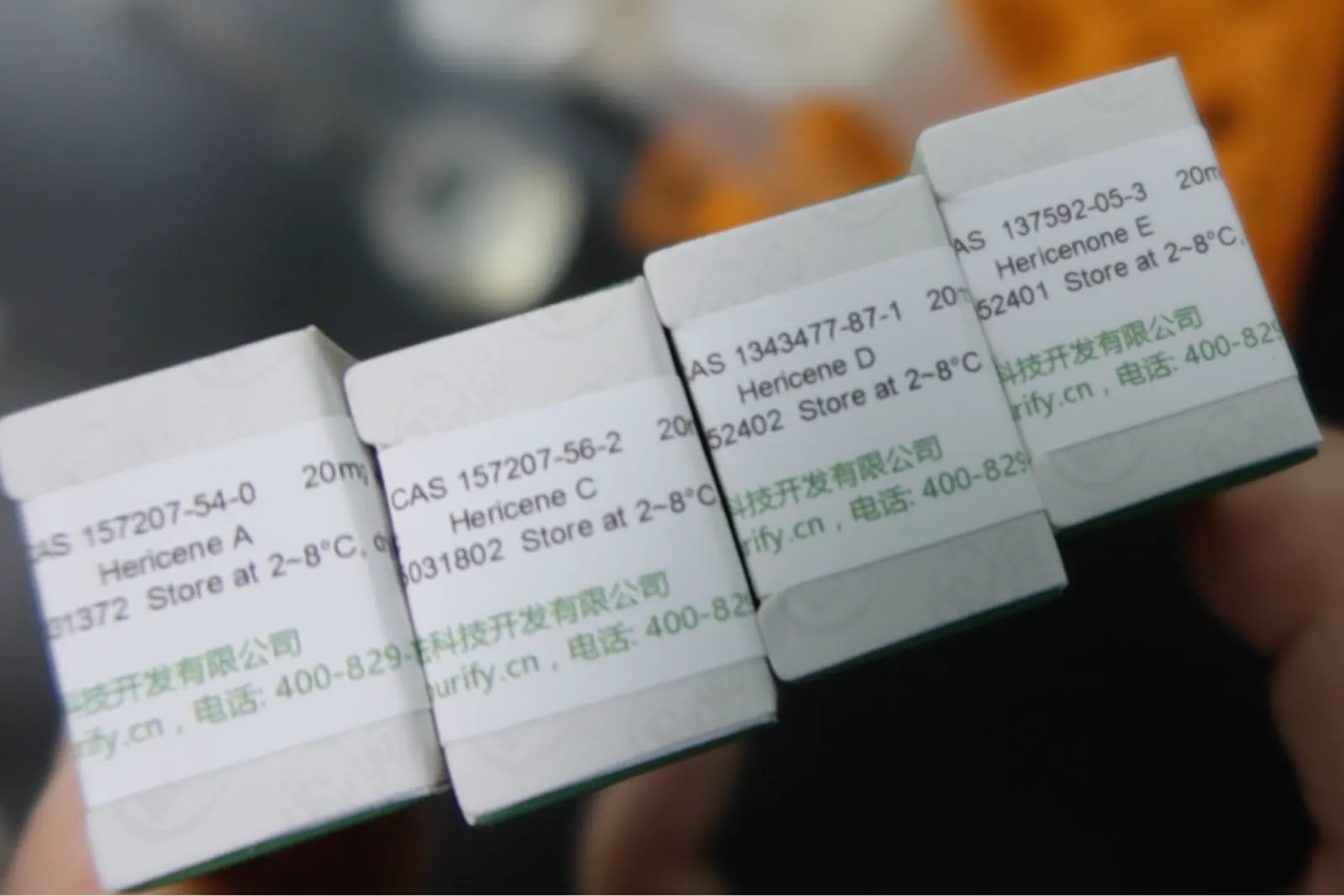
Hericenones in extract of lion’s mane are the number buyers compare most often and understand least.
Version 1.0 · Published: 07.09.2026
Scientific reviewer: Mateusz Rosa, founder of Aloha Fungi, international TCM practitioner (Doctor of Acupuncture Level A certificate issued by WFAS, an NGO in official relations with WHO, 2018)
We are publishing a laboratory report with a „Fail” status and explaining why, for us, it is better material for a conversation with a B2B client than a pretty number with no context. I want to know what is in the extract we choose, and we expect the same from suppliers: tests, quantification methods and documents tied to a specific batch. At the same time, our experience in therapeutic practice shows that a very good result for one chosen parameter does not always go hand in hand with equally good feedback from the people using the preparation. That is a personal observation, not a controlled product comparison and not proof of efficacy. It is a reason for us to assess the whole preparation rather than end the assessment at one line of a COA.
In 60 seconds
- 🧪 Six hericenones in the batch 260204 sample add up to 1.533%. That is our own sum of the rounded results from the Omnient Labs report (UPLC, procedure LAB TM-305), not a separate laboratory total.
- 📜 The line „Total Hericienones and Hericenes” is 1.717%, and it covers two groups of compounds. Quoting that figure as „hericenone content” inflates the result by the hericenes.
- ⚠️ The 2.5% specification threshold was not met, hence the „Fail” status. We do not hide it and we do not change its interpretation. The status concerns one requirement, not efficacy or safety.
- 🔬 Determinations marked with footnote 2 are outside the laboratory’s accreditation scope. The accreditation marks on the document do not cover these results.
- 📊 The result applies to a liquid sample as delivered to the laboratory. We do not transfer it to other batches, capsules or powdered extracts. Every purchasing department should read a COA the same way.
- 💡 One number does not replace a brief. Raw material, form, serving, extraction method, purity and the link between document and batch are the minimum worth asking a supplier about.
What exactly was tested, and on which sample?
The data comes from an Omnient Labs report. Report date 10 March 2026, analysis 6 March. Batch 260204 is a development sample, not a product on sale. Contents were quantified by UPLC (procedure LAB TM-305), a liquid chromatography technique that separates the components of a sample. The results apply to the sample as delivered to the laboratory.
We do not automatically transfer them to other batches, capsules or powdered extracts of Hericium erinaceus.
For a purchasing department this is the first control question for any COA: does the document describe exactly the form and the batch I am buying? A report on a liquid is not a report on a powder of the same species.
How many hericenones did the report show, and how do you add them up?
The report showed six hericenones with a combined content of 1.533%, plus three hericene lines and ergosterol. The sum of six hericenones is our own calculation based on the rounded results in the table. The laboratory did not issue a separate total for hericenones alone, only a combined line for hericenones and hericenes together.
| Compound, name from the report | Result |
|---|---|
| Hericenone H | 0.123% |
| Hericenone E | 0.009% |
| Hericenone C | 0.883% |
| Hericenone F | 0.127% |
| Hericenone D | 0.344% |
| Hericenone G | 0.047% |
Other quantified components:
| Compound, name from the report | Result |
|---|---|
| Hericene D | 0.026% |
| Hericene A/B | 0.121% |
| Hericene C | 0.038% |
| Ergosterol | 0.217% |
In the summary line „Total Hericienones and Hericenes” the report gives 1.717%. The name covers hericenones and hericenes together. This value should not be presented as the content of hericenones alone. Ergosterol is reported separately.
Adding the rounded results for hericenones and hericenes gives 1.718%, 0.001 percentage points more than the total in the report. Without the unrounded data we do not settle the cause of this difference; we quote the laboratory result unchanged.
💡 If a supplier writes „hericenones 1.7%”, ask whether that is the sum with hericenes. In this report the gap between 1.533% and 1.717% is exactly the hericenes.
Full Omnient Labs report with the chromatogram (PDF).
What does a „Fail” status on a COA mean, and what does it not mean?
A „Fail” status means the measured value did not reach the threshold written into the specification. For the sum of hericenones and hericenes the laboratory required at least 2.5%. The measured 1.717% is below that, so the sample did not meet this requirement. We do not skip this information or soften its interpretation.
This status concerns one specific compound-content requirement. The document itself is not a study of efficacy in humans nor a full safety assessment of the sample. It contains no heavy metals, no microbiology and no raw-material identity. Those are separate tests and separate documents.
In a footnote the laboratory also notes that determinations marked with the number 2 are not covered by its accreditation. This applies to the results in the tables above, despite the accreditation marks visible on the document. A buyer who assumes that the accreditation logo in the header covers every line of the report is reading the document wrong.
Why is one parameter not enough to assess an extract?
One parameter is not enough because it reduces a complex preparation to a single gauge and skips what decides repeatability of supply: raw-material type, form, serving size, extraction method, purity, and the link between document and batch. Compound content is information about composition, not a measure of what the person using the preparation will feel.
When we judge an extract solely by the concentration of one compound, we assume that this one number is enough to compare its value. I consider that approach mechanistic. In a purchasing brief the same logic leads to ranking offers by one column, and then to a complaint when the next batch comes in a different form or with a different carrier.
It is worth distinguishing a compositional analysis from a study involving people. The 2009 study by Mori and co-authors involved 30 participants and the intervention lasted 16 weeks. It tested a specific preparation containing lion’s mane powder and compared it with placebo PMID: 18844328. It was not a ranking of extracts by percentage of hericenones, nor a test of our sample.
We do not derive a conversion factor from such a study: twice as many hericenones means twice the effect. Nor do we draw the opposite conclusion, that a lower result is better.
How does Aloha Fungi combine science with experience from practice?
We follow the science and we listen to the people who use the preparations. We have seen a gap between attractive numbers and feedback from practice (a product with fantastic numbers that did not bring the expected result among patients). Such an observation raises questions, but does not tell us whether the cause was composition, method of use or expectations.
When I speak of the „matrix of nature”, I mean the complexity of the raw material that a single parameter does not describe. I feel humility towards that complexity. I do not treat it as proof that natural always means better, nor as a reason to ignore an unmet specification.
We want to look for a balance between what we can measure and what we do not yet understand. That is why we show results together with their limitations, instead of picking only the most attractive number out of a document.
What should you ask an extract supplier beyond hericenone content?
Ask about six things: raw-material identity (fruiting body or mycelium), the form of the preparation, the serving size, the extraction method, purity (heavy metals, microbiology) and the link between every document and a batch number. Only the full set of answers lets you compare two offers in which „hericenones” show a similar number while the products differ.
A batch passport pulls this information into one place. It links a batch number to specific results and documents, and shows the source of every piece of information: an independent laboratory or a manufacturer’s certificate. This lets you check what was actually tested, instead of settling for the slogan „tested product”. We show what such a passport looks like on the batch passport page.
We do not race for numbers. We want to be able to explain every number we show.
FAQ
What is the difference between hericenones and hericenes on a COA?
They are two different groups of compounds quantified in lion’s mane. In the Omnient Labs report six hericenones add up to 1.533%, while the summary line „Total Hericienones and Hericenes” at 1.717% covers both groups together. The second figure should not be quoted as the content of hericenones alone.
Does a „Fail” status disqualify the batch?
The status says that one specification requirement was not met. It says nothing about efficacy or safety. The purchasing decision depends on the threshold you set in your brief and on whether the rest of the batch documentation is complete.
Does a UPLC result for a liquid carry over to a powder from the same batch?
No. The results apply to the sample as delivered to the laboratory. A different form needs its own determination.
Does Aloha Fungi provide a COA for every batch?
We publish batch documents in the product passport with the source of every result stated. Report 260204 concerns the development sample described in this article, not a product on sale; we do not assign it to other batches.
Read next
- The number on the label versus extract quality
- Technical brief for a Lion’s Mane extract: point by point
- Before you ask for a quote: define the mushroom ingredient you need
Summary
The report we are publishing has a „Fail” status. We show it in full because, for a B2B buyer, such a document is more instructive than a number taken out of context: it shows the specification threshold, the difference between hericenones and hericenes, the scope of accreditation and the form of the sample.
Hericenone content in a lion’s mane extract is information about the composition of one sample in one form. To compare offers you also need raw-material identity, form, serving, extraction method, purity and the link between documents and the batch.
We do not race for numbers. We want to be able to explain every number we show, and we expect the same from the suppliers we work with.
References2 sources
- Omnient Labs (2026). Certificate of Analysis no. 26-076, sample „Lion’s Mane Mushroom DHA Solution”, batch 260204, UPLC LAB TM-305. Report dated 10 March 2026 for ALOHA WEALTH AND WELLNESS Sp. z o.o. PDF. 2. Mori K, Inatomi S, Ouchi K, Azumi Y, Tuchida T (2009). Improving effects of the mushroom Yamabushitake (Hericium erinaceus) on mild cognitive impairment: a double-blind placebo-controlled clinical trial. Phytother Res 23(3):367-372. PMID: 18844328.
Have specific requirements?
Build a procurement brief: catalog match, missing inputs and a ready inquiry draft. Nothing is sent.