
Cordyceps CS-4, militaris and sinensis: what the names on the label mean
Cordyceps CS-4 is not a strain of Cordyceps militaris, nor wild sinensis. It is the fermented mycelium of a different organism. Three names on a label are three different raw materials, with different composition, price and legal status.
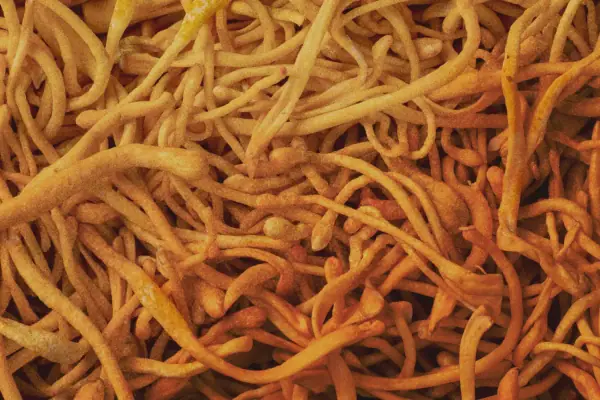
Cordyceps CS-4 is the first abbreviation a buyer asks about, and the first one suppliers get wrong.
Version 1.0 · Published: 09.09.2026
Subject-matter reviewer: Mateusz Rosa, founder of Aloha Fungi, international TCM practitioner (Doctor of Acupuncture Level A certificate issued by WFAS, an NGO in official relations with WHO, 2018)
Cordyceps CS-4, Cordyceps militaris and Ophiocordyceps sinensis are three different raw materials, not three names for one mushroom. On a label they can sit side by side, in one line, as if interchangeable. They are not. One is a wild fungus-and-insect complex from Tibet, one is a cultivated fruiting body, one is mycelium from a fermenter. A buyer who cannot tell them apart pays for a name and receives a material.
In brief (60 seconds)
- 🍄 Ophiocordyceps sinensis is the wild “caterpillar fungus” from the Tibetan Plateau, hand-collected at 3,000-5,000 m above sea level. Rare, protected, unrealistic as a bulk raw material.
- 🧪 CS-4 is neither sinensis nor militaris. It is a strain isolated from sinensis-related material and multiplied by fermentation. In supply-chain terms it is Paecilomyces hepiali, in newer taxonomy Samsoniella hepiali [Dai 2018]. Mycelium, never a fruiting body.
- 🌱 Cordyceps militaris is a separate species whose fruiting body can be cultivated at industrial scale. The main real source of cordycepin in commercial products [Phull 2022].
- ⚠️ “Sinensis” plus “fruiting body” on a broker’s COA is most often fermented mycelium with a nice name. High cordycepin next to the name sinensis needs an explanation, because this material contains almost none.
- 📊 At Aloha Fungi we work with the fruiting body of Cordyceps militaris, not CS-4. Standardised above 30% β-glucans and a minimum of 0.3% cordycepin, measured on every batch.
- ⚖️ The legal status in the EU is not the same for these three materials. Before an ingredient goes into a specification, check it with a regulatory adviser.
Why does the word “Cordyceps” alone not tell you what you are buying?
Because “Cordyceps” on a label is a trade name, not the identity of a raw material. Behind that word can stand wild Ophiocordyceps sinensis, a cultivated Cordyceps militaris fruiting body, or CS-4-type fermented mycelium. Each has a different compound profile, a different price per kilogram and a different research history. So the first question to a supplier is “which Cordyceps?”, and only the second is “how much cordycepin?”.
I have seen specifications with “Cordyceps sinensis CS-4 fruiting body extract” in a single field. Three words, three contradictions. CS-4 is not sinensis. CS-4 has no fruiting body. And an extract from a sinensis fruiting body would cost more than the whole batch of capsules.
What is wild Ophiocordyceps sinensis?
A fungus that parasitises moth larvae, growing high on the Tibetan Plateau, in Nepal and Bhutan. In Chinese 冬虫夏草, “winter worm, summer grass”. It is collected by hand, in spring, at 3,000-5,000 m above sea level, and it is precisely the difficulty of the harvest that built its status as an imperial-court rarity over the centuries.
For the supplement industry this has one consequence: wild sinensis as a bulk raw material does not exist. Prices run into thousands of dollars per kilogram and availability is limited. Anything cheaper is something else. Sometimes honestly described, sometimes not.
💡 If the “sinensis” offer is cheap, it is not sinensis.
What does CS-4 actually mean?
CS-4 is the name of a strain isolated from material related to wild sinensis and multiplied in fermenters, in liquid culture. In supply-chain practice this organism is Paecilomyces hepiali; more recent taxonomic work places it in the genus Samsoniella [Dai 2018]. Whatever the Latin name: it is mycelium, never a fruiting body.
Where does the confusion come from? In China, Jinshuibao-type products, based precisely on powdered CS-4 mycelium, are registered traditional medicines. That gave CS-4 a reputation as “the real one”. On the international market, though, it ends up in jars as “Cordyceps sinensis mycelium” or, worse, as “Cordyceps sinensis” with no qualifier at all.
How to recognise it beyond paperwork: dark brown powder, a smell reminiscent of soy sauce, good solubility. The markers that make sense for it are adenosine and D-mannitol, not cordycepin. If a COA for CS-4 material shows high cordycepin, ask where it came from.
How is Cordyceps militaris different, and why do we work with it?
Cordyceps militaris (蛹虫草) is a separate species from the same family, and the only one that can be cultivated to the fruiting-body stage at industrial scale. Orange, club-shaped fruiting bodies grow in controlled cultivation on a rice-based medium with fungal components, with no insect and no mountains. It is the main real source of cordycepin in commercial products [Phull 2022].
At Aloha Fungi we chose the militaris fruiting body for three reasons. Batch repeatability: the same process, year after year. An auditable source: we know where it grows and on what. And measurable markers: β-glucans above 30% by enzymatic method and cordycepin at a minimum of 0.3% by HPLC, on every batch. We do not work with CS-4 and we do not sell mycelium as fruiting body.
One caveat an honest supplier raises unprompted: the status of Cordyceps militaris in supplements on the EU market is the subject of notifications in the RASFF system [RASFF 2022]. Before the ingredient goes into your product specification, check it with a regulatory adviser for the specific category and country.
How to read the label: name, material, question for the supplier
| The label says | What it usually is | What to ask |
|---|---|---|
| Cordyceps sinensis extract | Most often CS-4-type fermented mycelium, not the wild fungus | Species confirmed by DNA? Process: fermentation or harvest? |
| Cordyceps sinensis mycelium | Fermented mycelium, often P. hepiali | Which strain? Which markers (adenosine, mannitol)? |
| CS-4 | Paecilomyces / Samsoniella hepiali, mycelium from liquid fermentation | Why is there cordycepin on the COA if this is not militaris? |
| Cordyceps militaris fruiting body | Cultivated fruiting body, orange powder | Cordycepin by HPLC per batch? Regulatory status for my category? |
| Cordyceps, no qualifier | Unknown, and that is the answer | All of the above, before any price is quoted |
💡 A Latin name without the part of the mushroom and without the process is half the information. The other half sets the price.
Frequently asked questions
Is CS-4 a strain of Cordyceps militaris?
No. CS-4 is a strain isolated from sinensis-related material and multiplied by fermentation; in supply-chain terms it is Paecilomyces hepiali, in newer taxonomy Samsoniella hepiali. Cordyceps militaris is a different species, cultivated to the fruiting-body stage. A label that combines “CS-4” with “militaris” or with “fruiting body” describes something that does not exist.
Where does high cordycepin on a “sinensis” label come from?
Wild sinensis and CS-4 fermented mycelium contain only trace amounts. A high number next to that name usually means one of three things: the material is in fact militaris, cordycepin was added as an isolate, or the species name is simply wrong. Each case requires an explanation from the supplier.
How do you recognise militaris without a lab?
By colour and smell. Militaris fruiting body gives an orange powder with a mushroom smell. CS-4 mycelium is dark brown and smells like soy sauce. A very sweet, instantly soluble powder suggests a carrier. This is a first screen, it does not replace a COA with method and DNA.
Read also
- Fruiting body, mycelium, mycelium grown on grain
- The number on the label and extract quality
- How to read Cordyceps labels in Europe (Yi)
Summary
Three names, three raw materials. Ophiocordyceps sinensis is a wild fungus from Tibet that is not in any cheap jar. CS-4 is mycelium from a fermenter, honest as mycelium, dishonest as “sinensis” and absurd as “militaris fruiting body”. Cordyceps militaris is a cultivated fruiting body and the only real source of cordycepin in the products the European market works with.
At Aloha Fungi we work exclusively with the militaris fruiting body and measure cordycepin on every batch. Not because tradition does not matter to us, but because this can be repeated year after year without waiting on the mercy of the mountains.
Before you ask for a price, ask about the species, the part of the mushroom and the process. Those three answers say more than all the numbers on a COA put together.
Bibliography3 sources
- Dai R.Q. et al. (2018). Response to neotypification of Paecilomyces hepiali. Taxon 67(4). DOI: 10.12705/674.7. 2. Phull A.R. et al. (2022). Cordyceps militaris as a Bio Functional Food Source: Pharmacological Potential, Anti-Inflammatory Actions and Related Molecular Mechanisms. Foods. PMC8875674. 3. RASFF Window (2022). Notification 2022.4226: Unauthorised novel food ingredient Cordyceps militaris in food supplement. RASFF 559027.
Have specific requirements?
Build a procurement brief: catalog match, missing inputs and a ready inquiry draft. Nothing is sent.