
Coffee with functional mushrooms: trend, market and the Aloha Fungi × Coffeedesk case
Coffee with functional mushrooms is a coffee beverage with an added extract from an adaptogenic mushroom, most often Cordyceps, Lion's Mane or Reishi. The global mushroom coffee market was valued at 3.23 billion USD in 2025, with a forecast growth to 5.56 billion USD by 2035.
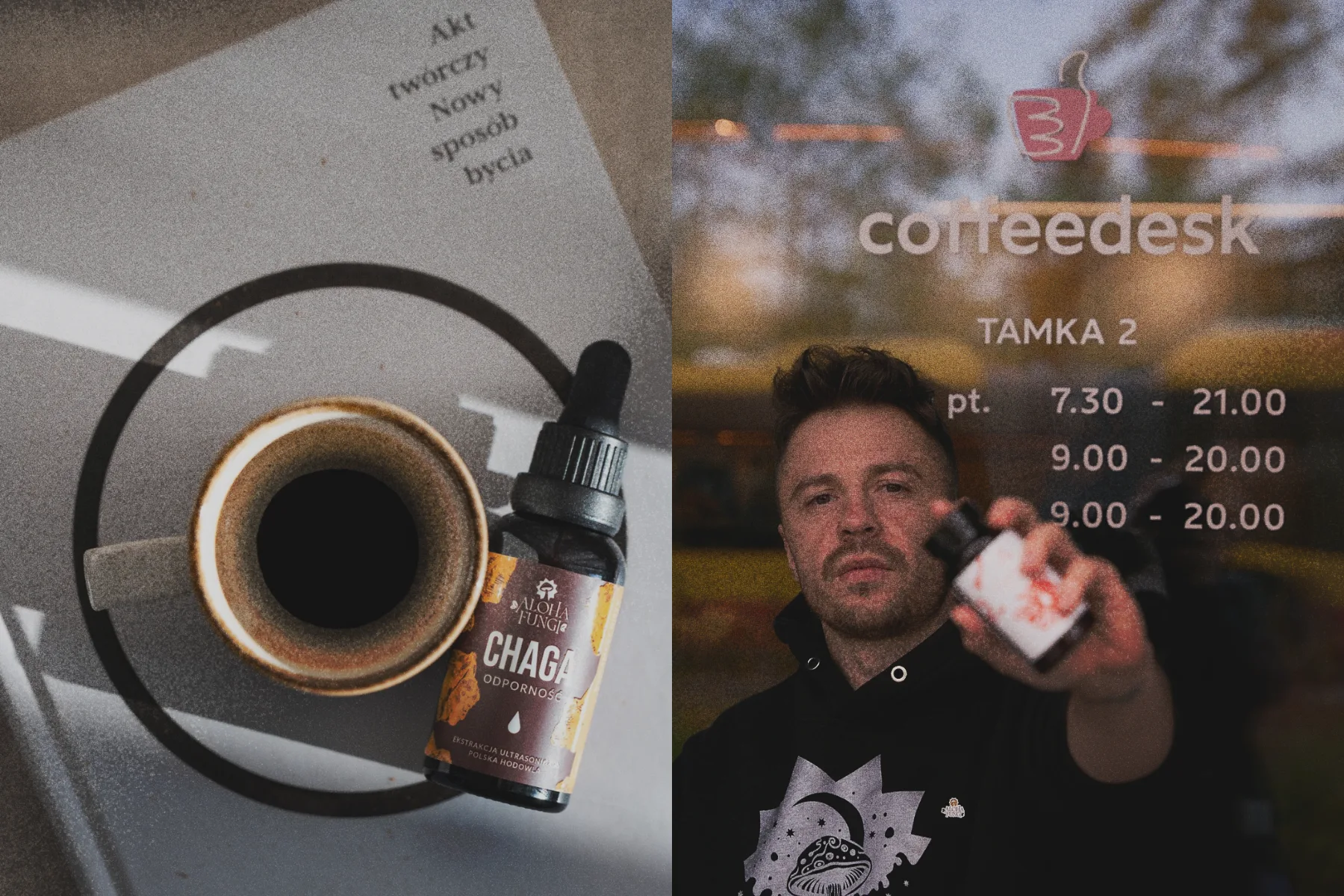
Mushroom coffee has moved from a curiosity to café menus.
Version 1.0 · Published: 25.05.2026
Subject-matter reviewer: Mateusz Rosa, founder of Aloha Fungi, international TCM therapist (Doctor of Acupuncture Level A certificate issued by WFAS, an NGO in official relations with the WHO, 2018)
Coffee with functional mushrooms is a coffee beverage with an added extract from an adaptogenic mushroom · most often Cordyceps, Lion’s Mane or Reishi. The global mushroom coffee market was valued at 3.23 billion USD in 2025, with a forecast growth to 5.56 billion USD by 2035 [Precedence Research 2025]. In Poland, the category entered the mainstream partly through the Aloha Fungi × Coffeedesk collaboration (autumn 2024), which placed adaptogens in specialty café menus instead of the supplement shelf.
In short (60 seconds)
- 🍄 Global functional mushroom market: 12.06 billion USD in 2025, forecast 20.74 billion USD in 2031, CAGR 9.45% [Mordor Intelligence 2025].
- ☕ Mushroom coffee segment: 3.23 billion USD in 2025 → 5.56 billion USD in 2035 [Precedence Research 2025]. Powders account for 64% of the market.
- 🤝 In 2024, Coffeedesk introduced Holistic Cacao (cacao + Cordyceps + Lion’s Mane + Reishi + Chaga) and Faster Brew (coffee + Cordyceps) in collaboration with Aloha Fungi.
- ⚖️ In the EU none of the mushroom compounds has an approved health claim. Communication runs through mechanism and tradition, not a treatment promise.
- 🔁 Coffee is an existing habit onto which you can layer functionality without building a ritual from scratch.
Why did coffee become the carrier for mushrooms?
Coffee has something supplements do not · a ready-made habit. The customer drinks it every day, often at the same time. Morning before work, after training, during a meeting. That’s a time, a context and a repeatability a supplement still has to learn.
Mushroom coffee leverages this habit. The customer does not need to remember a capsule. They drink their coffee and, on the side, receive a portion of mushroom extract.
The global functional mushroom category was worth 12.06 billion USD in 2025 and is expected to grow to 13.20 billion USD in 2026 [Mordor Intelligence 2025]. The 2031 forecast is 20.74 billion USD at an average annual growth rate of 9.45%. The mushroom coffee segment alone is growing faster · 3.23 billion USD in 2025 → 5.56 billion USD in 2035 [Precedence Research 2025]. This shows that mushrooms are no longer only a supplement category and are entering everyday products.
The powder form accounts for 64% of the mushroom coffee market in 2025 [Precedence Research 2025]. It’s a natural choice for coffee · powder mixes well with hot liquid, has a predictable portion size and doesn’t ruin the flavour of the beverage.
💡 Coffee does not require building a ritual from scratch. It is enough to add a new layer to something that already exists.
Which mushrooms most often end up in coffee and beverages?
In practice, simple pairings work · one mushroom matched to one moment of the day. The customer doesn’t need to understand the whole of mycology to understand the product.
| Mushroom | Traditional direction | Best carrier | Time of day |
|---|---|---|---|
| Cordyceps | traditionally associated with endurance and supporting Kidney Qi in TCM | coffee, matcha, shots | morning, before training |
| Lion’s Mane | traditionally associated with mental work | coffee, matcha, light cacao | before conceptual work |
| Reishi | traditionally used in the evening in calming protocols | cacao, infusions, plant milks | evening |
| Chaga | traditionally used in autumn-winter infusions | cacao, spiced infusions | autumn, winter |
| Coriolus versicolor | traditionally associated with immunity and the gut | capsules more often than a beverage | year-round protocol |
| Tremella | traditionally used in skin protocols in TCM | matcha, light beverages, cacao | year-round beauty ritual |
The table shows traditional directions, not promises. Each of these mushrooms has the status of a food supplement in the EU, not a medicinal product. The choice of a specific extract depends on the person, the product format and the goal · which is why at Aloha Fungi we select it through consultation, not off the shelf.
Raw material form: why does a fruiting-body extract make the difference?
Any powder someone calls a “mushroom” can be added to coffee. Market practice shows that quality is recognised by five things:
- Raw material form: extract from the fruiting body, not mycelium grown on grain. Mycelium cultivated on a grain substrate can contain 70-85% grain and only marginal amounts of active mushroom compounds.
- Extraction ratio: 8:1, 10:1, 20:1 · the higher the ratio, the more raw material went into a gram of finished extract.
- Standardisation: declared β-glucan content (most often 30%, 40% or higher), not just total polysaccharides (which may include ballast α-glucan from grains).
- Lab and purity: testing for heavy metals, pesticides, microbiology. This is not an option · it is the industry standard in the EU.
- Origin and production trace: from whom, where from, what process.
These five elements separate a supplement that makes sense from a powder that is only a trend signal on the label. In coffee the difference is additionally visible in taste: an extract from a standardised fruiting body has a clearer, “herbal-forest” profile. Mycelium with a grain mash tends to taste bland and floury.
In hot beverages the extract is best added after brewing, to a drink at drinking temperature, not heated longer than necessary. High temperature over a long time can lower the active profile of some polysaccharide fractions. This is a purely product-level rule · the same reason matcha is not poured with boiling water.
🇵🇱 Polish research trail
Research on functional mushrooms in Poland is conducted, among others, by the team of prof. Bożena Muszyńska at the Department of Pharmaceutical Botany, Collegium Medicum, Jagiellonian University in Kraków. From the portfolio relevant to coffee: Reishi (quantification of indole compounds in Ganoderma mycelium · Molecules 2022), Lion’s Mane (effect of plant substrate on the accumulation of bioactive compounds · Molecules 2025), Cordyceps (analysis of cordycepin and adenosine bioavailability in simulated digestive juices · Int J Food Sci Tech 2024, a study unique on a global scale) and Coriolus (PSK/PSP review · Postępy Fitoterapii 2016). For a coffee brand this is an argument that the scientific backing for mushroom coffee exists also in Poland, not only in the USA and Japan.
💡 Mycelium on grain contains 70-85% grain, not active compounds. That is the difference an informed customer starts looking for.
Signals from retail: what’s happening on the market?
In the West, mushroom coffee has moved from a niche to retail mainstream. In February 2025 Marks & Spencer rolled out a line of “mushroom shots” with Lion’s Mane and Reishi in the UK, which The Guardian described as functional mushrooms entering mainstream retail · with the caveat that British food law restricts attributing medicinal effects to food [The Guardian, February 2025].
The same restriction applies in Poland and the EU. Regulation (EC) No 1924/2006 on nutrition and health claims states clearly that a health claim on food is permitted only if it has been authorised and entered in the EU Register of nutrition and health claims. As of 2026, none of the compounds typical of functional mushrooms (mushroom β-glucans, hericenones, ganoderic acid, cordycepin, lentinan) has an approved health claim. The approved claim for β-glucans applies exclusively to oat and barley β-glucans in the context of maintaining normal LDL cholesterol levels · it does not automatically extend to mushroom β-glucans [EU Register, 2026].
For a coffee brand this means a concrete thing: the product can be functional, but communication has to stick to mechanism, tradition or a study result with a qualifier. Safe forms are “coffee with Cordyceps for the morning ritual”, “cacao with Reishi for the evening”, “Lion’s Mane traditionally associated with mental work”. Unsafe ones: “coffee that cures fatigue”, “cacao for insomnia”, “a beverage that strengthens memory”. The first will pass a UOKiK (Polish consumer protection) inspection, the second will not.
Case study: Aloha Fungi × Coffeedesk
Coffeedesk is one of the most recognisable coffee brands in Poland. An online shop with third-wave roasters, a network of specialty cafés, and a customer who is open to new beverage formats. In autumn 2024, two products from the Aloha Fungi adaptogen line appeared on the Coffeedesk café menu.
☕ Holistic Cacao
A beverage based on ceremonial cacao with an addition of Cordyceps, Lion’s Mane, Reishi and Chaga [Coffeedesk 2024]. Seasonal profile · autumn and winter. In the menu’s intent, an alternative to afternoon coffee for those who want a warmer drink with a deeper flavour profile and are not looking for more caffeine.
What works in this concept:
- A clear time of day: cacao · an afternoon-and-evening beverage · does not replace morning coffee; it complements the menu.
- Seasonality: autumn and winter is when the customer looks for drinks with a warmer, “spicy” profile · cacao with Reishi and Chaga feel natural here.
- Communication simplicity: the customer does not need to know all four mushrooms; it is enough to see “cacao with adaptogens” and understand this is a beverage with a higher intent than a regular hot chocolate.
☕ Faster Brew
A classic pour-over coffee with an addition of Cordyceps, described by Coffeedesk as a beverage that gives energy but does not overload [Coffeedesk 2024]. The positioning targets the customer who knows specialty coffee, wants less of a caffeine “hit to the head”, but is looking for something with a deeper backdrop than a plain filter.
What Cordyceps is doing here:
- Traditionally in TCM it supports Kidney Qi and is used as an endurance adaptogen.
- In the literature it has been studied in the context of aerobic capacity · including in a 12-week RCT (Hirsch 2017, n=28), in which the Cordyceps group improved VO2max by +11% vs placebo [PMID: 28429943]. This is a clinical study, not an automatic transfer to every cup of coffee, but it frames the mechanism the beverage targets.
Mateusz worked with Coffeedesk on extract selection and product description. The café menu communication was designed to stick to mechanism and tradition, without treatment promises.
What this collaboration showed
1. Functional mushrooms can step beyond the capsule. A café is not a supplement shelf · the customer makes a decision in 20 seconds, “coffee or cacao, with something or without”. Mushroom coffee has to fit that rhythm.
2. Good products own one moment of the day, not all of them at once. Faster Brew is for the morning; Holistic Cacao is for the afternoon and evening. The customer gets it without a briefing.
3. Careful communication doesn’t hurt sales. Coffeedesk did not promise the customer “treating fatigue” or “miracles for insomnia” · it framed the beverage through energy, warmth and ritual. That was enough.
🗣️ According to Mateusz Rosa, founder of Aloha Fungi, international TCM therapist, author of the books “Awakening Health” and “Functional Mushroom Supplementation”:
“The products that scale fastest are those that don’t try to do everything. Cordyceps in morning coffee has one job; Reishi in evening cacao has another. The customer needs to know when to reach for which.”
What does this mean for the coffee market in Poland?
Over the last five years Polish specialty coffee has matured. The customer knows single origin, fermentation, processing, distinguishes brewing methods. The next layer is functional coffee · a beverage in which the ingredient decides the time and purpose, not only the taste.
For a coffee brand, mushroom coffee is:
- A seasonal menu extension without creating a separate product category (as Coffeedesk did with its autumn line).
- Premium positioning without raising the price of the bean · a higher unit margin on the same coffee base.
- Cross-sell with half-day beverages: Cordyceps in the morning, Reishi in the afternoon · the customer comes back twice instead of once.
- A format for testing: you can verify a seasonal menu in a café faster than you can launch a retail line.
For roasters and café chains, the biggest risk is bad communication · slogans like “coffee that cures”, “mushroom coffee for insomnia”, “energy without side effects”. Each of them breaks EU Reg. 1924/2006 and can end in a UOKiK ruling. The proven path is mechanism and tradition, without a promise of a health effect for the reader.
What are the implementation models for mushroom coffee?
In practice we see several paths a coffee brand can take into the functional category.
1️⃣ Seasonal café menu (fastest)
Time to implementation: 4-8 weeks What you need: extract selection, dosing method, menu item description Example: Coffeedesk with Holistic Cacao Risk: minimal · if the seasonal slot doesn’t sell, it disappears from the menu after two months
2️⃣ A packaged coffee line with an added extract (medium risk)
Time to implementation: 3-6 months What you need: a formula stable over time, certified blends, a label compliant with Polish food law and GIS (Polish Chief Sanitary Inspectorate) requirements Format: a sachet or pre-packed pouch makes dosing easier Note: requires registration as a food or food supplement, depending on the formula
3️⃣ D2C subscription (long-term)
Time to implementation: 6-12 months What you need: your own shop, an educational funnel, content For whom: a coffee brand that wants to move beyond single-purchase and build LTV
4️⃣ Private label / B2B with an extract producer (most scalable)
Time to implementation: depends on scale What you need: a manufacturing partner that supplies extracts under your brand and supports formulations This is exactly how we work at Aloha Fungi with coffee brands, cafés and roasters
What has to line up for the product to work?
Four things you can’t go around.
🥄 Portion
The customer must know how much extract is in the drink. A mere mention of “with Cordyceps” without a number on the packaging or in the technical sheet is a signal of a lack of quality. Industry standard for an 8:1 or 10:1 extract: 0.5-2 g of extract per portion (depending on the mushroom and the goal).
🍄 Raw material quality
Fruiting-body extract, not mycelium. Standardisation on β-glucans, not just total polysaccharides. Lab tests for metals and pesticides. These are the five elements we describe in Aloha Fungi product descriptions.
👅 Taste
Cordyceps and Lion’s Mane are easier to combine with coffee · they have a relatively neutral profile. Reishi and Chaga sit better in cacao and spiced infusions · they have a clearer bitterness that contrasts with a clean filter.
🗣️ Language
Safe communication: “coffee with Cordyceps for the morning ritual”, “cacao with Reishi for the evening”, “Lion’s Mane · in our practice we select it for conceptual work”. Unsafe: any sentence with the verb “cures”, “boosts immunity”, “eliminates stress”, “beats fatigue”.
💡 Well-designed mushroom coffee does not promise miracles. It has good taste, a clear function, an honest portion and a composition you can explain in a single sentence.
Frequently asked questions (FAQ)
Is coffee with functional mushrooms a safe combination?
For most people, yes. Extracts of Cordyceps, Lion’s Mane, Reishi or Chaga in typical portions (0.5-2 g) are registered in the EU as ingredients of a food supplement, not a medicinal product. Contraindications apply to people taking immunosuppressants or anticoagulants, pregnant and breastfeeding women, and people with autoimmune diseases in an active phase. In these cases the decision is made by the attending physician.
Which mushroom best fits morning coffee?
In our practice, Cordyceps and Lion’s Mane. Cordyceps is traditionally associated with endurance and support for Kidney Qi in TCM; Lion’s Mane with mental work. Both have a flavour profile that does not clash with coffee. Reishi and Chaga fit cacao and evening beverages better.
Does a mushroom extract change the taste of coffee?
In typical portions (up to 1 g per cup) a fruiting-body extract gives a subtle, herbal-forest tail in flavour · more visible in light roasts and less in espresso. Mycelium on grain often brings a floury, bland aftertaste, which is why specialty brands choose fruiting-body extracts.
Why fruiting-body extract and not mycelium on grain?
Mycelium grown on a grain substrate can contain 70-85% grain and marginal amounts of active mushroom compounds. The fruiting body is the part of the mushroom that contains the most species-characteristic compounds (ganoderic acid in Reishi, hericenones in Lion’s Mane, cordycepin in Cordyceps). Standardisation on β-glucans only makes sense with a fruiting-body extract.
When is the best moment to add the extract to a hot drink?
After brewing, when the drink is at drinking temperature. High temperature over a long time can lower the active profile of some polysaccharide fractions. It is a purely product-level rule · the same reason matcha is not poured with boiling water.
Is coffee with Reishi suitable for the evening?
Coffee itself contains caffeine, so in the evening we generally advise against it for sensitive people. Reishi naturally fits cacao or a caffeine-free infusion better than coffee. In traditional TCM Reishi is an evening mushroom, associated with winding down and HPA axis regulation.
What sets a café beverage with mushrooms apart from an instant sachet?
In a café you have freshly brewed coffee, precise temperature control and a fresh portion of extract. An instant sachet offers convenience, but often a lower-quality coffee base and a smaller portion of extract. For a retail brand the best compromise is ground coffee or sachets from good beans with a separate extract to add fresh.
How can a coffee roaster introduce a functional mushroom line?
The fastest path is a seasonal café menu (4-8 weeks from decision to roll-out). You need a selected fruiting-body extract from a verified source, a dosing method, a menu description compliant with EU Reg. 1924/2006. Aloha Fungi works with coffee brands and cafés on the product side (extract selection, formulation) and the communication side (menu description, barista materials). If you are considering a roll-out, write B2B in DM.
Two collaboration paths
| 🤝 B2B Coffee brands, roasters, cafés | 🍵 B2C End customer |
|---|---|
| Bringing mushroom coffee into your menu or retail line? | Don’t know which mushroom to start with? |
| We will select fruiting-body extracts and help with the recipe and communication compliant with EU Reg. 1924/2006. That’s how we worked with Coffeedesk. | Fill in the survey. In response you’ll receive product recommendations and a usage guide. |
In DM write: B2B | In DM write: DOBÓR |
| → B2B collaboration form | → Selection quiz |
Check out our product lines: 🟡 PRIME: energy and performance (Cordyceps, Lion’s Mane) 🟣 LONGEVITY: regulation and winding down (Reishi, Chaga, Coriolus)
We don’t sell mushrooms. We select them. Regulation, not magic.
Read also
- Functional Mushrooms in Beverages: Market, Formats and B2B Applications
- Functional mushroom chocolate: the market, the drop, and what it means for brands
- Water or alcohol: what extraction actually pulls out
About the author
Mateusz Rosa is the founder of Aloha Fungi, an international TCM therapist with 8 years of therapeutic practice. He holds the Doctor of Acupuncture (Level A) certificate issued by the World Federation of Acupuncture-Moxibustion Societies (WFAS, an NGO in official relations with the WHO, 2018). Author of the books “Awakening Health” and “Functional Mushroom Supplementation”. At Aloha Fungi he is responsible for extract selection, raw-material standards, customer education and product collaborations with food and coffee brands, including Coffeedesk.
Regulatory disclaimer
A food supplement should not be used as a substitute for a varied diet and a healthy lifestyle. The educational content in this article does not replace medical consultation, diagnosis or treatment. Consult supplementation with a doctor if you take medications, are pregnant, breastfeeding, have a chronic disease or are planning surgery.
The mechanisms of action described are based on scientific research and the traditional TCM framework. They do not constitute a promise of a health effect for the individual reader.
Bibliography10 sources
- Mordor Intelligence (2025). Functional Mushroom Market Size, Growth, Share & Report Analysis 2031. mordorintelligence.com/industry-reports/functional-mushroom-market
- Precedence Research (2025). Mushroom Coffee Market Size to Hit USD 5.56 Billion by 2035. precedenceresearch.com/mushroom-coffee-market
- The Guardian (February 2025). Mushroom magic? M&S introduces ‘shots’ said to bring you up or down. theguardian.com/lifeandstyle/2025/feb/08
- Coffeedesk (2024). Nowość w kawiarniach Coffeedesk: Jesienne napoje z adaptogenami od Aloha Fungi. kawiarnia.coffeedesk.pl
- Coffeedesk (2024). Kawa z grzybami, czym są adaptogeny i jakie mają działanie. kawiarnia.coffeedesk.pl
- Hirsch KR, Smith-Ryan AE, Roelofs EJ, Trexler ET, Mock MG (2017). Cordyceps militaris Improves Tolerance to High-Intensity Exercise After Acute and Chronic Supplementation. J Diet Suppl. PMID: 28429943
- Brown GD, Gordon S (2003). Fungal beta-glucans and mammalian immunity. Immunity. 19(3):311-5. PMID: 14499107
- Wasser SP (2017). Medicinal Mushrooms in Human Clinical Studies. Part I. Anticancer, Oncoimmunological, and Immunomodulatory Activities. International Journal of Medicinal Mushrooms, 19(4):279-317. DOI: 10.1615/IntJMedMushrooms.v19.i4.10
- European Commission. EU Register of nutrition and health claims made on foods. ec.europa.eu/food/safety/labelling_nutrition/claims/register/public
- Regulation (EC) No 1924/2006 of the European Parliament and of the Council of 20 December 2006 on nutrition and health claims made on foods.
Have specific requirements?
Build a procurement brief: catalog match, missing inputs and a ready inquiry draft. Nothing is sent.